Wednesday, 22 January 2020

A better safety net for senior citizens

Republished from New Straits Times, Jan 22, 2020,
with the author’s permission. Read the original here.
By Yong Soo Heong

AS WE REVEL in the Lunar New Year celebrations with throaty shouts of “Gong Xi Fa Cai” or “Huat Ah” whenever we meet our friends and relatives or partake in the sumptuous yee sang salads, I can’t help but think about the not-so-fortunate who might not have the means to even celebrate.

In Pandan Indah, Kuala Lumpur, recently, I saw an old Chinese woman of more than 70 years struggling to cross the busy road. Armed with several lanterns intricately-made from ang pow packets, she had obviously employed her skills to earn a little extra.

Just the other day, I met Edwin, a 71-year-old Indian man selling curry puffs and nasi lemak in Wangsa Maju. I was gripped by what he said: “Even at this age, I try to make myself useful. I don’t want to be put in a situation where I have to beg for money. My wife makes them in our house and I come out to sell.”

We noticed many old Malay women squatting nearby drive-through restaurants, selling various kinds of snacks when they should be at home with their grandchildren. This makes you wonder why they’re still struggling to make ends meet.

Malaysian life expectancy is on the rise with males expected to live for 72.5 years and 77.4 years for females. By 2035, 15 per cent of our population would comprise people over 65 years, or about five million people. That’s just 15 years away and that’s a lot of old people.

Last year, Ringgitplus Malaysia, a financial comparison website, conducted a financial literacy survey and found that 21 per cent of Malaysians didn’t save money at all. Of this lot, 11.9 per cent didn’t save or admitted that they spent a lot on lifestyle, including shopping and entertainment.

Another 33.7 per cent revealed that their debt repayments rendered them unable to save, followed by 29.2 per cent who believed their essential expenses were too high, leaving them with too little amount to save, while the remaining 25.2 per cent saved only when there was enough at the end of the month.

Of those surveyed, 35 per cent kept less than RM500 a month, 23 per cent saved RM501 to RM1,000, 13 per cent (RM1,001 to RM2,000) while close to nine per cent said they could set aside more than RM2,000 a month. Interestingly, 89.2 per cent realised that their Employees’ Provident Fund (EPF) savings were not enough for retirement and 54.6 per cent of respondents aged 20 to 29 didn’t have a retirement plan at all.

Introduced in 1951, the EPF scheme made it compulsory for employees to contribute 11 per cent of their salaries to their EPF accounts. Employers contribute the equivalent of 13 per cent of the salaries of employees earning RM5,000 and below, and 12 per cent if salaries are more than RM5,000.

With Malaysians having enjoyed an average dividend of 6.02 per cent return for the last 10 years (2008-2017), the relatively high EPF dividend rate had given many contributors a false sense of long-lasting financial security. It’s time for a relook, seriously.

EPF statistics show that 70 per cent of its contributors who withdraw funds at 55 often use up their savings less than 10 years after retiring. But in recent years, there has been an increasing trend for contributors not withdrawing their EPF at one go.

Only 48 per cent of the labour force of 14.5 million out of a population of about 32 million have active EPF accounts, while 10 per cent work for the government and are eligible for pension. Others in the informal sector or self-employed are not covered by any retirement scheme.

EPF has suggested that the minimum savings that EPF contributors should have at age 55 is RM228,000. What’s startling is that only 18 per cent of contributors have that amount minimum savings target of RM228,000 in their account by 55. At RM228,000, this equates to a monthly withdrawal of RM950 to cover basic needs for 20 years.

In the past, many Malaysians used to depend on their children or grandchildren for incomes after they’ve retired. Some 30 years ago, the pressure on off-springs was not so intense as the burden could be spread around as they’ve usually about half a dozen siblings in a family. Now, people are living longer but have fewer children to support them.

Which brings to mind that there should be other schemes other than the EPF to provide a better safety net for senior citizens. It may be high time to look into private retirement schemes or even a lifelong income scheme for the elderly like in Singapore. In this way, retirees don’t have to outlive their savings, therefore having less reliance on family support once they build up their savings while being employed.

So, there needs to be a serious push to get more people to have better financial literacy to fend for themselves during old age. This is also where the Shared Prosperity Vision (SPV) can also evaluate into providing a wake-up call, especially for people in denial of their financial reality, or even effecting higher incomes for more Malaysians.

As Aesop, the ancient Greek storyteller used to say,”It is thrifty to prepare today for the wants of tomorrow.” Gong Xi Fa Cai!

  • Datuk Yong Soo Heong is a former chief executive officer and editor-in-chief of Bernama. Read more about him here.

Thursday, 5 December 2019

KTMB issues are man-made

Republished from New Straits Times, Dec 5, 2019,
with the author’s permission. Read the original here.
By Yong Soo Heong

AFTER GLEANING through the Auditor General’s Report 2018 Series 2 on Keretapi Tanah Melayu Bhd’s (KTMB) accumulated losses of RM2.829 billion at the end of last year, I thought one of the lesser-known quotes of former United States president John F. Kennedy is most apt to describe the dilemma facing the age-old railway operator.

The statesman, who’s better known for saying “Ask not what your country can do for you, but ask what you can do for your country”, was spot on when he said: “Our problems are man-made, therefore they may be solved by man. And man can be as big as he wants. No problem of human destiny is beyond human beings.”

Similarly, the AG’s report appears to have pinpointed what ails KTMB, and many of the issues were man-made. And they can be solved with enough thinking on what can be done without fear or favour.

KTMB, according to the report, was not given the freedom to make decisions, particularly on the company’s operations and usage of assets. And this had indirectly contributed to a less stable financial position for KTMB.

The audit found inefficient maintenance of commuter trains and significant weaknesses in its ticket system, which were laid bare recently.

The AG felt that the objectives of establishing KTMB by corporatising Keretapi Tanah Melayu had yet to be fully realised.

Improvements would also have to be made at the company secretary level, standard operating procedures, strategic business plans and best-practice key performance indicators.

The crux of the matter is that KTMB relies solely on ticket sales and freight haulage, which are bound by the government’s policy in determining fares and charges. So, who disallows KTMB from making decisions to perform better?

Surely that’s man-made. Can this seemingly Gordian knot of a problem be resolved quickly to allow KTMB to have a fresh start?

Interestingly, the problems that plagued KTMB are not unbeknown to the current leadership, as some of them had issued a strong statement on Aug 9, 2017, on what should be done if they came to power.

Now that they’re in power, they should put their heads together and decide what can be done to make KTMB robust and successful.

After a meeting to discuss matters afflicting KTMB, Pakatan Harapan issued a statement to assail the Railway Network Access Agreement (RNAA) between KTMB and Railway Assets Corporation (RAC), which entailed KTMB transferring all its rolling stocks and land to RAC.

PH had hinted that the deal provides a backdoor for crony companies to use the rail network and undermine KTMB’s core businesses, including the freight and haulage business.

This would surely increase KTMB’s operational costs as RAC would charge KTMB for the use of its rolling stocks.

A matter-of-fact statement was issued by RAC on March 23, 2017, when it said the railway network in Peninsular Malaysia was owned by it — a federal statutory body under the Transport Ministry — and the network was being used fully by KTMB.

In accordance with the Transport Ministry’s policy on multiple railway operators (MRO), the use of the railway network in future would be expanded to other qualified operators, said RAC after it inked an agreement with one party for the latter to use the network, in which RAC is hailed as capable of taking the national railway industry to great heights.

Politicians, who were on the cusp of gaining power some nine months later, had countered that RAC, with only 38 employees, was in no position to manage KTMB’s assets, including the maintenance of rolling stocks and tracks.

Those responsibilities, they claimed, would be sub-contracted to other crony companies.

Well said.

After PH’s election victory last year, the KTMB workers’ union sprang into action a month later and urged the government to restructure RAC and place it under KTMB, so that the latter can be a more multi-faceted business organisation.

By restructuring RAC, the union argued, KTMB would have additional revenue sources through assets, and would not have to depend on operations and the government for assistance. The union also clamoured for a drastic policy change to transform KTMB into a multi-faceted business organisation.

A study by Penang Institute, a think tank in which some members of the administration may be familiar with, had suggested in March last year that the rationale of the RNAA should be examined, and employing Britain’s Network Rail’s experience would be instructive.

It said the separation of ownership and operation did not prevent the British asset owner (then known as Railtrack) from suffering unsustainable financial losses despite serious accidents, such as the Hatfield train crash that killed four people and injured 70 on Oct 17, 2000. Eventually, Railtrack was wound up and replaced with a government entity — Network Rail.

Although the Penang Institute cautioned that the situation in Britain and Malaysia was different, some of the underlying lessons and principles applied to KTMB’s situation, in that the separation of ownership and operations would not necessarily increase the efficiency and transparency of either the asset owner or the operator.

Penang Institute had suggested a less radical approach in reviewing RNAA, and for RAC to return the ownership of rail assets to KTMB. It should not charge the latter for the use of railway tracks or rolling stocks to reduce operational expenses.

A more radical approach would be to return the ownership of the tracks, stations and land back to KTMB, so that it may monetise some assets to subsidise ticket prices.

  • Datuk Yong Soo Heong is a former chief executive officer and editor-in-chief of Bernama. Read more about him here.

Monday, 11 November 2019

MySay: Wish list for a more comprehensive environment for social work

This article appeared in The Edge Malaysia
of Nov 11, 2019. Read here.
By Jim Lim Teik Wah 

SOCIAL WORK is an acknowledged activity of potential professional standing besides it being a study-subject of widespread academic interest. Its close relation “social care” is a broader and more generic activity representing a major lifeline for many. Both are mainstream occupational undertakings by practitioners and formal and informal care-givers, care workers, support workers, to name some common titles used elsewhere although social work is the more sophisticated form. 

Their standing as a profession has not grabbed headlines as such, nor interest amongst the Malaysian rakyat or its major news media. For reasons not unsurprising, many are either unaware of what the professional activity (social work and social care) encapsulates – beyond general altruistic intent and interventions for and on behalf of individuals and families.

The campaigns over the years to advance social work as a practice-led profession, suitably “fit for purpose”, present to us an opportunity to significantly improve lives and protect the vulnerable. The social work fraternity collectively must redouble its efforts to promote its activities to increase public education and recognition, not forgetting the vital role social care plays too. 

It is with great excitement and relief that I hear that “social work” will soon become a recognised profession following plans to table laws to upgrade the status of social workers. The Women, Family and Community Development Minister, Datuk Seri Dr Wan Azizah Wan Ismail said on October 9 in Parliament, the move is aimed at improving efficiency in case management of targeted groups while ensuring adequate qualified social workers for the country. 

“The ministry is taking several steps to ensure that the Welfare Department will change its focus on social worker’s job scope so that they will conduct case management for the targeted groups. Among the changes is the introduction of the Social Workers Profession Act, which is expected to be tabled in the Dewan Rakyat in December this year (2019).”

The recent budget 2020 does not allocate any specific funds towards the development of social work. There are, however, related themes towards creating inclusive and a more equitable society and general measures to address low wage, to raise income benefits for specified groups, to increase maternity leave and to improve access to housing. 

In the light of this much awaited proposed legislation, the following is an illustration of the impact of the profession on the lives of the most vulnerable in our society. In other words, it is my “wish list” for a more comprehensive environment where social work is weaved meaningfully, usefully and inextricably, as it should, into various areas of need:  

Child protection: The social work role in this area is enormous and significant – social workers would primarily be involved in assessments for eligibility for help and services, and they would be the front-line of child protection activity leading the prosecution, when working closely with enforcement agencies such as the police.

Courts dealing with children can also rely on reports from social workers and in many developed countries, social workers are regularly appointed as guardians’ ad litem to assist the courts in the determination of the child’s welfare and future. This happens, for example, in cases involving matrimonial disputes, in fostering and adoption cases. Social workers are often approached for their assessment with families, ranging from sentencing and disposal cases with offending juveniles to complex decisions on wardships (in the higher courts). They underpin the principle that the interest and welfare of the child is paramount.

Social workers would also intervene directly, with judicial powers to remove children from family households where the children’s safety and welfare appears compromised. They would seek suitable substitute families for abandoned babies, work with neglected children and assist those in long-term children’s homes in promoting their life chances. 

Care for the children with disabilities: The social work task here is primarily to assess, support and enable care-givers and families to obtain assistance and respite in their care tasks. The government intervenes only to lessen the burden, not to assume care, unlike cases of child neglect and abuse where governmental bodies may assume parental duties or loco parentis. 

In some instances, the professional social work task of assessment will end with the assignment of a care worker (care-giver) to assist the family coping with the severely disabled child as part of a time-limited support plan.

Women: Social workers are common in this area of activity because women play a vital and yet often “taken-for-granted” primary role in families with regards to safeguarding, protection and nurturing. The social work task would be offering advice and support, including assistance in prosecution in domestic violence cases and in measures to uphold both the children’s welfare and the interest of the main care-giver. 

Social workers and care workers may work from community advice centres, women’s aid shelters and community homes to support the victims and their dependents.

Adults with disabilities, including HIV/Aids and drug dependency:  Social workers will be “case managers” in this field to ensure that support, treatment and care is effectively targeted, followed-up and monitored, as current legislation provides. There is scope for joint approaches including shared supported housing placements in order for a streamlined service (including health and welfare services). Social workers in community-based drug rehabilitation centres as well as NGOs would perform outreach work as well as in public education. Many day-care staff or support workers would also perform duties which overlap the social work task.

Mental health: Social workers are a major occupational stakeholder in mental health. In developed countries, they hold powers which can over-ride an individual’s civil rights through involuntary admissions to a place of safety, e.g. a hospital, for observation and treatment. They also work within the judicial process, in matters such as the protection of property and, safeguarding and protecting individuals and the public.

Social workers are considered part of a multi-disciplinary team in specialised psychiatric facilities, including direct involvement in therapeutic programmes alongside other paramedics such as occupational and speech therapists, to name a few. The social worker’s main tasks are to undertake assessments of the individual’s living conditions and family circumstances and contribute to the medical team in drawing up individual treatment plans.

In mental health services for children, social workers have a crucial role in providing the link between the medical and psychological staff and the patient/family. In developed countries, children and adolescent mental health services are common and often jointly provided by the government health and welfare ministries. 

Elderly: The social work role in the area of elderly support and care is again, enormous. Social workers often assist the medical team in providing social histories and provide on-going reports on rehabilitative treatment regimes. They can be pivotal in convincing elderly people on facing daily-living realities and in coping with the significant changes in their lives, including residential care and perhaps away from immediate family members. They can act independently to prevent forms of elder abuse, either within the family or outside, including matters related to inheritance and finance.

Crime and probation and after-care services: Suffice it to say that, within the constraints of this area, probation officers in my view are essentially social workers in a criminal justice setting. The social work aptitudes and skills share commonalities although “conservatively inclined” law makers would prefer to see probation officers move away from a social work welfare perspective and towards more of a criminal management one.

Working in partnership and inter-agency: As was referred to earlier, social workers play a key role in medical settings especially in severe terminally-ill cases or, where legal decisions rests on balancing risks as to complicated continuing care. Likewise, social workers are relied upon as a service to the courts and protection tribunals. In adoption panels, the social worker’s recommendations are part of the essential prerequisites for a successful permanent placement decision. Social workers are often also integral members of multi-agency disaster relief teams. 

In many Western countries inter-agency working is the norm. Their joint activities range from basic information sharing to joint planning at the strategic organisational level. This is the established modus operandi in child protection work, i.e. social work, police, schools and health personnel work in tandem. There is considerable overlap in services among different departments and breaking down any barrier among them can only be positive for the consumer or service user. 

  • Jim Lim Teik Wah is former Director of Social Services (UK), CEO of a London-based mental health charity, UK judiciary member on protection and regulation and in academia. He is a Fellow of the Institute of Directors (UK).  Retired now, Jim spends his time within his beloved Penang, UK and Italy. 
  • Read more about him here.
  • Word count: 1,440 words

Friday, 18 October 2019

Penang mediators nip problems in the bud

Republished from New Straits Times, Oct 18, 2019,
with the author’s permission. Read the original here.
By Yong Soo Heong

DISPUTES tend to happen almost every day. They stem from the smallest of tussles to the heaviest of confrontations.

If they are left to fester, the problems associated with them can become more damaging.

Therefore, it is advisable to nip the problem in the bud through dialogue, negotiations or mediation before they transform into full-scale legal battles.

The Penang Council of Justices of Peace (Penang JPs) is trying to help through its mediation bureau.

It is aimed at people who may not be able to afford major legal jousts and their hefty fees.

And the good news is that the aid is free.

On the other side of the coin, I believe the council aims to stay relevant since JPs are a creation by the British and are in use in certain parts of the Commonwealth.

JPs in Penang want to ensure that they remain useful as they were traditionally appointed from community and business leaders as intermediaries between the government and the people.

Their stalwarts include Datuk Seri R. Arulnasalam, who is Penang JPs president; Tan Sri Yusof Latiff, a long-time Malay community leader; and Datuk Seri Markend Joshi, a noted personality in the Gujerati community.

Rejuvenating the role of JPs in the state took place in 2014, said the council’s indefatigable honorary secretary, Datuk Ong Seng Huat.

This was when Datuk Lim Chong Fong, who was then in private practice before being subsequently appointed judicial commissioner and then High Court judge in Penang, penned a paper on transforming the Penang Council of JPs after the government enacted the Mediation Act in 2012.

One thing led to another and soon the council began its journey of transformation when it invited professionals, especially from the legal fraternity, to provide training and talks to members and volunteers.

One of the first to be invited was Datuk Syed Ahmad Idid, a director of the Kuala Lumpur Regional Centre for Arbitration some 15 years ago, who gave insights into approaches to mediation.

Since 2015, Penang JPs had been ensuring that its members and volunteers were given the right exposure to act judiciously, starting with Penang-born lawyer Harbans Singh and supported by T. Tharumarajah, then Penang Bar chairman.

One of the latest resource persons roped in was Associate Professor Dr Noushad Ali Naseem Ameer Ali, adjunct professor at Universiti Sains Malaysia, who advocated that trust and genuineness are important in mediation as the approach is not rights-based.

Since it has a huge emotional element, body language, facial expressions and other signals are key to building trust among disputants.

Penang JPs opened its doors for mediation services in April at the government-owned Kompleks Masyarakat Penyayang, where people with petty disputes may seek help on every weekday.

The response has been terrific as more than 40 volunteers are on standby to offer mediation services, said Ong, who is pleased that they had been able to resolve conflicts not only at the bureau but also in other places, like places of worship and at work.

It was found that the mediators were being sought for advice and counselling, and that litigation wasn’t even needed to resolve some of the longstanding and prickly matters.

While some lawyers see this movement as a potential threat to their business, there are others who do not see it that way.

One senior lawyer says that as the courts are congested with a long list of litigations, the avenue by Penang JPs is a welcome development as mediation is in consonance with the aspirations of the government.

Interestingly, a handful of young lawyers had also joined the voluntary mediation services.

Ong sees this as also a way for them to build networks and exercise social responsibility, especially for those in the low-income group.

A pertinent point brought up by lawyers for disputes involving family matters is that ego is always behind some of the suits where they could have easily been resolved via mediation.

For example, one lawyer in the volunteer group even suggested to a litigant to opt for mediation instead as the amount in a will had been reduced to a fraction of what it was because of legal costs.

Syed Ahmad concurs with Ong that community mediation serves as an important means to keep the community harmonious where any conflict or dispute, no matter how petty, is speedily resolved before it ends up in court.

The former High Court judge says what is being done by Penang JPs should be emulated in other states since mediators take a thorough approach in understanding both sides of the story and take the middle ground to come to a decision to satisfy both parties.

In this voluntary and alternative dispute resolution process, the mediator facilitates communication and negotiations between parties to assist them to reach a speedy and amicable agreement.

One can’t help feel that the energetic efforts of Penang JPs in taking such a bold step in promoting community mediation also stems from the proud tradition of the state’s motto of “Penang Leads”.

Now Ong intends to get Penang JPs’ help to expand this alternative dispute resolution mechanism to include the government apparatus, starting with the Department of National Unity and Integration.

It’s a logical progression. Penang Leads.

  • Datuk Yong Soo Heong is a former chief executive officer and editor-in-chief of Bernama. Read more about him here

Tuesday, 24 September 2019

Missing the woods for the trees ver lucrative durians

Republished from New Straits Times, Sep 24, 2019,
with the author’s permission. Read the original here.
By Yong Soo Heong

DURIANS are big businesses that run into billions of ringgit these days.

With the incessant demand from mostly affluent consumers for premium quality durians like Musang King, Black Thorn and Trakka, cultivation of the thorny fruits in Malaysia has taken on a serious approach. 

Thanks to the growing fascination for premium flavoured durians, Pahang has emerged as the country’s premium durian axis.

Malaysia produces 300,000 tonnes of durians annually. Almost a quarter are premium durians and strong demand stems from their thick flesh, taste, aroma and colour.

Some 22,000 tonnes of premium durians are exported annually to major markets like Singapore and China.  China, in particular, has now emerged as the “go-to” market because of its big population base and their deep pockets.

With China now allowing the entry of whole durians, it’s likely to open the floodgates. 

As Musang King is known to retail for as high as RM110 per kg during off-peak seasons, premium durians are now seen as the new source of agricultural wealth. That probably explains the mushrooming of various durian investment schemes.

One, for instance, invites a minimum investment of RM10,000 where a guaranteed return of RM7,700 annually begins from the fifth year.

Durian orchards have also become a major tourist draw.

Overseas tourists have jumped on the durian trail to savour the “real creamy thing”.

That’s one side of the story. Cultivation is another. It’s an all-year-round toil before you can reap your rewards. 

Interestingly, not everyone is on the same page. Strangely, they’re in places where they should know best.

Take the case of Datuk Seri Foo Sae Heng, who has 80 ha of durians in Bentong. As local labour was hard to come by, he decided to get foreigners. 

After a survey by the Agriculture Department at his estate, his officer was asked to go to the state-level office in Kuantan to get the approval. With the approval, Foo’s company submitted an application for six foreign labourers.

The company then hit a snag as it was told that 80 ha of durians only needed another pair of hands since it already has a manager and two labourers!

Why? Durians are seasonal, the department said! It didn’t even take into account fertilising, weeding and other agronomic practices?

A bewildered Foo asked how that calculation come about. The answer was — “it’s in the system”. But he was “advised” that the system could be circumvented if the application stated that he also intended to rear chickens and grow vegetables!

Foo complied as his aim was to recruit labour, never mind the extra hours for poultry and greens.  After two weeks, Foo’s application was approved and he was told to go to the Home Ministry in Putrajaya.

It wasn’t a bed of roses there as anyone who wanted a foreign worker in Peninsular Malaysia was there in the noisy hall.

When his turn came after two hours, it was another round of grilling as to why he needed foreigners for his durian orchard.

Satisfied with his answers, Foo was given a signed letter and told to go to another office of the same ministry but in a different building for another interview. 

After a long wait of two hours or so, he was told to return the next day as his application didn’t come with a bank draft for levy payment. No one told him this before. 

Foo was back again the next day with the relevant documentation and fees. After another long wait and interview, he was told to submit details online with one of the local recruitment agencies.

A Visa with Reference (VDR) approval must be obtained from the Immigration Department before employers can get foreign workers.

Applications must include an approval letter from the Home Ministry on quota approval, receipt of levy payment, filling up of IM.12 and IM.38 forms, security bond, copies of foreign workers’ passports, latest photos, medical certificates and insurance. 

Foo complied with all these requirements, including paying 50 per cent of the RM7,000 fee for each worker for medical check-ups and flight tickets.

But even after doing all this, Foo was told that his application was rejected because of irregularities over the workers’ backgrounds. 

Foo appealed and was told to wait another month after his submission. He was to call a telephone number and Foo called that number a dozen times but no one was there to even say “hello”.  He decided to go to Putrajaya and another round of queue numbers and waiting for more than two hours ensued before he was told to come back two weeks later. 

After a fortnight, the same process was repeated — ticket queue and anticipation. In the end, the person manning the counter just said his appeal was rejected and that was that.  That meant Foo had to start all over again and spend thousands of ringgit more to go through the same process.

But will he succeed or face more hurdles this time around?

After listening to Foo’s miserable tale, I remember two stalwarts in the business community, Tan Sri Ter Leong Yap and Tan Sri Lim Kuang Sia. They both spoke on the need for greater transparency in manpower recruitment at a recent gathering attended by Deputy Prime Minister Datuk Seri Dr Wan Azizah Wan Ismail in Shah Alam.  

The question now is how do we get government servants to see the bigger picture of “shared prosperity” espoused by the current administration?

Two durian seasons have come and gone. Do we want to kill the trees that lay the golden durians?

  • Datuk Yong Soo Heong is a former chief executive officer and editor-in-chief of Bernama. Read more about him here.

Thursday, 15 August 2019

When there's no water, there's no life

Republished from New Straits Times, Aug 15, 2019,
with the author’s permission. Read the original here.
By Yong Soo Heong

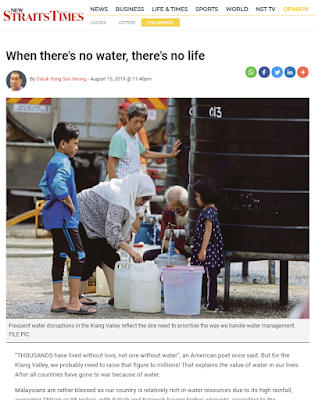
“THOUSANDS have lived without love, not one without water”, an American poet once said. But for the Klang Valley, we probably need to raise that figure to millions! That explains the value of water in our lives. After all countries have gone to war because of water.

Malaysians are rather blessed as our country is relatively rich in water resources due to its high rainfall, averaging 250cm or 98 inches, with Sabah and Sarawak having higher amounts, according to the Statistics Department.

As a result of its abundance, we tend to take a lackadaisical attitude towards water, especially in its use and conservation because it’s relatively cheap until a crisis strikes. Like recently when most parts of the Klang Valley were affected by river pollution and supply of piped water was disrupted.

Despite the names of several water concessionaires depicting heartwarming themes of satisfaction and felicitations, the nearly eight million residents in the Klang Valley didn’t actually have a splashing time indeed whenever such disruptions occur.

Residents face harrowing times whenever there’s no water to drink, for cleansing or flushing toilets, especially those living in high-rise flats where life is somewhat paralysed. When there’s no water, there’s no life.

The amount of money paid to companies to produce potable water runs into the billions. They include work on infrastructure construction, supply of building materials, pipe-laying and reservoir construction, to name a few. The accent is on infrastructure and very little on proper management if past experiences are anything to go by.

So, we’re still saddled with Third World-like water woes like river pollution as a result of lack of enforcement. Consumers often wonder what safeguards have been put in place by these big water management companies.

Like the recent water cuts, said to be due to sudden river pollution and possibly by saboteurs. So far, we’ve not heard whether the culprits had been apprehended. Amidst the lull, we often tend to forget about those bone-dry water-less situations until the next water disaster strikes.

These disruptions have been happening too frequently. One exasperated consumer with an oil and gas company on the outskirts of Kuala Lumpur says saboteurs ought to be whipped for the misery they’ve inflicted on millions of people. Pollution must be regulated, monitored, controlled and enforced, she said.

Another dismayed consumer from Ampang, fuming over the on-off scheduled water cuts in July after the long four-day water disruption last April, describes the picture of scores of consumers lining up to fetch water from tankers for their daily needs as being more reminiscent of a Third World country struggling with basic infrastructure rather then one heading towards a Vision 2020 dream of becoming a developed nation!

The people behind the water business have described the industry as big. And many want to have a slice of the business. But it’s sad that people think it’s just about drawing water from the rivers, getting it filtered, treated and then piping it to consumers. That’s only one thing.

A more precarious and dangerous scenario is that many of the water concessionaires have their sources of water located near human habitats. Anything can happen in view of the proximity. I wonder when we will ever move up the value chain in terms of better water management.

Dr Xavier Jayakumar, the Water, Land and Natural Resources Minister, said recently that the country’s water industry is in dire straits. A grim assessment indeed.

Although some water concessionaires appear to have that “money or nothing” attitude, it’s time for his ministry to co-ordinate with relevant stakeholders and wield the big stick.

Some non-governmental organisations claim that they’ve heard the same lame excuses being produced whenever there’s a water crisis. It’s high time that these Third World excuses are banished into the ocean.

Malaysia is expected to see its water resources reduced by 20 to 25 per cent between 2025 and 2030. And Dr Jayakumar says despite the looming threat, the country’s water industry is not yet equipped to effectively address the water shortage.

He needs to identify what are the shortcomings so that people in the water business would buck up. By exposing their inadequacies, we as consumers will know where to pinpoint the source of our discomfort should another water crisis erupt.

This brings me to my main point: there’s a need for better water management — 360 degrees in all from water collection, filtration, treatment, distribution and sales.

We need to be cognisant of the current disincentive where people don’t treat water with greater respect because tariffs are relatively low. When tariffs are low, we tend to waste water needlessly. According to an old adage, people won’t know the real worth of water until the well is dry.

Getting people to have access to clean water calls for big investments. It’s not a small business. But the money expended for such endeavours must be well-spent.

We also ought to get tough with businesses so that they won’t argue that higher water tariffs will reduce them to poverty. We can tell them that they still get to drive their flashy limousines but they too must pull their weight and shoulder the responsibility for better water management.

We need to be resolute on this as we have heard plaintive cries from businesses whenever the government wants to raise electricity tariffs or push for greater automation. This has been going on for decades.

One environmental activist who had been hearing excuses for yonks has suggested that when the next major river pollution crisis occurs, the officers in charge of environment in that area should be arrested first for dereliction of duty.

Then the state exco member and federal minister in charge should also be shown the door. It might just work, he says.

  • Datuk Yong Soo Heong is a former chief executive officer and editor-in-chief of Bernama. Read more about him here

Wednesday, 3 July 2019

The elderly need a more efficient support system

Republished from New Straits Times, Jul 3, 2019,
with the author’s permission. Read the original here.
By Yong Soo Heong

MOST MALAYSIANS are proud of the fact that we have a 94-year-old prime minister who travels far and wide at a punishing pace to give noteworthy speeches or media interviews, makes his views known to other leaders or just to witness something useful.

Tun Dr Mahathir Mohamad is a man in a hurry, always yearning to accomplish many things for fellow Malaysians. He’s definitely the only senior in the 90-plus bracket in our country of 32 million, still relatively healthy, mentally alert and working hard, putting many younger people to shame.

Many of his schoolmates and friends would probably have retired. But Dr Mahathir is the exception to the norm — true to the adage that age does not matter so long as the matter does not age!

The same, however, cannot be said for many other seniors in the country. Granted, Dr Mahathir may be aided by a retinue of aides looking after his needs so that he can execute things judiciously at the highest office, but not everyone who has aged would have the privilege of such assistance or the physical and mental make-up. The elderly in the country certainly need a more efficient support system.

With a fast ageing population, the question of who cares for our senior citizens is becoming increasingly crucial. Malaysia’s life expectancy has been rising. Life expectancy at birth in 2015 was projected at 72.5 years for males and 77.4 years for females.

Do we have plans in place to train more people to properly care for the elderly? Where do the elderly turn to if their offspring or relatives are unable to care for them? These are pressing issues which the government has to act on if nothing yet has been done. Gerontology has to be put into sharper focus if we’re to address the well-being of the elderly.

It’s especially compelling for those in the M40 and B40 categories while those in the T20 or with large extended families would have the luxury of caregivers, either in the form of employees or enlisted relatives.

A case in point is someone I know in the public relations industry: Ron is pushing 64 and still unmarried, although he plans to do so soon with the love of his life from Germany. He still has to work and care for his mum in her 80s. But finding the place with the right geriatric care is like looking for a needle in a haystack.

Many have lamented that most so-called geriatric care centres or nursing homes are no more than places for their operators to make big bucks. All they have to do is find a big enough accommodation with beds, television sets, toilet facilities, some able-bodied helpers and a cook or two, and they are in business! Some even equate the vastness of their premises and facilities with top-notch caring capability. But the truth is far from reality.

Fees are hefty and range around RM5,000 a month in Kuala Lumpur and Petaling Jaya. Some who can only afford to spare RM2,000 a month say they’re often in a lurch.

This brings to mind what prominent Malaysian economist Dr Jomo Kwame Sundaram opined two years ago after the Employees Provident Fund (EPF) revealed that about 70 per cent of members who withdraw their funds at age 55 use up their savings less than a decade after retiring. This meant that most EPF savings were not enough to stay out of poverty after retirement, he said.

With 69 per cent of our population of “working age” between 15 and 65, only 48 per cent of the labour force of 14.5 million have active EPF accounts. In 2017, EPF raised the minimum savings target by age 55 from RM197,000 to RM228,000.

But Jomo says that only 18 per cent of members have that much savings, far short of EPF’s target of getting at least half its members to meet the minimum level by 2021. Low investment returns and withdrawals permitted — for housing, health and education — imply even less for retirement.

More than two-thirds (68 per cent) of EPF members aged 54 had less than RM50,000 in EPF savings! Jomo says with the household poverty line income at RM930 monthly, RM50,000 in savings will last only 4½ years. The bottom fifth of EPF members have average savings of only RM6,909!

An exasperated Ron says that despite the hefty fee, the service leaves much to be desired, especially in terms of giving proper exercise to prevent the onset of dementia. He bemoans the lack of focus and enforcement on nursing homes for senior citizens.

If the government has given focus to the kind of training that kindergarten teachers must have, it’s high time that it also paid attention to the other spectrum of the population: the elderly.

Now that we’ve restarted the “Look East Policy”, perhaps it’d be pertinent to look at Japan’s widespread respect for its seniors and a powerful obligation to care for them. With changes to Japan’s demographic structure of society, caring for the elderly is increasingly seen as a social, and not exclusively family concern, according to Iza Kavedzija, an anthropology lecturer at the University of Exeter.

We ought to appraise Japan’s Long Term Care Insurance (LCTI), designed to provide cover to all those over 65.

The LCTI is one of the most comprehensive social care systems for the elderly in the world, aimed at reducing the burden of care on families.

With adequate funding, the market for providing proper geriatric care can perhaps be properly undertaken along with the creation of clear and consistent rules and roles as well as training for caregivers, operators of nursing homes and even the informal networks of volunteers.

  • Datuk Yong Soo Heong is a former chief executive officer and editor-in-chief of Bernama. Read more about him here.


Wednesday, 1 May 2019

Flash back to school

TEOH SOONG KEE is a specialist doctor – an obstetrician – working in a private hospital in Ipoh. He has been there for decades, and often taking pride in the fact that some of the babies that he delivered were now grown-ups and turning to him to deliver their own. But Soong Kee, for all his settling down in Perak, was a product of three schools in Penang: Wellesley School, Westlands School and Penang Free School. Several years ago, he wrote a book, Young Emotion, in which he recalled his schooldays through poems, articles and short stories. Here is one of them.
Both my parents came from China. My father had three years of schooling and could just read the newspapers while my mother was illiterate. I never attended any kindergarten. Yet, schooling in Penang, especially in the Penang Free School, gave me a strong foundation for the years ahead.
Wellesley — Good conduct? 
When I went to Primary One in Wellesley School in 1953, I could not speak more than three words in English. The first words we had to learn were “Teacher excuse me” when I wanted to go to the toilet. However, I was good in arithmetic, perhaps from my coffee shop environment. Within a week, I was given some sums to do, and then I was transferred to Class 1D which was a double-promotion class. We had to do three years work in two. Not surprisingly, I was in 26th position in the first year, but I managed to rise to 10th position in the second year.
I still remember some of my classmates like Tan Poh Seng, Lim Eng Hong, Lee Chaing Hin and Chew Gim Hye. Later I found out that Teh-Tiong Sa was also my classmate then. I nearly got the prize for Best Conduct, but it went to Lim Say Kwee, whom I believed was the nephew to the headmaster. Our class teacher was a Eurasian, Mr Johnson. My mum would give me a raisin bun, a milk drink and ten cents for refreshments during recess. I remembered envying the other schoolmates who could go inside the tuck shop for noodles and ice-cream. Occasionally, a school boy would sell me his coupon for ten cents. It was a treat for me!
Each week, the dental nurses would come to our class to check our teeth. Unlike most pupils, I looked forward to the trip to the dental clinic as I had a pretty-looking dental nurse attending to me. I had not reached puberty yet so there was no erotic fixation! She did an excellent job and kept most of my teeth intact (with the black mercury fillings) till today.
Westlands — General knowledge prize! 
After two years, all of us were transferred to the feeder schools such as Westlands, Francis Light and Hutchings schools. While Wellesley School was only a five-minute walk from my rented room in Swatow Lane (famous for the New World Park ice kacang), I had to sit in a trishaw for a 20-minute ride to Westlands School. The fare was only $3 per month, but sometimes we had to cram six children in the trishaw. 
Since we were from the express class, we went straight into standard 4E. I had chicken pox during the mid-year test and attained 24th position in the class, but fortunately I improved to 5th place by the end of the year. I did better in the next two years, achieving within the top three positions. In Standard Five, I obtained 100 marks in four subjects, and that was in the days when it was not common to get such high marks. There was a special General Knowledge test in which I managed to win the prize. I chose a book titled “100 Great Lives” which is still in my possession. We had to sit for a statewide Form One entrance exam to stream the students to the secondary schools. The top 200 boys would enter Penang Free School. I managed to be the top student from Westlands but was beaten by a few others from Francis Light School including Dennis Lee. 
I was among the shortest kids in the standard. However it was an advantage for me as the children were grouped in four classes within the games houses according to height and not to age. So even when I was in Standard Six, I was placed in Class III, mixing with the younger students. I was even made Captain of the Class I football team! In Standard Five, I was called up to see the headmaster, once for talking during assembly and on another occasion for “fighting”! I remembered that I was in the same group with Oh Siew Leng while Ong Tat Teik was in the rival group. 
We used to have drama lessons every other week. I was rather enthusiastic and remembered how melodramatic I would be, playing the different roles in the sketches. In 1957, the year of our Independence, I was selected to be the voice of one of the characters in a puppet show at the combined schools concert. I acted as a Malay boy and I had to shout “Merdeka” three times in the closing scene. 

Penang Free School

I entered PFS in 1958 in Form 1A under Goh Teong Chye as our form teacher. He would ask all the students to contribute 20 cents per month to buy the daily newspaper, which he would read first. The next day he passed the papers to us to cut out the highlighted news for display on the notice board. I nearly won the prize for National Language (Malay language for the non-Malays).

The Malay boys were not eligible as they had to sit for the Bahasa Melayu test. However, Jammal claimed to be eligible, being an lndian Muslim, and he beat me by two marks for the National Language prize. One morning at the end of the year, there was singing in the class. I remembered singing a Russ Hamilton song “Tip Toe through the Tulips”, but received a lot of laughter. I had mispronounced the words as “Chip Choe through the Chulips”! The best singer that day was Ong Hean Beng. 

The next year in Form 2A, we were under Mr Cheng Hin who had just returned from Brinsford Lodge Teachers College in UK the year before. He was very enthusiastic. At the beginning of the year, he announced that the class project would be to produce a magazine. This was unheard of for such a junior class. However, we did produce the cyclostyled magazine and sold it for 20 cents. In the magazine, there was a quiz which we could send in the answers to him during the school holidays. I got the prize, as apparently I was the only one to mail in the answers. Knowing my interest on the stars, he gave me a book on Astronomy. I managed to achieve 4th position in the whole form, but the Form Teacher’s remarks on my report card were “good but rather playful at times!” 
Somehow I did not remember much about my Form 3 year except that we all had to study hard for our LCE (Lower Certificate of Education). In those days, with an LCE, one could join the government service as a policeman. I was second in the form for the school exam and obtained five As and two Bs in the LCE. 
With my marks, I was placed in the Form 4 Science class. Usually the top 40 students were streamed into the Science class but there were a few top students like Iyer (now Sulaiman) who did not like Science and went to Form 5A. We had to study three science subjects and two mathematics papers. We were glad that History was dropped. Dennis came to 5 Science but was allowed to sit for two science subjects as he took music as an examination subject. Several of us would cycle to Dennis home in Mt Erskine, especially when the rambutans in his garden were ripe. We produced a class magazine which we called “The Mad Mosquitoes”, an unusual name with no apparent reason! 
I managed to do well in Forms 4 and 5, being in 3rd and 5th in the forms respectively. For my Cambridge School Certificate (sometimes called Senior Cambridge) I obtained seven As out of eight, together with Tan Poh Hwa and Koe Chong Aun. I only got a Credit for my English Language but got a distinction A1 in English Literature! Thanks to Mr Bennet who helped us enjoy English poetry written by Keats, Shelley and Byron and even Shakespeare’s “Twelfth Night”. “If music is the food of love, play on!” We just have to pass the national language to qualify for the Malaysia Certificate of Education (MCE). We had to sit for the Sixth Form Entrance exam for eligibility to enter Form Six in January, as the SC Exam results would only come out by March. I was thrilled that I obtained the second highest marks in the state.
Tuition 
I never had tuition in all my school years. My parents could not afford the fees even though they were just about ten to 20 dollars a month. It was a credit to our teachers who taught so well, that tuition was unnecessary. Perhaps our parents were not so kiasu then. The only time when I needed extra help was in Bahasa Kebangsaan. So in Form Five, I enrolled in the evening classes held at Hu Yu Seah night school for just three dollars a month. We were even given a certificate after attending the weekly classes for one year. 
Some of us would meet in one of the homes to study together. More often, especially for those of us who lived in crowded homes, we cycled to the Penang public library to study and consult the reference books such as the Encyclopedia Britannica. We did not have internet Google then!
Teachers 
We still remembered some quirks among our teachers. Lee San Hoe was very superstitious and would become very angry when he saw two white chalks upright on the table. Another teacher Tan Ah Fee would sing out loud “la la la Speedy Gonzales”. Captain Mohd Noor (who used to be in the army) would ask us “how many gantang” when we returned from the toilet. His favourite suit was pink in colour. He also kept his shoes shining bright – some claimed that he would place his shoes under a lady’s skirt! He was particularly stern with the Malay boys. Another Malay teacher, Iskandar, was rotund in size but was very kind and friendly, offering to give free tuition in his home. Our first Malay language teacher was actually a Chinese, Beh Teik Chooi, who had remarried to a Malay lady. He was fond of telling us stories from the Japanese occupation. One teacher would teach us by making us spend the whole period, copying notes which he wrote on the notice board. Ambrose was the earliest to arrive in the school and the first to make announcement during the Monday school assembly. Our Form 4 PE teacher, Teh Keng Chooi, did the unusual, by getting our class photograph taken without our shirts, exposing our scrawny chests! 
Another teacher Khoo Tiang Lim claimed that he did not use soap for bathing, as it might wash away our natural body oil. KTL said to Wee Kyam Hooi, who often made humorous remarks in class, “you are allowed only one joke a year!” Our Biology teacher, Lee Eng Leong, corrected us when we used the word “hole” for the female organ. He insisted it was a “slit”. There was a very fierce teacher Teoh Cheng Hai nicknamed “bulldog”, but he was actually quite pleasant if we worked in his craft class on Saturdays. There were very kind teachers, but there were some who would throw chalks or even the wooden black board dusters at us. We also had our first lady teacher, who came as Miss Tan Cheng Ee, but later disappointed some of us when she became Mrs Oh Eu Kok. We used to make fun of her by sighing “OOOOOh...” Then we had an English retired army major, Edwards, who taught us Physics. His army discipline included a long ruler but tempered with gentle “Oh dear dear dear...” when we gave the wrong answers. 
One type of punishment imposed by many teachers in the lower forms was to make us write repeatedly, for example “I must not eat in class” or “I must not be late for school”. If we were asked to write 10 pages, our writing would be extra large but if we were to write the same sentence 100 times, we would squeeze the 100 lines on one page. On one occasion, we were asked to write the sentence “I must put a full-stop at the end of the sentence.” But a number of us forgot to put the punctuation at the end of some of the lines! C Ponniah would punish by asking the student, in his shrill Tamil accent, “Be mounted”, that is, to stand on the chair. 
Sports 
There were many opportunities to take part in sports and games. Every student learned how to play football, cricket, hockey, badminton and rugby, in rotation throughout the year. Tennis was more for the richer kids. We even had Additional Sports Day where every student had to take part in the  100 yards, 400 yards, high jump and long jump. Points were given for each student who achieve the qualifying standard that was decided according to the age group. I was able to get all the four points, just managing to clear the qualifying standards. One year, I was sick and could not take part. My house (Pinhorn, blue colour) lost the championship by two points! If I had been well, Pinhorn would have won! I was not good in sports but managed to represent my House in football, cricket (but never scored a run) and debate. 
School activities 
In the upper forms, we had to come back to school twice a week for two lessons, followed by extra-curricular activities which could be scouting, cadets, or band followed by games. There were many clubs and societies to join, from Science and History to Music and Drama, Photography, Gardening and Art and Craft classes. There were no religious or cultural societies then, although there was an informal gathering of Christians during the recess once a week in one of the teacher’s houses in the school compound. Dennis used to invite me to join them. On other days, a group of us grouped together during recess to share Smarties sweets, to be purchased by one boy in rotation. 
I took part in the Stamp Club, Craft Class, Science Society and the Music and Drama Society, Historical Society (it made interesting trips) and the National Language Society. For one whole year I was forced to join the Scouts, but I was not interested. I did not wear the scout uniform. However, I passed the Tenderfoot test and enjoyed the camping and hiking trips. 
In Form Lower Six, I was Science Editor for the Outlook magazine but in the following year I was asked to be sub-editor of the School Magazine by Yeo Guan Teik. In those days, we had to type the articles on the typewriter, and the printer used individual metal letters to set the pages. We often had to check the proofs again and again till the wee hours of the night. Even though I was a novice photographer, I managed to capture some images of memorable events, which were included in the school magazine. We started the first PFS Newsletter, a bi-monthly newspaper, but were asked by the headmaster to hand over to another editorial board headed by Srinivasa Iyer. 
The Sixth Form Recreational Activities (SFRA) was formed for those Six Formers who were not involved in any uniformed group or school sports teams. We played the miscellaneous games such as netball (the boys enjoyed playing with the girls, much to the horror of Ambrose), volleyball, table tennis and folk-dance! As chairman of SFRA, I was given the privilege to learn the new game of softball and even became an instructor (at least on the theoretical aspects). 
When we went into Form Six, we faced a different world. There were girls admitted to our class. There were not so many in the Science classes as in the Arts classes, but least most of the Science girls wanted to do Biology rather than Mathematics. The boys had to learn to restrain their pranks and jokes and show chivalry. At the end of the year concert, our Form 6 Sc Class entered a team of four boys and four girls called “Battle of the Sexes”. They sang a couple of humorous songs, (with lyrics adapted by me) entitled ”Woman is Fickle” against ”Man is Flirtatious”. One of the memorable lines was Poh Hwa who sang, “When will you be mine” and Ee Looi replied, “If you got the money, honey, I’ve got the time”! We won the Prize for best group performance!

Saturday, 27 April 2019

Sustaining the right quality of life for individuals with challenging needs in ageing

The elderly: Caring for them can be a viable
industry with expanding job opportunities. 
Source: Johannes Jansson, Wikimedia Commons 
 
By Teoh Ai Hua, Jim Lim Teik Wah & Dr Thomas Khor

MANY ELDERLY people, suffering from age-related disabilities, some of which are substantive, rely exclusively on family members and close community organisations to help tend to their daily needs and well being. A significant number will continue to remain in their own homes and live with their family members. However, it is not uncommon, judging from media reports, that many older people are neglected, living out their twilight years in miserable circumstances or in situations of severe indifference within their households. There have been cases of abuse too. This paper aims to highlight key responsibilities that the government should assume in improving the support and care services for the elderly, including ways to encourage and facilitate new “service providers” to address the needs of this growing vulnerable population. This paper argues that these measures, when comprehensively put in place, will expand and improve services as well as develop the social care industry as a viable sector for new job creation. More importantly, we believe it will eventually lead to improving and sustaining the quality of life for older people living in the community.

  • Teoh Ai Hua is Senior Lecturer, School of Applied Psychology, Social Work and Policy, Universiti Utara Malaysia
  • Jim Lim Teik Wah, Former Director of Social Services in the UK
  • Dr Thomas Khor, Managing Director, Home MediCare, Penang
  • This paper was presented at International Social Work Symposium organised in collaboration with a number of universities and the Malaysian Association of Social Workers (MASW), April 27-28, 2019. Read here.
This is the full paper (3,200 words in all):

INTRODUCTION

Malaysia is estimated to become an “aged” nation by 2030 when 15% of its population will be over 65 years old (United Nations, 2015). The majority of older people will be living with and cared for by their families. In Malaysia, it has been reported that between 60% to 70% of the older persons live with their children or extended family (Pala, 2005; Hamid, 2015; Kooshair, Yahaya, Hamid, Abu Samah and Sedaghat, 2012). While living with their children does not imply dependency on the part of the older persons, there are differences between the main carers for older men and older women. Older men normally rely on their wives and/or daughters while older women rely mostly on their children only (Hamid, 2015). However, the biggest challenge for most families is coping with the care-giving burden for older persons with certain degree of dependency due to frailness or dementia (Choo et al., 2003; Nikmat, Howthorne and Al-Mashoor, 2015)

It is not uncommon to read in the media about older people being neglected, living out their twilight years in miserable circumstances or in situations of severe indifference within their households. The burden of care on caregivers may lead to the abuse of the elderly (Choo et al., 2003). One particular research has shown that 26% of the respondents (older persons) have experienced at least one incident of abuse, with emotional abuse being the most prevalent (Hamid, Abdullah and Yahaya as cited in Hamid, 2015) yet the health professionals demonstrated poor understanding of signs of elder abuse and neglect (Ahmed et al., 2016). Nevertheless, the absence of data on such matters in Malaysia is an indicator of low awareness and priority of the subject matter (Hamid, 2015).

Past research in Malaysia have also focused on the quality of life of older persons in institutions or at their own home, the burden on caregivers, and nursing care and social care services (Aziz and Ahmad, 2017; Choo et al, 2003, Nikmat, Howthorne and Al-Mashoor, 2015, Tey et al, 2016). One report pointed out that having a maid or providing nursing care for the elderly living with their families may not reduce the burden on the caregivers (Choo et al., 2003). However, most were focused on the public sector perspective, and not much has been written on social care services provided by  independent players or the private sector where the elderly or their caregiver can pay for services as an option of care. There is certainly a need for care services for those who can afford to pay for them.

METHODOLGY

The growing population of older people can have a major impact on health and social service provision, including social care. The repercussions, both social and economic, will be major and far reaching if resources are not planned or distributed properly. Some questions that need to be addressed are:
  1. Who can older people with challenging needs (and their families) engage, if they can afford paid home help services?
  2. Are these services available?
  3. Are these services regulated?
  4. What are the qualifications of the caregivers or care workers, if available?
  5. What can the government do to ensure quality and availability?
This paper aims to examine the existing ecosystem of social care services, relevant legislation and training programmes for elderly care in Malaysia. At the end, several recommendations will be presented and implications for social work practice will also be discussed. 

FINDINGS

THE PRESENT SCENARIO

(1) Underdeveloped social care services for elderly care

In general, social care services for the elderly provided by the public sector, i.e. the Department of Social Welfare, can be divided into three types, namely, (i) cash and in-kind benefits, (ii) institutional care, and (iii) home care (Hamdy and Yusuf. 2018). However, the government direct services (provided by its own welfare officers or assistants) are mainly from category (i) and (ii), while home care services are indirect services where the government giving funding to non-government organisations and volunteers to run free home help programmes, activities centres (e.g. Pusat Aktiviti Warga Mas, PAWE) and transportations services (e.g. Unit Penyayang Warga Emas, UPWE). The volunteers involved in home help programmes are mainly retirees or old persons themselves, and the service is still limited to a few areas. As at March 2017, there were 2,150 volunteers providing services to 5,892 older persons (Mohd Salleh, 2017).

The health service also provides care services for older people in the form of outpatient care and hospitalisation. Although there are more private hospitals compared to public ones in Malaysia, over 70% of all admissions are to public hospitals where older persons make up over 20% of the total admissions (Tey et al., 2016).  However, the health service also faces limited resources and they are not able to provide a continuum of care including home care, day care and respite care (Ambigga et al., 2011).

As a result, scarce medical resources may be directed inappropriately. One example is the need to care for older people following admissions via accident and emergency facilities, resulting in what is termed as “bed blocking”. Many hospitals are facing difficulties in discharging these people, sending them home. This is mainly due to the lack of supporting services in the community.

In addition, most of the services provided by the voluntary and private sectors are residential homes (free or low fee) or nursing homes (more expansive). They do not cater to the needs of older people who want to remain at home. In essence, services for older persons with challenging needs who live independently or with their families are rather limited. 

Due to an under-developed aged care infrastructure, many private unlicensed residential homes have sprung up, especially in big cities, to meet the demand. There are glaring examples of such establishments operating without due regard to safe environment or operating safeguards despite the existence of the Care Centre Act 1993 and the Private Aged Healthcare Facilities and Services Act 2018 (Serving seniors requires passion, 2019: para 9). Stories of elder abuse are not uncommon. Other problems include inadequate staffing ratio, depersonalised rooms and unattractive environment and sometimes, they use public hospitals as dumping grounds for residents they are unable to care for.

(2) Undefined qualification of caregivers under existing legislation on elderly care

Offering shelter and care on a commercial basis and operating at standards as yet  undefined or unquantifiable, the care facilities have left many elderly people at some risk. This problem is compounded by the lack of choice. Although the Care Centre Act 1993 and the enactment of the Private Aged Healthcare Facilities and Services Act 2018 have provisions for the government to regulate the service providers in terms of number of residents, staff-resident ratio, health and safety measures etc, monitoring and enforcement remain wanting. 

Moreover, the qualification requirements of staff and care workers remain ambiguous. For example, Section 7 of the Care Centre Act 1993 gives power to the Director General of Social Welfare to impose conditions for registration yet it was undefined when comes to qualifications of persons employed as in 7(b) and 7(c), and without additional schedule or by-law:
“7(b) to ensure that any person employed at the care centre, whether in its management or otherwise, is a fit and proper person, whether as regards age or otherwise, to be employed at the care centre; and 
7(c) to ensure that the care centre will be adequately staffed by a sufficient number of persons with suitable qualifications or experience.”

On the other hand, the Private Aged HealthCare Facilities and Services Act 2018 defines caregiver as “anyone, other than health professionals, who provides personal care to any care recipients” and all licensee of healthcare services must ensure that caregivers are trained and competent (Section 20(b)) and the training of caregivers in basic life support (Section 26(4)), and the licensee can be revoked of his or her license if the licensee employs unqualified person as a caregiver (Section 30(e)). However, it only spelt out healthcare services provided by health professionals and para health professionals (Schedule 1) and qualifications of those healthcare professionals that are currently being regulated by legislation (Schedule 2). Again, no specific qualifications are mentioned for the caregiver.

While nurses are seen as qualified in providing nursing care, experience on the ground has shown that many of the elderly who require home care services may not need nursing care all the time. Research has also shown the importance of social support in achieving better quality of life for those living at home (with proper support) in comparison with those at nursing homes (Nikmat, Howthorne and Al-Mashoor, 2015). The role of caregivers must be valued and their capacity must be enhanced.

(3) Underdeveloped and unregulated training courses for caregivers or care workers

Currently, only one university, Universiti Putra Malaysia, offers a postgraduate programme in gerontology. It does not address the needs of trained care workers. Such needs are normally not addressed at the tertiary level (Hamid, 2015). The National Council of Welfare and Social Development Malaysia (MAKPEM), in collaboration with the Open University Malaysia (OUM), has offered a Professional Certificate for Caregiver which is a 16-module programme (MAKPEM, 2014). However, only one module is on elderly care. The MAKPEM-OUM Professional Certificate serves more as a self recognition for NGO workers. It is not accredited by the Malaysia Quality Agency (MQA). It is also not getting any recognition from the underdeveloped social care sector.
 
Seeing the lack of training and recognition of qualifications in the social welfare sector, the Department of Social Welfare has actually started an initiative to develop relevant training and standards through the National Occupational Skill Standards (NOSS) framework several years ago (Jabatan Pembangunan Kemahiran, 2016). Elderly care (27.4) is placed under Sector 27 Care and Community Services, and three (3) levels of NOSS have been identified: 
  • Level 3: Elderly Care Centre Operation
  • Level 4: Elderly Care Centre Administration
  • Level 5: Elderly Care Centre Management
From the titles given, it seems that the skill standards set for the three (3) are meant for operators or managers of care centres, and not so much for caregivers or care workers. The latter needs Levels 2 and 3 competencies in providing direct care and support for the elderly. In Australia, one needs a qualification in Certificate III in Individual Support (Ageing, Home and Community) to become an aged care worker (www.opencolleges.edu.au). In the United Kingdom, it has set standards at Level 2 and Level 3 Diploma in Health and Social Care (Adult), as well as up to Level 4 Diploma in Adult Care that can be offered through many accredited institutions like City and Guild (www.cityandguilds.com).

In this regard, Malaysia has no social care qualifications set at Levels 2 and 3, the nearest equivalent would be the Professional Certificate for Caregiver by MAKPEM-OUM. Its relevant standards and competencies have yet to be examined and accredited by a regulatory body. 
 
(4) Historical and cultural factors

In Malaysia, as in many other Asian countries, looking after elders is a family duty. It is very difficult to send an elderly person to a residential care home. This familial responsibility is prevalent amongst all the races. Nevertheless, modernisation trends and societal changes are altering mindsets. Lower fertility, higher rates of childlessness, and increases in the number of divorces and people remaining single, have all contributed to a shrinking pool of potential care-givers within the family setting. 

Care for the elderly could be headed for a crisis in terms of the availability and accessibility of essential services. As mentioned earlier, services outside the family remain fragmented. They are also of varying quality and scattered inconsistently across the country. Many families now use foreign domestic helpers as “caregiver”, adding onto their other job tasks. Many of these helpers are not trained or properly compensated, resulting in the elderly person making do with a second rate service.

RECOMMENDATIONS AND IMPLICATIONS

The roles of the government

The government should undertake to improve support and care services for older persons, including ways to encourage and to facilitate new “service providers” to address the needs of this growing vulnerable population. These include:
 
(1) Developing a more active and diversified social care sector

This can be done by generating conducive conditions including developing business-friendly policies in the social care market that encompasses a mix of service provision by the public, private, non-profit and voluntary sectors. This diverse care provision, offering a range of care to meet different needs will be able to offer “choice, appropriateness and sensitivity” in the light of the country’s multi-diverse communities. 

(2) Setting and regulating standards for practice in social care
  1. Enhancing existing legislation, such as the Care Centres Act 1993, by developing regulatory mechanism that sets standards for practice of care workers and for quality service by service providers. Skills applicable include managing elderly people with sensitivity whilst assisting with all aspects of daily living, hygiene, nutrition, mobility and basic one-to-one counselling. Caregivers would also need to cope with those with multiple medical needs. 
  2. Therefore, we would like to propose the establishment of an Inspection and Registration Unit, within the Department of Social Welfare Malaysia. Its main role is in implementing, safeguarding and protection for elderly people living in residential care. As demand for care-giving inevitably rises, the unit must also have adequate powers to apply sanctions on underperforming organisations and on those who employ untrained staff.
(3) Setting and regulating the training courses in social care
  1. The role of a caregiver or care worker must be a recognised occupation, assuming the status of vocational level standards under the National Occupational Skills Standards (NOSS) framework. These caregivers who are trained would have a recognised certificate which they can usefully take with them to another employer, an individual, a family or a residential home. In this regards, the Department of Social Welfare may seek to appoint established educational and training institutions to approve courses. 
  2. Training and accreditation must follow and further education providers must be encouraged to provide basic short courses, encompassing syllabus which are fit for the purpose of individual care-giving. (There are any examples of such courses run in developed countries). Educational pathways should be created for qualified caregivers to pursue more advanced professional qualifications at the tertiary level when they want to move up in their career.
  3. It is important to note that setting training and practice standard as well as creating occupational pathway for caregivers is to get more locals into the social care sector instead of relying on foreign workers or maids to look after the well being of older persons in the country.
(4) Establishing a Commission for Social Care
  1. The government may not regulate social care qualifications through enacting legislation like how the health professionals and para-professionals are being regulated. However, the government can set up a Commission for Social Care as a national body for all forms of social care, so as to (1) ensure that standards are maintained, (2) regulate training of social care workers and (3) provide relevant accreditation. The commission will, through regular monitoring and inspections, ensure that providers undertake service quality improvements. 
  2. Before setting up such a commission, the government may prepare a consultation paper for the care of elderly people and adults with disabilities and should review all current services for elderly people with a view of implementing positive changes to ensure long term sustainability and to enhance individual dignity and purpose.
Implications for social work practice
When the above suggested measures are in place, and the numbers of qualified caregivers have increased, it can actually help to enhance the practice of social work in the following way:
  1. Assessment and care planning: Social workers will be able to do needs assessment which can be met with suitable services as there will be more resources or choices available for social workers to consider in formulating care plan with older persons. 
  2. Interventions: Besides being able to conduct psychosocial assessment and interventions, the skills and practice standards in social care are essential for social workers who provide direct service to older persons. Even if the social worker is not the key worker to the older person, they would be able to supervise family members or other caregivers of proper ways in supporting the daily living of older persons at home.  
  3. Inspection: This can be the role of the social workers in the Department of Social Welfare to ensure quality service delivery by trained caregivers or care workers in institutional or community care for older persons.
CONCLUSIONS

Our elders deserve more and should not be discarded once their working lives are over, as they are entitled to continuing support, care and love for as long as their bodies and mind can sustain them. With great shifts in attitudes and an accompanying increase in recognised community of caregivers, the quality of existence of elderly people will be immeasurably enhanced. This is without a shadow of doubt. We owe it to our elders.

REFERENCES

Ahmed, A., Choo, W. Y., Othman, S., Hairi, N. N., Hairi, F. M., Mohd Mydin, F. H., & Illiani Jaafar, S. N. (2016). Understanding of elder abuse and neglect among health care professionals in Malaysia: An exploratory survey. Journal of Elder Abuse & Neglect, 28 (3), 163-177.

Ambigga, K.S., Ramli, A.S., Suthahar, A., Mohd Tohit @ Mohd Tauhid, N., Clearihan, L., & Browning, C. (2011). Bridging the gap in ageing: Translating policies into practice in Malaysian primary care. Asia Pacific Family Medicine, 10 (1), [2]. https://doi.org/10.1186/1447-056X-10-2

Aziz, N.A. & Ahmad, Y. (2017). The quality of life of aging population: a study among older person who received long term care services at old folks home, Penang. Journal of Administrative Science. Special Edition: Socio-Economic Issue, 14 (3), 1-18. Retrieved from https://jas.uitm.edu.my/images/ SPECIALEDITIONVOL3_2017/5.pdf.

Care Centre Act 1993 (Act 506)

Choo, W.Y., Low, W.Y., Karina, R., Poi, P. J. H., Ebenezer, E., & Prince, M. J. (2003). Social Support and Burden among Caregivers of Patients with Dementia in Malaysia. Asia Pacific Journal of Public Health, 15 (1), 23–29. https://doi.org/10.1177/101053950301500105

Gaughan, J., Gravelle, H., & Siciliani, L. (2015). Testing the bed‐blocking hypothesis: does nursing and care home supply reduce delayed hospital discharges? Health Economics, 24, 32– 44. doi: 10.1002/hec.3150

Jabatan Pembangunan Kemahiran (2016). National Occupational Skills Standard (NOSS) Registry. Putrajaya: Kementerian Sumber Manusia. Retrieved from http://www.jkm.gov.my/jkm/uploads/files/pdf/DaftarNOSSversion4Feb2016.pdf

Kooshair, H., Yahaya, N., Hamid, T.A., Abu Samah, A. & Sedaghat, J.V. (2012). Living arrangement and life satisfaction in older Malaysians: the mediating role of social support functions. PLoS ONE, 7 (8), e43125. doi:10.1371/journal.pone.0043125.

Hamdy, M.S. & Yusuf, M.M. (2018). Reviewing on public long-term care services for older people in Malaysia. Malaysian Journal Of Science Health & Technology, 2 (Special). Retrieved from http://mjosht.usim.edu.my/index.php/mjosht/article/ view/49/24

Hamid, T.A. (2015). Population ageing in Malaysia: a mosaic of issues, challenges and prospects. UPM Serdang: Universiti Putra Malaysia Press. 

Hamid, T.A., Za, S. F., Mansor, M., Yahaya, N., & Ali, Z. (2010). Cohort differences in perceptions of elder maltreatment Paper presented at the The South East Asian Conference on Ageing 2010. Grand Millennium Hotel, Kuala Lumpur, Malaysia. Retrieved from http://seaca2010.files.wordpress.com/2010/07/microsoft-powerpoint-perception-tah-sfzaet-al-17-july-2010.pdf

Hamid, T.A. & Chai, S.T. (2013). Meeting the needs of older Malaysians: expansion, diversification and multi-sector collaboration. Malaysian Journal of Economics Studies. 50 (2), 157-174.

Majlis Kebajikan dan Pembangunan Masyarakat Kebangsaan Malaysia (MAKPEM) (2014). Laporan Tahunan 2014. Kuala Lumpur: MAKPEM.

Mohd Salleh, M.F. (2017, March). Ageing in an inclusive society: social support system for older persons in Malaysia. Paper presented at the Senior Official Meeting of the UNESCO Management of Social Transformations (MOST), Kuala Lumpur Retrieved from https://www.kpwkm.gov.my/kpwkm/uploads/files/Muat%20Turun/MOST/S4_ P1_Tuan%20Hj_%20Fazari.pdf

Nikmat, A.W., Hawthorne, G., & Al-Mashoor, S.H. (2015). The comparison of quality of life among people with mild dementia in nursing home and home care - a preliminary report. Dementia. 14 (1), 114-125.

Pala, J. (2005). Population ageing trends in Malaysia. Monograph series, Population Census 2000. Putrajaya: Department of Statistics, Malaysia.

Private Aged Healthcare Facilities and Services Act 2018 (Act 802)

Serving seniors requires passion and purpose. (2019, March 9). The Star On-line. Retrieved from https://www.thestar.com.my/metro/metro-news/2019/03/09/serving-seniors-requires-passion-and-purpose/

Tey, N.P., Siraj, S., Kamaruzzaman, S.B., Chin, A.V., Tan, M.P., Sinnappan, G.S. & Muller, A.M. (2016). Aging in multi-ethnic Malaysia. The Gerontologist. 56 (4), 603-9. doi: 10.1093/geront/gnv153.

United Nations (2015). World Population Ageing Report. New York: United Nations. Retrieved from https://www.un.org/en/development/desa/population/ publications/pdf/ageing/WPA2015_Report.pdf