Showing posts with label History. Show all posts

Sunday, 19 December 2021

The Japanese invasion of Malaya, 1941

In December 1941, the darkest days in Penang's history unfolded. Days after the Japanese military had begun their invasion of Malaya through Kota Bharu, there was widespread mayhem and destruction in George Town when Japanese bombs were dropped amidst simultaneous heavy machine-gun fire on the local population. 

I guess we shall never know today what happened to Westlands School during the war - the people who could remember that period may be too old or no longer around - but in 1965 when my friends in this blog were in the final year of our primary school education there, it was only 20 years since the Japanese surrendered control of the land back to the British. Although we boys missed the trauma of the war years, our parents did not. They went through much suffering, and life in the 1950s and 1960s was still difficult enough for most of them. And while it impacted us as young boys, we ourselves didn't know better due to our own childhood ignorance. In our own ways though, we remained resourceful. Left to our devices, we fell back on traditional children's games to entertain ourselves.

These are the five stories I wrote elsewhere to commemorate the 80th anniversary of the Japanese invasion of Malaya in 1941.

80th anniversary (1): Japanese invasion

Today, 08 December 2021, marks the 80th anniversary of a very significant event in Malaysia's history. At 00:30 (that is, 30 minutes past midnight) on the eighth of December 1941, Japan launched their offensive on the Malayan peninsula. This was the beginning of almost four full years of hellish dark days of the Japanese Occupation from 19 December 1941 till their surrender on 02 September 1945. Earlier, they had sailed from southern Indo-China and their fleet of warships dropped anchor 3km from the coast of Kota Bharu.  Read more here.

80th anniversary (2): The bombing of George Town

Previously, I had related how George Town had awoken on 08 December 1941 to the first sounds of Japanese enemy aircraft flying over the town. Three days later on the 11th of December 1941, terror rained down on the inhabitants of George Town. Terror in the shape of bullets and bombs. It was truly a rain of terror. Not yet a reign of terror, no, it had yet to begin, but literally, a rain of terror. Without warning, the Japanese aircraft dropped their bombs and trained their machineguns on the people who congregated in the Chinese quarter of the Beach Street area. Read more here.

80th anniversary (3): Silent evacuation

On the 13th of December 1941, the first of four quiet evacuations of the British from Penang soil took place. Although not apparent at that time, these evacuations also signalled that the British Empire itself could be unravelling in South-east Asia. Never mind that Britain came back to administer Malaya after Japan had surrendered in Penang on 02 September 1945, it was never to be the same again. The seeds of nationalism planted, a movement for Independence and self-governance began taking root. Read more here.

80th anniversary (4): White flag

Eighty years ago on the 16th of December 1941, the Japanese military invaded Malaya and bombed Penang. It is quite safe to say that many families in Penang, if not all, were affected by the atrocities. I know that mine were displaced. On my maternal side, my grandparents fled to the hills, the chau huan that I had mentioned in Part 2. My paternal grandparents probably did the same too and they never really recovered after the Occupation was over. My father continued with his education at Penang Free School after the War but because of the pressing economic circumstances, he had to quit within the year to find work and support the family (at that time, comprising his parents and a sister.) Such sacrifices were not uncommon as the local population tried everything to rebuild. Read more here.

80th anniversary (5): From the Japanese perspective

At four o'clock in the afternoon of the 19th of December 1941, the first Japanese troops landed on Penang island. This was a result of Penang surrendering after nine days of continuous bombardment by Japanese enemy aircraft and the quiet evacuation of the British military garrison and European civilians. With the island now totally defenceless, it fell upon the local civilians to fly the white flag to signify Penang's surrender to the Japanese military. In today's 80th anniversary story, the last of my five-part commemoration of the sad occasion, I shall reproduce two stories from The Syonan Shinbum newspaper. Read more here.

© Quah Seng Sun

Monday, 30 August 2021

Straits Echo


THIS IS quite a well-known picture, a three-storey building that once housed the venerated Straits Echo Press newspaper. I have no idea when the newspaper located its operations here but very long ago, it used to operate from a shophouse in Beach Street. In the 1960s, I do remember seeing the building at this spot – the corner of Penang Road and Dato Koyah Road – but never in my wildest dreams then could I foresee that one day in the 1970s, I would have this newspaper as my first employer, albeit only for a short six-month stint.

I said venerated because where the Press was concerned, this English language daily was the pride of Penang. Often, it carried news that the more national-level The Straits Times, with its headquarters in Singapore, was unable to report first-hand. Before the Second World War, The Straits Times occasionally had to rely on re-printing news that had earlier appeared in the Straits Echo. Thus in a way, the latter, despite its regional coverage, was seen as an ultimate source of authority for news about Penang.

Like The Straits Times, the Straits Echo newspaper was a broadsheet which was a large format and somewhat unwieldy to hold. To keep up with the times, but more to challenge The Star newspaper which hit the streets in 1971, the Straits Echo transformed into a tabloid in the 1970s. With it came a new name, The National Echo, and blue was adopted as its colour for the masthead in contrast to The Star’s red. The competition with The Star was keen and at one stage, an evening edition – the so-called street edition – of the newspaper was introduced so that readers could read that day’s news on the same day. Later, The National Echo opened an office in Kuala Lumpur and shifted its centre of operations there. Unfortunately, it could not compete with the likes of New Straits Times, The Malay Mail and The Star, and The National Echo folded in 1986.

When I worked there in the 1970s, the newspaper was owned by someone named KK Liew. The editor was a Eurasian named Wilson de Souza while the senior editors were Cheah Cheong Lin and Sunny Tan. The chief reporter was a very loud man named G Ratnam. Among my peers were people like Kee Thuan Chye, Ung Mah Pheng, Ong Thean Seang and Ooi Kee Beng. The last named is now the Executive Director of Penang Institute.

© Quah Seng Sun

Updates and add-ons:

Lim Siang Jin: 

  • My great grandfather, Lim Cheng How, used to manage the company that owned the Straits Echo. This is from my grandfather’s memoirs: “Attached to the Criterion Press, Ltd, former proprietors of the Straits Echo, the premises of which were at Nos 226 and 228 Beach Street, presumably as an assistant, my father rose to the appointment of manager with, I believe, a salary of $100/- pm which was then considered excellent pay having regard to the fact that the cost of living was cheap”.
  • In the mid-1980s, the late Soo Ewe Jin (later one of the Deputy Executive Editors of The Star)  and I were approached to come up with a plan to revive The National Echo, perhaps take it back to Penang and focus on news from the north again. We were both working for ISIS Malaysia then. Both from Penang, we were quite excited about the project, however, nothing came out of it.

Thursday, 10 May 2018

Never caught


I HAVE a confession. I’ve been holding a little secret for more than 50 years. But it’s time for me to disclose it and get the incident off my chest.

Do you know that around the present-day fenced perimeter of the Westlands Centre for Sports Excellence is a 10 feet-wide tarred walkway? It wasn’t always tarred in the past. In fact, prior to 1963, the Westlands Primary School fence was right up till the edge of the drain that ran along Victoria Green Road and Khaw Sim Bee Road.

Then at the end of 1962, the Public Works Department called a tender to construct a walkway. In the process, the school’s perimeter fence was moved inwards.

The construction of the walkway began in January 1963. At that time, I was in Standard Four and I would be walking home every day after school. All the way from Westlands School to Seang Tek Road. Every day, I could see workers constructing the walkway, dumping gravel and then finally pouring a layer of asphalt before a mini-roller was used to compress and flatten it. A nice, dark, flattened surface around the school.

And there I was, daily, digging the heels of my shoes into the still-soft asphalt when I felt that no-one was watching. A long line of holes in the asphalt, several feet apart. The next day, the holes would have been repaired and I took delight in digging in my shoes’ heels again. This went on for days and miraculously, nobody caught on that it was little me, little 10-year-old innocent me, that was the culprit.

Then Chinese New Year arrived on the 25th of January. The school closed for several days. When I returned after the holiday break, I found that the asphalt had hardened. I could no longer make holes in the walkway. Oh well, end of my little pleasure. And that is my little secret of 55 years, now revealed. What a naughty boy.

@ Quah Seng Sun 2018

Tuesday, 1 May 2018

Westlands’ Northam Road connection

LET ME relate to you the story of the Northam Road Government English School and how Westlands School could trace its roots to this government English school and inter alia, to the much respected Harold Cheeseman after whom the Cheeseman Hall at Westlands was named.

For a long while, I had just a passing interest in this government school. The only information I had previously was that it was located at 11 Northam Road, Penang. However, right after my friends and I began this blog on Westlands School, I realised the historical connection between the two institutions. I needed to find out where exactly was this Number 11 Northam Road, especially since it didn't show at all in the present maps of George Town.

The Northam Road Government English School (NRGES, left), with 400 students, was run by Harold Cheeseman for a few months in 1922 before he became Penang's Inspector of Schools. It operated for slightly over a decade after that. In 1933-34, the students were moved to Hutchings School before ending up in the new Westlands School in 1935. The premises of the NRGES were occupied by the Shih Chung Branch School from 1938. It is now in a dilapidated state (right) awaiting its next renewal.


I started searching elsewhere and Hey Presto! guess what, here it is. Number 11 Northam Road is now where the Shih Chung Branch School once operated from. Realising that it was once the Shih Chung Branch School stirred in me an old memory. I remember that 10 years ago, I had written something about this school in my personal blog. I had even mentioned in passing that it was also used as a government English school. But it escaped me that it was THE Northam Road Government English School. It is only lately that I've managed to tie almost all the loose ends together.

What more do we know about this building? Its history is known but it is incomplete. Originally belonging to the two Cheah brothers, Tek Soon and Tek Thye, the building was bought up by Tye Kee Yoon. Between 1908 and 1920, the building was used for various purposes. At the start, it was used as the Chinese Consulate but later, the Tye family leased it out for use as the Bellevue Boarding House. In 1910, RN Brunel-Norman took over the boarding house and called it as Raffles-by-the-Sea, or simply Raffles for short. However, due to constant confusion arising from the hotel bearing a name similar to that of the Raffles Hotel in Singapore, Brunel-Norman was forced to re-name his establishment as Hotel Norman in Sept 1912. He was to continue the hotel business for another two years. By Dec 1914, having made up his mind to leave Penang, he put up his hotel under the auctioneer's hammer. Maybe Brunel-Norman was not able to find a buyer because within a few months, that is, in 1915, the building had entered a new phase as the P'i Joo Girls School until 1920.

According to Dr Kim Phaik Lah, former Associate Professor at the School of Educational Studies, Universiti Sains Malaysia, Penang: “P’i Joo Girls School was a pioneer Chinese girls school in Penang. Established in 1915, its three principals were educators from China. At its height, there were more than 250 students. The school, however, closed down in 1920. The same year, Fuchien Girls School (now Bin Hua or Penang Chinese Girls High School), was founded. Mdm Chee Yuet Wah, the first principal of Fuchien Girls, was a student of P'i Joo Girls.”

This report below comes from the Penang Heritage Trust website:
The once-stately mansion of Goh Chan Lau, which means “Five-Storey Villa”, was built by the brothers Cheah Tek Soon (Xie Deshun) and Cheah Tek Thye (Xie Detai). Cheah Tek Soon’s daughter Cheah Liew Bee (Xie Liumei) was married to Goh Say Eng (Wu Shirong), a fervent supporter of Sun Yat Sen. It was said that Goh Say Eng had persuaded the Cheah family to sell off the villa to financially fuel the revolutionary activities of Sun Yat Sen.
In 1908, the villa passed into the hands of Tye Kee Yoon (Dai Xiyun), the Chinese Consul in Penang, who turned it into the Chinese Consulate. After the 1911 Revolution, his son Tye Phey Yuen (Dai Shuyuan) became the first Consul of Republican of China in Penang.
In 1915, the brothers Leong Eng Kean (Liang Enquan) and Leong Yin Kean (Liang Yingquan) rented the upper floor of the bungalow as the premises for the P’i Joo Girls’ School, which was forced to shut down when the Education Bill of 1920 was put into effect.
The Shih Chung Branch School, founded in 1938, occupied these premises until 1994.
I shall now attempt to fill in this blank with the unknown history of Goh Chan Lau from 1920 to 1938 but first, I shall reproduce this excerpt from a news report in The Straits Times of 19 Aug 1922:
PENANG SCHOOLS: Solving the Accommodation Difficulty
The Government has now taken over the fine-looking and commodious building, No 11 Northam Road, that was formerly the Hotel Norman and more recently, a Chinese Girls' School, on a three years' lease, in order to provide accommodation for children for whom no room can be found in the other schools at the present time. This arrangement, we are informed, is only a temporary one pending erection of permanent Government buildings.
This new establishment which is styled "Government English School" has accommodation for 600 children if necessary, but if that number is admitted arrangements will have to be made for extra teachers, etc. At present the number in attendance totals about 400 and there is, we hear, accommodation for 30 or 40 more children. The boys are all in the primary classes and under the charge of Mr HR Cheeseman, formerly of the Free School, who is as everyone knows a fine disciplinarian, and keen sportsman and indefatigable volunteer. The site and building are admirably suited to the purpose, indeed a better location in Town could not have been selected. The house stands in a large compound, one side of which is sufficiently spacious for drilling and even a football match.
The Towkays from whom the place is leased to Government are Messrs Thye Chee Tean and Tye Shook Yuen, the executors of the estate of the late Mr Tye Kee Yoon, Chinese Consul in Penang. In his will the late Mr Tye Kee Yoon bequeathed certain sums for charitable and other purposes. The executors of his estate have consequently been able kindly to promise to subscribe $50 a month towards the school funds as long as the Government holds a lease from them, as a token of respect for the memory of the late Chinese Consul and in accordance with his wishes.
The Government, we learn, intends to erect new school buildings in Green Lane, and when these have been completed, in about a couple of years' time, the older boys in the Free School will be transferred to them, leaving the present buildings (i.e. the Free School) in Farquhar Street for the elementary classes. It is also under contemplation to erect a new school in Perak Road about a year hence which will also be devoted to elementary education. There will be sufficient playgrounds at these schools for the boys' recreation.
So you can see here the connection of Harold Cheeseman with the Northam Road Government English School. However, Cheeseman stayed with the school for just a mere five months as he was soon transferred to become the Settlement's Inspector of Schools. The Government English School used the 11 Northam Road premises right until the end of 1933. On 11 Dec 1933, the school organised its last annual prize giving ceremony, which was reported thus in the Malaya Tribune of 14 Dec 1933:
The Government English School, Northam Road, held its annual prize giving on Monday when a very creditable entertainment was staged by the pupils. 
Mrs O'Sullivan gave away the prizes, and was thanked by Mr Hamid Khan, the headmaster, who said that during the year work had commenced on a new school to be built at Westlands to take the place of the present school and it would be ready for occupation next year.
Besides recitations and action songs, Mr Tan Thean Seng's squad gave a fine exhibition of ju-jitsu and boxing. Five second-year Malay boys appeared in a short play entitled "Ja'afar and The Thief" and acquitted themselves with distinction, their enunciation being exceptionally good.
Despite Hamid Khan's confidence about the Westlands School being ready for occupation in 1934, we now know that the intake of new boys into Westlands School only began in 1935. During the one-year interim period between the Northam Road Government School closing at the end of 1933 and the Westlands School opening in 1935, the boys were transferred to Hutchings School to continue their education. This short news item in the Singapore Free Press And Mercantile Advertiser of 10 Mar 1934 related what happened:
NEW ENGLISH SCHOOL: $50,000 Scheme Launched in Penang
The Government are building a new Elementary English School at Westland (sic), Burmah Road. The approximate cost is to be $50,000. Work has been started and is expected to be finished by the end of December next. The school will have accommodation for 600 pupils. A cricket pitch, tennis courts, badminton courts, etc, will be laid on the site, which is seven and a half acres.
The new school will replace the Government English School at Northam Road, which is now empty, as the boys are transferred to Hutchings school.
After the Northam Road Government English School moved out, it was not known what exactly had become of the building in the next few years except that the executors of the estate of Tye Kee Yoon would have retaken control of the premises.

In Oct 1937, it was reported by the Malaya Tribune that the building was under-going demolition. Actually, the five-storey building was not being demolished but just under-going renovation work in preparation for its next phase as the premises of the new Shih Chung Branch School which was established in 1938. The Shih Chung Branch School has an equally interesting history but researching this must be someone else's project, not mine. I won't cover it here.

Below is the earliest image of the Westlands School that I could find, taken in February 1935:


© Quah Seng Sun 2018

Friday, 6 April 2018

Cheeseman and his hall


THIS IS the Cheeseman Hall today, both inside and outside, although I don't remember it being so garishly painted back in the good old school days. I understand that it is still being used for events. However, it was very gratifying to see that despite the Education Department having taken over the former Westlands Primary School and turned it into a Centre for Sports Excellence, the original name for the Cheeseman Hall was retained. The authorities could have quietly renamed it a long time ago and nobody would have been the wiser. There would have been no public hue and cry because hardly anybody today would know who the bloody ’ell this Cheeseman was. In fact, nobody would have noticed it except for us few diehard former Westlands Primary School students on a nostalgic visit to our former primary school. But the fact that they did not change the Hall's name meant that there was still a strong connection with the past.

When I was writing the story on the roads around Westlands, I had inserted an undated map of the area which I discovered in an old book. I surmised the map could have been possibly drawn in 1935 or 1936. Recently, I got lucky again. Just about a fortnight back, I unearthed from the archives of the National Library Board of Singapore an equally old map of Penang. Well, almost as old. This map was also undated but the National Library estimated that it was likely prepared by the Japanese before the Second World War that began in December 1941. Given that the Anglo-Chinese School building (now the Pykett Methodist Primary School building) was opened at the end of 1937 - and shown here as the encircled 21 in red - that would narrow down the date of the map to be between 1938 and 1941. A four-year-window. Like the 1935 or 1936 map I mentioned earlier, the Cheeseman Hall building was still not included in this later map. (Note: In the map from the National Library archive, the encircled red numbers were added by the Japanese – there were 55 numbered buildings in all - to identify the main offices, clubs, school, police stations, hospitals, etc, with each landmark given its Japanese equivalent translation.)

To be sure, the Cheeseman Hall building did not exist when the main school block was constructed in 1934. According to a newspaper report, whenever it was so required, a “hall 80 feet by 20 feet will be available for assembly, lectures, exhibitions or speech days by folding the wooden partitions between two classrooms.” (Malaya Tribune, 14 Mar 1934)

So when was the Cheeseman Hall built? Before the War or after the War? I’m sorry to say this but records are just not there anymore. But my nagging speculation is that the building could have been erected around or after 1948. You see, Harold Ambrose Robinson Cheeseman, after whom the hall was named, was the Federation of Malaya Director of Education  He retired at the end of 1948 after a long and illustrious career of 41 years in the service of Education. He had spent his entire career in the Malayan peninsula, having started fresh off the boat in 1907 as an assistant master in Penang Free School. After he retired as Director of Education, tributes to honour him went into full swing, such as the establishment of a Cheeseman Fund in October 1949 to commemorate his work in education (Malaya Tribune, 13 Oct 1949) and the naming of a road opposite Penang Free School as Cheeseman Road instead of Greenlands Avenue in July 1950 (Singapore Standard, 28 July 1950). Therefore, I wouldn't be too surprised if the Westlands School had also decided to name their new hall after Cheeseman too. The earliest mention I could find of a Cheeseman Hall in the news was in the 21 May 1951 edition of the Singapore Standard. [An update: I have discovered an earlier mention of a Cheeseman Hall at Westlands School. The Singapore Standard of 6 December 1950 mentioned the "Westlands School Speech Day and Exhibition (Chesseman Hall) 5.30pm.]

© Quah Seng Sun 2018

Saturday, 31 March 2018

Those were the days


IT IS often said that our schooldays are the most carefree days of our lives. While we may not have been aware of it at the time, those carefree days were, however, a significant influence on shaping our young lives. Beyond the school gates, history-making events in the wider world were also leaving their mark, on top of our personal experiences at Westlands.

This is a journey back in time to our Westlands years from 1960 to 1965.

1960
  • The Malayan Emergency (1948-1960) ended on 31 July 1960 when the Malayan government declared the state of emergency was over.
  • Russia shot down an American U2 spy plane. Its pilot, Francis Gary Powers, was detained for two years.
  • John F Kennedy became the President of the United States.
  • Radio RAAF Butterworth was established.
  • The movies we saw: GI blues (Elvis Presley), Swiss family Robinson, Spartacus (Kirk Douglas).
  • The songs we listened to: Oh! Carol (Neil Sedaka), The twist (Chubby Checker), It's now or never (Elvis Presley), Only the lonely (Roy Orbison).

1961

  • Tunku Abdul Rahman proposed the concept of a “Mighty Malaysia" consisting of Malaya, Singapore, North Borneo, Brunei and Sarawak.
  • Yuri Gagarin became the first man to orbit the Earth.
  • On 13 August 1961, construction of the Berlin Wall began, cutting off West Berlin from all of surrounding East Germany and East Berlin.
  • The movies we saw: Blue Hawaii (Elvis Presley), Guns of Navarone.
  • The songs we listened to: Runaway (Del Shannon ), Travelin’ man (Ricky Nelson), Tonight my love, tonight (Paul Anka).


1962
  • Detection of Soviet nuclear missiles in Cuba by American spy planes led to the Cuban missile crisis, a tense standoff between the two major Cold War nuclear powers.
  • Marilyn Monroe, 36, was found dead in her bedroom.
  • Sonny Liston defeated Floyd Patterson to become world heavyweight champion.
  • The movies we saw: Dr No (first James Bond film), Lawrence of Arabia (Peter O'Toole), The Longest Day.
  • The songs we listened to: Limbo rock (Chubby Checker), Speedy Gonzales (Pat Boone), Love me do (Beatles, debut single), Stranger on the shore (Acker Bilk), Roses are red (Bobby Vinton), The man who shot Liberty Valance (Gene Pitney).

1963

  • The Federation of Malaysia was declared on 16 September 1963 with the merging of Malaya, Singapore, Sabah and Sarawak.
  • Indonesian opposition to the formation of Malaysia resulted in Konfrontasi, the Indonesian-Malaysian confrontation that was an armed conflict but undeclared war.
  • With the background of increasing guerrilla insurgency in South Vietnam, President Ngô Đình Diệm was overthrown and executed, along with his brother, on 2 November 1963.
  • President John F Kennedy was assassinated in Dallas, Texas on 22 November 1963.
  • Television Malaysia began broadcasting in black and white.
  • The movies we saw: From Russia with love, The birds (Alfred Hitchcock), Summer holiday (Cliff Richard).
  • The songs we listened to: I want to hold your hand (Beatles), Oh Malaysia (Anneke Grönloh), Sukiyaki (Kyu Sakamoto), Puff the magic dragon (Peter, Paul and Mary).


1964

  • The Games of the XVIII Olympiad were held in Tokyo.
  • In August 1964, the USS Maddox was involved in the Gulf of Tonkin incident, which led to an escalation of the Vietnam War and US involvement.
  • Lin Dai committed suicide.
  • Cassius Clay defeated Sonny Liston in a technical knockout to become the world heavyweight champion.
  • The movies we saw: A hard day’s night (Beatles), Goldfinger, My fair lady (Audrey Hepburn and Rex Harrison), Mary Poppins (Julie Andrews).
  • The songs we listened to: A hard day’s night, She loves you (Beatles), Hello, Dolly! (Louis Armstrong), Under the boardwalk (Drifters), Wishin' and hopin' (Dusty Springfield).

1965

  • The American ground war in Vietnam started, together with the massive bombing campaign.
  • Singapore was expelled from Malaysia, and became an independent nation.
  • President Sukarno was deposed after an attempted coup, and control of Indonesia was transferred to General Suharto and the military.
  • Muhammad Ali (who had changed his name from Cassius Clay) knocked out Sonny Liston in the first round of a rematch.
  • The movies we saw: The sound of music (Julie Andrews), Doctor Zhivago (Omar Sharif).
  • The songs we listened to: Yesterday (Beatles, a track on their Help! album), Satisfaction (Rolling Stones), Downtown (Petula Clark), Ferry cross the Mersey (Gerry and the Pacemakers).


-- Yeo Guan Khim --

Wednesday, 14 March 2018

The roads around Westlands


IN ONE of my earlier stories, A space called Westlands, I had included this map that I traced free-hand from the Kelly Maps that I originally found on the Internet. 

For those not in the know, the Kelly Maps is a collection of historic survey maps made of George Town, Penang Island and Province Wellesley. Between 1891 and 1893, FW Kelly supervised the block surveys of the entire of Penang and in the ensuing years until 1897, his block surveys were put together into a grid and thus forming sheets. These block surveys are now referred to collectively as the Kelly Maps. Thanks to FW Kelly, we now have a pretty good idea of what Penang must have looked like in the early 1890s.

Recently, I uncovered an undated map of George Town which I would place as maybe 1935 or 1936, basing this assumption on the fact that the Westlands School building was already on the map while the Anglo-Chinese School building (later to become the Pykett Methodist Primary School) was not. The ACS building was only constructed in 1937 and indeed, it was officially declared open by the Straits Settlements Governor, Sir Shenton Thomas, on the 11th of December that year.

What’s so fascinating about this meticulously-drawn map is that it still showed the four bungalows which were collectively known as the Westlands Bungalows as well as the Khaw Sim Bee Mansion (aka the Westlands House).

By 1936, there was already a through road that linked from the Westlands Bungalows to the Chinese Recreation Club. Although the CRC was established in 1892, their present grounds were only acquired sometime between 1903 and 1906. Their Victorian-style clubhouse saw light of  day in 1931 and until it was built, the club was using an old wooden bungalow called Eastbourne, located at the corner of Pangkor Road and Burmah Road, where the Queen Victoria memorial statue stands today. Westlands School was located on Victoria Green Road which was named after the Victoria Green of the Chinese Recreation Club. Skirting the southern boundary of the school grounds was Westlands Road. Maybe in 1936, it was still uncompleted or untarred but it was to connect Perak Road to Anson Road. Part of the road was later to be renamed as Khaw Sim Bee Road.

The renaming of roads in Penang probably began from 1941. The sharp-eyed scrutineer of the map would have noticed the presence of another road in the vicinity known as Westlands Avenue. That was indeed the original name of the present-day Pykett Avenue. In a tribute story carried by the Malaya Tribune of 9 Jan 1941, it read:
Westlands Avenue will henceforth be called Pykett Avenue in memory of the late Rev GF Pykett.
This change of name was made possible by an eloquent appeal by Dr Ong Huck Chye seconded by Mr HH Abdool Cader, before the Penang Municipal Commissioners at their first meeting of the year yesterday.
Dr Huck Chye declared that section 109 of the Municipal Ordinance which did not give the Commissioners any power to change the names of streets had been so amended by Ordinance 48 of 1940 that they now have the full discretion to do so as and when required.
He proceeded to give a concise history of the Anglo-Chinese School and the life of the late Rev Pykett, whose contribution to education in Malaya, he said, was by no means small.
Dr Huck Chye said:
“The Anglo-Chinese School Penang, one of the three leading English schools in this settlement, is celebrating its Golden Jubilee sometime in May this year. It is but befitting that such a memorable occasion be commemorated by the erection of a lasting monument in the form of a bust, or statue of its founder or pioneer worker or in the least by the naming of an important landmark or thoroughfare after him.”
© Quah Seng Sun 2018

Sunday, 4 March 2018

Historical picture

FROM The Straits Times of 5th February 1935, here is a picture of the Westlands School when it was first completed. It is to be noted that directly behind the double-storey school building, hidden from view, was a single-storey block that comprised the canteen, toilets and the coolie quarters.

Friday, 2 March 2018

The school emerges

IT WAS not until 20th January 1933 that the Straits Settlements Government began asking for tenders to construct the school buildings. The tenders were advertised several times in the local newspapers in January and February of that year and closed on 17th February. 

For reasons unknown, the results of the tender were only announced at the end of the year. It would have been very easy to miss out on this brief, one-line story in the Singapore Free Press and Mercantile Advertiser of 23rd December, 1933: “The tender of Messrs Swan and Dunn Ltd of Kuala Lumpur ($56,300) has been accepted for the erection of a new English school at Westlands, Penang.”

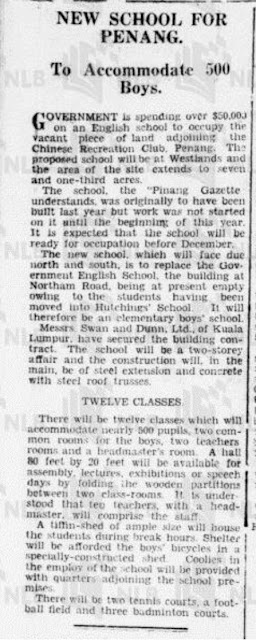
Because of this, the construction of the school itself was delayed by several months. In the 14th March 1934 issue of the Malaya Tribune, readers finally had an idea of the development:

Government is spending over $50,000 on an English school to occupy the vacant piece of land adjoining the Chinese Recreation Club, Penang. The proposed school will be at Westlands and the area of the site extends to seven and one-third acres.

The school was originally to have been built last year but work was not started on it until the beginning of this year. It is expected that the school will be ready for occupation before December.

The new school, which will face due north and south, is to replace the Government English School, the building at Northam Road, being at present empty owing to the students having been moved into Hutchings School. It will therefore be an elementary boys' school.

Messrs Swan and Dunn, Ltd, of Kuala Lumpur, have secured the building contract. The school will be a two-storey affair and the construction will, in the main, be of steel extension and concrete with steel rook trusses.

There will be twelve classes which will accommodate nearly 500 pupils, two common rooms for the boys, two teachers rooms and a headmaster's room. A hall 80 feet by 20 feet will be available for assembly, lectures, exhibitions or speech days by folding the wooden partitions between two classrooms. It is understood that ten teachers, with a headmaster, will complete the staff.

A tiffin shed of ample size will house the students during break hours. Shelter will be afforded the boys' bicycles in a specially-constructed shed. Coolies in the employ of the school will be provided with quarters adjoining the school premises.

There will be two tennis courts, a football field and three badminton courts.

By the end of 1934, the Westlands School had been completed and was ready to receive its first intake of new pupils. FC Barraclough was the first headmaster of the new Westlands School.

© Quah Seng Sun 2018

Thursday, 1 March 2018

A space called Westlands

UNTIL 1957, there was only the Westlands School. In that year, another block of school buildings opened in Khaw Sim Bee Road and that became the Westlands Secondary School. The original Westlands School in Victoria Green Road thus became known as the Westlands Primary School to differentiate it from the secondary school.

But Westlands. What was Westlands back in the past before the Westlands School was constructed? Until the early 1930s, the area was reported to be a wide open space belonging to Khaw Joo Chie, one of the eminent sons of Khaw Sim Bee who, in turn, was the most eminent and illustrious scion of Khaw Soo Cheang. The Khaw family had their business empire in Thailand.

In 1919, the President of the Penang Municipal Commission stated at a meeting that Joo Chie had “placed 25 acres of land at Westlands for Municipal coolies to plant foodstuffs and had also given $200 as prizes to the coolies who grew the most foodstuffs on the land.” (Malaya Tribune, 16th May, 1919)

Logan Road, Perak Road, Pangkor Road and Burmah Road made up much of the perimeter of the Westlands open space. To the south-east of this land was a road known as Westlands Avenue. It was only in this south-eastern corner that several spacious bungalows had been erected.

There were four detached bungalows which together were known as the Westlands Bungalows, inhabited mainly by the Europeans. One of the former headmasters of Penang Free School, Ralph Henry Pinhorn, was known to have stayed in one of these bungalows. Another well-known occupant of the Westlands Bungalows was the Revd George F Pykett who was very closely associated with the growth of the Anglo-Chinese School in Penang. The Anglo-Chinese School later became known as the Methodist Boys' School. Directly opposite the Westlands Bungalows but facing Westlands Avenue was a mansion belonging to the Khaw Sim Bee family, known as Westlands House.

In the 1930s, these were the only references to Westlands that I knew of: the four units making up Westlands Bungalows, Westlands House, Westlands Avenue and the vast tract of open space called Westlands bordered by the five roads named above. Sadly, all five landmarks have disappeared from the maps.

The 18th December 1931 edition of The Straits Times had a one-line mention of Westlands as a “large open space” that had been marked out for road construction. Then on 20th February 1932, the Singapore Free Press and Mercantile Advertiser reported that “a block of land about 7½ acres in Burmah Road, Penang, known as ‘Westlands’, belonging to Mr Khaw Joo Chie, has just been acquired by Government for a sum of $115,000, which works out approximately to $15,500 per acre. The site is intended for the new buildings of the Government English School at present in Northam Road.”

So there we have it, the first mention of a school going up in a large open space known as Westlands. But also interesting is the news of an existing Government English School in Northam Road which I shall write more about that in a later post.

© Quah Seng Sun 2018

Thursday, 22 February 2018

A snippet of history (2)

ANOTHER snippet of history with Westlands School as the background location. 

First, a story in The Straits Times of 2nd July 1952 on the formation of a junior Red Cross unit:
PENANG, Tues - A new junior Red Cross unit was formed at Penang Westlands School yesterday at an inaugural ceremony attended by Mrs Spenser Wilkinson, Director of the Penang Red Cross Society.
The boys were addressed by Rev M. Dodsworth, North Malaya District Superintendent, Methodist Mission, and Mrs L J Brittain, assistant branch director for the youth section.
After the ceremony a film depicting Red Cross activities was shown.
One year later, this story appeared in The Straits Times of 23rd July 1953. 
The picture above shows Mrs R P Bingham, president of the British Red Cross Society, Penang & Province Wellesley, inspecting a guard of honour formed by Junior Red Cross units of Westlands School, Penang. With her is her son, Richard.

Wednesday, 21 February 2018

A snippet of history (1)

A SNIPPET of history with Westlands School as the background. This story appeared in The Straits Times of September 23, 1947.


Mr F C Sands, Scout Commissioner for Malaya, pinning a gilt cross for gallantry during the war on the breast of Troop Leader Hooi Seng Tuck during the scout rally held in Mr Sands' honour at Westlands School, Penang. District Commissioner Basha Merican is standing behind Mr Sands. (Photo by Kee Chun Studio, Penang)

Monday, 19 February 2018

History, establishment

AN EXCERPT from Let the Aisles Proclaim, authored by Quah Seng Sun in conjunction with Penang Free School's Bicentenary celebrations in 2016:
The Straits Times of 30th September 1930 had reported that “In Penang a new English boys’ school at Perak Road, the Francis Light School, accommodating 500 boys was opened in January.” The earliest reference to Westlands School was in the 31st July 1934 edition of The Straits Times when Mohamed Rouse spoke in the Legislative Council of “the new Westlands School in Penang is to be opened shortly.” On 25th May 1937, the same newspaper wrote of “the Westlands School Boy Scout Troop (Third Penang) repeated their 1934 victory in a competition for junior troops for the Victoria Shield on the Empire Day sports and rally.” The three feeder schools – Hutchings School, Francis Light School and Westlands School – in turn received their intake of boys from the Wellesley Primary School. The New Straits Times of 30th May 1990 quoted a former Wellesley Primary School teacher as saying that the school started in 1929, but the school was known earlier as the Hillview Government School (Singapore Free Press and Mercantile Advertiser, 9th December 1930). The Singapore Free Press and Mercantile Advertiser of 7th October 1924 had reported that “In Penang the temporary Hillview School has been opened.”  The Straits Times of 8th December 1928 referred to “the Free School, Hutchings School and Hillview School at the present time corresponded to the upper, middle and preparatory schools of an English public school.”

Welcome

WE ARE from the Class of 1965, the former pupils of the old Westlands Primary School in Victoria Green Road, George Town, Penang. Most of us spent at least five of our early formative years here, studying hard and playing hard but more importantly, making new friends and establishing bonds that have lasted until today. 

This was the school crest. We do not know when it was introduced in the school but it was already in use when we joined in 1960 or 1961. We suspect it was introduced way before the country's Independence. WS of course referred to Westlands School because prior to 1957, there was only one Westlands school in Penang and that school provided a primary education. After Independence, a separate school for the older boys, one that provided secondary education, was established nearby and it became necessary to distinguish between the two institutions. Thus, we became the Westlands Primary School. But the crest remained unchanged.

Having left this educational institution more than 50 years ago in 1965, our hope is to use this platform to document the personal journeys of our primary school friends. We would like also to recollect and record our experiences of those days, in school and beyond -- the games we played, school activities, fashion, music, movies, etc, which were very much a part of growing up as pre-teen boys in George Town.

We believe that this project will be of relevance as it can add to the history and heritage of Penang, especially since the school itself ceased to exist many decades ago.