Showing posts with label New Straits Times. Show all posts

Friday, 30 December 2022

Of wet blankets and sour grapes

Republished from New Straits Times, Dec 30, 2022,
with the author’s permission. Read the original here.
By Yong Soo Heong

IN THE aftermath of the bruising 15th General Election, two items are not short of supply under the current rainy weather — wet blankets and sour grapes.

Wet blankets are a common sight when floodwaters rise quickly to inundate homes. And sour and tangy grapes may sometimes be found among the many varieties flooding our market thanks to this year's bumper harvests in Australia and New Zealand.

A wet blanket can also refer to someone who spoils the enjoyment of others in a celebration, or someone who dampens other people’s joy.

This expression started around the 1870s, when cooks at that time kept wet blankets in the kitchen to smother out fires that were accidentally started.

It’s derived from one of the many fables by ancient Greek storyteller Aesop entitled “The Fox and the Grapes”.

In the story, a thirsty fox sees a bunch of plump juicy grapes hanging high from a vine, but fails in all its attempts to get hold of it.

Feeling dejected, the fox walks away without ever tasting the grapes while trying hard to convince himself by muttering: “I am sure they are sour.” The moral of the fable is, it is easy to despise what you cannot get.

As I examined these two expressions, they are against an intriguing backdrop of a few politicians from the same fold, who poured scorn on the ability (or the lack of it) of Prime Minister Datuk Seri Anwar Ibrahim to steer the country towards a better future.

Strangely, these “has-beens” had lost badly in the recent polls besides having their election deposits forfeited, a stark indication of how badly they performed. They have little locus standi, and their time has passed, so to speak.

These “Doubting Thomases” said they had no confidence in Anwar's leadership and that the latter was only good in mouthing populist statements.

While the current government had stated it’s untrue that it could not be criticised, and constructive criticisms were always welcomed, it's certainly not open season for detractors to simply pour cold water on the administration without strong basis.

It’s now 2022 going on to 2023, and not 1981 or 1998. To borrow a line from John Lennon and Yoko Ono — give peace a chance — and do give this newly-stitched government a chance.

Anwar’s cabinet is hardly a month old, and even much less for the second echelon of deputy ministers. It’s heart-warming that some of them had even taken the lead for quick wins in a matter of days for the people’s benefit.

The government’s apparatus is not just Anwar’s alone. He has many competent people around him who want to prove the sceptics wrong.

That said, Anwar has to be strong enough to face the world each day and also weak enough to admit that he cannot do everything alone.

Anwar has proven his mettle by reaffirming the confidence of support for him on Dec 19. It spoke volumes of his skilful behind-the-scene manoeuvrings.

His true friends have made their support felt in times of need when others seemed to have vanished.

The South China Morning Post, which tracks Malaysia’s political developments closely, ran an uplifting editorial recently with the headline: “Anwar is the right leader to put Malaysia back on the right track”.

It opined that the outcome of the electoral impasse could be positive for the country, which now has a multiracial government led by a prime minister with Islamic credentials when it comes to fending off extremists.

The SCMP said despite intense distractions of coalition politics and potential racial agitation by the opposition, Malaysia is poised for greater stability and economic development!

Give the government some latitude first. We can scrutinise its scorecard when it hits the 100-day mark. In the meantime, let’s not upset the apple cart without rhyme or reason.

  • Datuk Yong Soo Heong is a former chief executive officer and editor-in-chief of Bernama. Read more about him here.

Monday, 5 December 2022

Let’s hope unity govt lasts the distance as people are tired of political manoeuvring

Republished from New Straits Times, Dec 5, 2022,
with the author’s permission. Read the original here.
By Yong Soo Heong

MALAYSIANS have suddenly become good at maths, especially when it concerns the numbers 222, 111, 81, 73, 30, 23, eight and zero.

You hear that “this doesn’t add up”, “they cannot be put together”, “what if there is a need to subtract when someone pulls out?” and “how long do you think these numbers will hold?”

We’re not talking about a simple maths test. The stakes are higher.

It’s about whether the unity government can last the distance of about 1,825 days as some sore losers may pull the rug out from under it.

Let’s also hope that Prime Minister Datuk Seri Anwar Ibrahim can prove his support in Parliament on Dec 19.

It’s also important for Anwar to prove his mettle after his ministers have been firmed up. Then they will have to hit the ground running to save the country.

It won’t be easy for the office-bearers but they have to accept that hard work will be the order of the day.

Too much time has been expended on politicking since February 2020 when the government fell.

Since then, nothing much has happened, save for financial aid for the people, allowing people to prematurely withdraw their savings from a provident fund, and stemming the spread of Covid-19.

People’s welfare must be given priority.

We’re lagging behind Indonesia, Thailand, Vietnam and Singapore.

Anwar hit the nail on the head when, on the campaign trail, he said he would prioritise revitalising the economy.

He and his team have to ensure the people’s wellbeing.

It’s about giving them access to reasonably priced quality food, healthcare and well-paying jobs.

Anwar set the right tone when he met heads of government departments two days after his swearing-in. The rallying of his troops is key to creating a mental revolution among civil servants to work hard for the government.

  • Datuk Yong Soo Heong is a former chief executive officer and editor-in-chief of Bernama. Read more about him here.


Friday, 27 May 2022

Do not let the Fourth Estate's work go to waste

Republished from New Straits Times, May 27, 2022,
with the author’s permission. Read the original here.
By Yong Soo Heong

THE ROLE of the media as well as challenges and opportunities facing it have often been debated to the point of almost ad nauseam.

But here's a new twist: how about challenges and opportunities under Industrial Revolution 4.0?

And that's the topic to be expounded at the National Media Forum organised by the Malaysian Press Institute (MPI) in Melaka on Sunday.

The event is held in conjunction with the launch of the National Journalists Day, or Hari Wartawan Nasional, 2022, or better known by its acronym, HAWANA 2022, by Prime Minister, Datuk Seri Ismail Sabri Yaakob.

The importance of the media cannot be overstated here in that it serves society by providing investigative reports, debates, discussions, background analysis and topical news stories.

The media informs as well as entertains, there’s no doubt about that.

For Datuk Hussamuddin Yaacub, the Chairman of Kumpulan Karangkraf, which publishes the Sinar Harian newspaper, he sees the staging of HAWANA as a significant step towards bringing back the original principles of journalism in terms of its professionalism, pride, authoritativeness and integrity against what he terms as a slide in journalistic principles through chequebook journalism.

Hence, there's much that the media forum can dwell upon given that MPI has invited several senior editors from newspapers and news portals, top news executives, academics and seasoned veteran journalists to air their thoughts.

Perhaps there should be much to chew on against the backdrop of dwindling newspaper subscriptions and diminishing advertisements among print publications, increase in online advertisements by tech giants, onslaught of news from online news aggregators linked to tech giants and independent news outfits, propensity of consumers to rely on free offerings from news aggregators, proliferation of fake and slanted online news, security of tenure for journalists and challenges in multi-tasking in today’s fast-paced journalism world.

In a world that’s plagued by tremendous cynicism as a result of widespread corruption and scandals, it’s pertinent that watchdog journalism be supported with greater gusto and hailed as an important step towards making public officials, businesspeople and others to be more accountable.

By being the Fourth Estate after the executive branches of the government, legislature and judiciary, the media has a major responsibility to the masses.

This is especially so in publicising issues that have a direct or indirect impact on society and subsequently demanding responses from public officials or parties implicated in the matter.

Given that the prime minister has seen fit to be present and accord a special day for journalists, it is hoped that he'll highlight the far-reaching roles that they play in mirroring the nation's consciousness, achievements or even setbacks.

In this regard, it would be very helpful if he could direct the attention of government servants to issues and complaints frequently raised by the public through news organisations, and to act on them almost immediately.

For example, in the area of the environment alone, we’ve been treated to a never-ending barrage of issues involving river pollution, air pollution and water supply disruptions due to contamination, illegal construction of dwellings and factories, forest degradation, reduction in forest habitats for endangered animal species, poor enforcement at all levels and the ineptness of certain agencies or ministries, to name a few, and they don’t seem to end.

When is the prime minister going to wield the big stick and ensure that government officials don’t just mouth motherhood statements that lead to nowhere in resolving pressing issues?

It’s crucial that he sets the seal for the government apparatus to pay greater heed to the Key Happiness Outcome of the people as their wellbeing will determine the success of his much-touted “Keluarga Malaysia”.

Otherwise, the painstaking work of journalists will go to waste and be akin to the Malay proverbs of “bagai hujan jatuh ke pasir (like rain falling on sand)” or “seperti anjing menyalak bukit (like dogs barking at hills)”.

  • Datuk Yong Soo Heong is a former chief executive officer and editor-in-chief of Bernama. Read more about him here.


Tuesday, 26 April 2022

Some need to learn empathy for good of country

Republished from New Straits Times, Apr 26, 2022,
with the author’s permission. Read the original here
By Yong Soo Heong

THE NINTH month of the Islamic calendar is also a special time for me because of several reasons.

Besides being invited to buka puasa events where I get to meet long-lost friends and acquaintances (and occasionally being the only non-Muslim at the table, I am also tasked to “guard the food” while my mates go for maghrib prayers!), it also allows me to reflect on the significance of empathy for those who are less-fortunate.

Fasting during Ramadan, I believe, helps to instil compassion for the poor, who may have much difficulty in putting food on the table.

My Muslim friends tell me, the last 10 nights of Ramadan are considered to be the best of the year. Of the 10, Lailatul Qadr is the holiest, where prayers are recited throughout the night.

One of the interesting activities for me during Ramadan is to help well-meaning friends like Fuzi Hanim Omar, a tireless 70-something “lady warrior”, whose tagline is “Building Bridges of Goodwill”.

Fuzi Hanim, who has been described as someone embodying the spirit of Merdeka with her work promoting inter-ethnic cohesiveness among underprivileged children, had often involved me in her Fuzi Magic “charity cluster”, where she would send food, clothes and money to orphanages and people in the B40 group.

Her volunteers will bring some festive cheer to the under-privileged in the Kayu Ara and Damansara Damai areas in Selangor by distributing satay and roti jala, as well as duit raya. They even provided aid to an orphanage in Kuala Lipis, Pahang.

Some startling facts emerge from these places casually referred to as orphanages, which we should reflect and ponder.

Many of the children are not really orphans but abandoned children. An orphan is one where he or she is deprived by death of one or usually both parents, but the parents of these children are still alive but divorced.

I’m told that these “orphanages” teeming with abandoned children are beginning to change their names to care centres (pusat jagaan).  

While cherishing people like Fuzi Hanim, I am also distracted by some disturbing news of the actions of some people just because they bask in the glory of wealth, titles and power.

I was dumbfounded when a wife of a Datuk was bound over for five years on a good behaviour bond of RM20,000 after she changed her plea and pleaded guilty to causing grievous hurt.

She had allegedly used a kitchen knife, a clothes hanger, a steel mop and an umbrella to cause multiple injuries to her maid’s head, hands, legs and internal organs.

Then, there is the case of a Tan Sri who didn’t pay his maid for 12 years until the latter reported it to the Indonesian embassy. These are just a few of the untold antics of the privileged class!

I commend the Indonesian ambassador to Malaysia, Hermono, and his officers for actively protecting Indonesians here. This is what real diplomats do whenever their citizens ask for help, not strut about at cocktail parties.

And we had better beware because Indonesia has stated that it’s not keen to send its citizens to work in countries where labour abuses go unpunished.

One maid recruitment association chief even said Malaysia may have to look elsewhere after this. Look elsewhere to continue our abuses?

Already, some Malaysian exporters have found difficulty in getting their products into developed countries because of their human rights track record. Have we still not learnt our lesson?

It’s a time for self-reflection, especially during this special month — you live in palatial homes, drive luxury cars, tote designer handbags and yet mistreat workers while still yearning for roti canai and teh tarik at 10 sen each in the 21st century? Come on. Get real.

  • Datuk Yong Soo Heong is a former chief executive officer and editor-in-chief of Bernama. Read more about him here.


Saturday, 9 April 2022

Establish citizens’ assemblies to hold politicians accountable

Republished from New Straits Times, Apr 9, 2022,
with the author’s permission. Read the original here.
By Yong Soo Heong

EVER SINCE Malaysia experienced a short-lived political renaissance in May 2018 only to be thwarted by the so-called Sheraton Move by self-serving politicians of every shade in February 2020, our country has been gripped by constant politicking.

The dismal reality from such manoeuvres has been that we’ve not been reaping the benefits of modernity while some of our neighbours who used to lag behind have overtaken us. We’ve been largely held back by narrow-minded policies that befuddle the mind of every right-thinking Malaysian.

And, no thanks to the Covid-19 virus that hit us since early 2020 and is still stifling our society in one way or the other.

Yes, the Ukraine crisis may have lifted crude oil and crude palm oil revenues sky high, but we're still a long way off from being that Asian Tiger we’re supposed to be. And, all that because many in the echelons of power seem to think that they know what's best for the country.

We now hear politicians pressing for the 15th GE to be held soon, the reasons being it's opportune to do so due to recent events in Melaka and Johor; any lingering delay may not be advantageous to some key players; time is ripe to court the naivety of voters who just turned 18; political opponents are in disarray and new alliances could be forged.

But, many in the political gamesmanship seem to be brimming with confidence on how to bring that winning formula for themselves and their hangers-on. I’m not so sure what they've in mind in terms of wealth-creation for the people because I've not heard much about this except that they want to return to power.

And, in the last two years, one of the key words that’s been bandied about was bantuan or aid, as if the country is enveloped by poor and hapless people. Nothing much about how to get citizens to earn better incomes, move up the economic ladder or businesses to take giant leaps forward.

Therefore, we often find ourselves in a dilemma.

Who do we vote for? Who could be trusted? Which politicians will not abandon their righteous cause? These are tough questions to answer.

What do we do to prevent ourselves from being “scammed” by sweet-talking politicians who come dressed in their all-white attire (perhaps to reflect purity in their souls and persona) or travel in some battered and spartan vehicle to show solidarity for the M40s and B40s?

Do remember that a winning ticket for a politician is a passport to a life-time of financial sustenance as they get pensions even serving for just one term!

And, we don’t even know what our lives are going to be in the next five years and beyond! So, guard that vote jealously and choose only those who can work for us!

I’ve been thinking about how to make those victorious politicians accountable for their actions or inaction (those whom we rarely see after they’ve won). We ought to institutionalise a proper feedback channel like a citizens' assembly to air our thoughts to lawmakers.

The deliberative democracy model that's being practised in the Ostbelgien German-speaking region of eastern Belgium is worth adopting so that we won't be fooled once every five years.

Also known as sortition, it’s an ancient practice of randomly selecting citizens to participate in legislative citizen assemblies to voice out their thoughts and suggestions.

Under this form of deliberative democracy, deliberation will be central to decision-making as it adopts elements of consensus decision-making and majority rule for problem-solving. These assemblies can provide the necessary checks and balances on politicians.

Naysayers may say why adopt a Western idea or it  won't work in Malaysia without proper funding or administrative support. Funding? That’s the least of our problems. It’s the will to make things work that's key. Financing could come from the Election Commission, Parliament or State Assemblies.

These assemblies could meet a few times annually and select people from all strata to avoid a potential middle class or upper class domination syndrome. The idea is to have a truly representative and deliberative democracy. It’s also about moving Malaysia forward.

  • Datuk Yong Soo Heong is a former chief executive officer and editor-in-chief of Bernama. Read more about him here.

Wednesday, 9 March 2022

Boosting Penang's musical heritage as an attraction

Republished from New Straits Times, Mar 9, 2022,
with the author’s permission. Read the original here.
By Yong Soo Heong

ON THE fourth floor of Komtar Complex in downtown George Town, Penang, lies a cultural oasis that showcases various “gems” related to the state’s pre-eminence in the performing arts and broadcasting industries.

Unfortunately, its prominence is masked by stores selling computer peripherals, fried chicken and souvenir knick-knacks before visitors can locate an escalator that takes them to this extraordinary place. 

Known as the Penang House of Music (PHoM), it’s a jewel in the crown among local music aficionados who care about Penang's musical heritage, and a labour of love by its founder, Paul Augustin, a self-taught 62-year-old Eurasian musician from the state, now a musical “historian”, curator, researcher and archivist.

The “house” promotes Penang as the motherland of musicians in the country. It came into being on Nov 21, 2016 under the Penang Musical Heritage Project in line with the state government's aim and vision to establish a heritage and creative arts city.

It traces facets of Penang’s musical journey from the 1900s when the British colonials held sway, Japanese Occupation in early 1940s, return of the colonials in the mid-1940s, the halcyon days of pre-Independence, the glory days of the Swinging Sixties right up to the Buoyant Seventies.

Of course, no presentation would be complete without its most revered star, P. Ramlee.

The legendary actor-singer (along with his heart-throb, Saloma) holds a special place among many better-known Penang-born or raised entertainers like Ahmad Daud, Ahmad Nawab, Zainal Alam, Rubia Lubis, Jimmy Boyle, Ooi Eow Jin, Albert Yeoh, Richard Hoon, Lee Yee and David Arumugam, to name a few.

PHoM also captures the journey of how the local populace entertained themselves in the past, how the different local communities celebrated their festivals with music and performances thrown in, including Penang's famed song, dance and tongue-in-cheek satirical routine — the boria.

Special mention must be made of the presence of a radio studio where visitors can briefly be deejays and record audio presentations for keepsakes and a diorama of a coffee shop in the 1960s complete with a jukebox and a Rediffusion audio box.

It wouldn’t be out of place to say that a fair number of the exhibits mirrored what people usually saw in 1960s, when Paul himself grew up with a host of top-notch musicians, as well as pursuits like requesting their favourite songs to be played on the airwaves.

Also on display are the then immensely popular magazines like Movie News and Majallah Filem that highlighted soon-to-be screened films and sizzling celebrity gossip.

Two exhibits stood out: one, a cubicle where you could listen to golden oldies by pressing a song list on a tiny computer screen at the side; the other, a modern audio-visual screen depicting the Chinese “wayang” puppet shows where the costumes could “change” at will with every movement of the viewer's hand!

Moving forward and thinking aloud, a more strategic location befitting its strategic role could be the old Penang City Council building near the Esplanade, or the rather neglected AIA Building in Lebuh Bishop or one of the bungalows belonging to Penang Institute in the leafy suburbs of Jalan Brown.

The first two locations would add lustre to the touristy attractions in downtown George Town and augment PHoM’s foot-traffic.

The suggestion to be in Penang Institute's serene environs, besides its ample space for exhibits and visitors, is also to complement the latter's research into what makes Penang tick since PHoM had also ventured into research, documenting and digitalising its collection.

PHoM’s archival efforts reflect Paul's mission about building Penang’s (and subsequently Malaysia's) musical repository for posterity to benefit future generations.

Such noble endeavours could also complement the work done by local universities as PHoM’s treasure trove is constantly sought after by researchers on the state’s illustrious local musical journey.

It all depends on how the powers-that-be in Penang aspire to boost PHoM as a musical heritage attraction while the “house” also sifts through an increasing storehouse of valuable documents and artefacts to augment the state's contributions to Malaysia’s “musical treasures”.

  • Datuk Yong Soo Heong is a former chief executive officer and editor-in-chief of Bernama. Read more about him here.

Friday, 21 January 2022

There must be better explanation for fatal cases

Republished from New Straits Times, Jan 21, 2022,
with the author’s permission. Read the original here.
By Yong Soo Heong

“UNREASONABLE haste is the direct road to error” was a quote that came to mind when I read that some clear-minded thinkers in our local medical fraternity were cautioning against the rollout of a second booster shot under the Covid-19 National Immunisation Programme.

That quote belonged to 17th century French playwright Jean-Baptiste Poquelin, better known by his stage name Moliere, as he expounded the virtues of deliberation before acting in haste.

The New Straits Times had cited several people well-versed in medical science that Malaysia ought to study all relevant data on the efficacy of the booster shot, which has yet to reach the arms of many.

I subscribe to that view as many cases unpleasant to the ears had surfaced of late with regard to casualties after getting the booster shot, elegantly classified as Adverse Event Following Immunisation (AEFI).

There has to be greater clarity as I believe all authorised Covid-19 vaccines must have the highest degree of efficacy and safety.

What if the lines of safety are blurred because we've not undertaken a serious study ourselves and had blindly kept in step with the Joneses?

Datuk Dr N.K.S. Tharmaseelan, a former Malaysian Medical Association president, said more data was needed and even the World Health Organisation (WHO) had yet to endorse a global rollout of booster shots.

WHO says: “Safe and effective vaccines are a game-changing tool: but for the foreseeable future we must continue wearing masks, cleaning our hands, ensuring good ventilation indoors, physical distancing and avoiding crowds.

“Being vaccinated does not mean that we can throw caution to the wind and put ourselves and others at risk, particularly because research is still ongoing into how much vaccines protect not only against disease but also against infection and transmission.”

We’ve to probe deeper, especially our own environment. As things stand, 26 million or close to 80 per cent of our population had received the first dose and 25.6 million or 79.6 per cent had taken the second. Nearly 30 per cent or 9.7 million had the third dose.

I'm drawn to morbidity or mortality cases following the third dosage.

There have been several high-profile cases of late. The usual culprit is often blamed on heart attacks. As easy as that? Clarity on how these fatal cases came about is sorely lacking.

Now we have been alerted to another high-profile case involving the father of a state-level religious figure. The authorities told us that the National Pharmaceutical Regulatory Agency is investigating after the religious official revealed that his father vomited, became weaker and even had a stroke after the third dose.

Why is this so when medicines are supposed to fortify one's body? Perhaps as a layman I wouldn't know why.

I’m just asking like any normal person why a trip to the clinic or hospital has to end like that. Someone must explain convincingly.

While we’e bent on achieving herd immunity, I suppose not everyone can be corralled into that herd. Although there's compensation from a fund for extended AEFI cases between RM50,000 and RM500,000, no amount of money will placate the loss of a dear one.

I support the proposal by Dr Zainal Ariffin Omar, chairman of the Volunteers for Community Engagement and Empowerment for Covid-19, who called for the formation of an independent technical committee to address vaccine hesitancy.

There’s still 20 per cent of the population who have yet to be jabbed and another 70 per cent to go for the booster.

Amidst all these, I’m terribly amused by a recent father and son conversation. Daddy told his son that he was better off getting Covid-19. His son was non-plussed at the sudden remark.

His dad then said he had at least a fighting chance of staying in conversation and be alive for three weeks or so in combating the virus before he succumbs. And, if he is lucky, he will get to stay alive.

But with the booster shot, it may boost his chances of meeting his Maker faster! It’s a sobering matter we’ve to consider seriously.

  • Datuk Yong Soo Heong is a former chief executive officer and editor-in-chief of Bernama. Read more about him here.

Saturday, 4 December 2021

Don’t overstay when the writing is on the wall

Republished from New Straits Times, Dec 4, 2021,
with the author’s permission. Read the original here.
By Yong Soo Heong

MY late mother, from Dongguan, Guangdong Province, in southern China, Low Ah Hup, had this advice for me to survive the rat race, bracing for life’s challenges or tip-toeing on social etiquette: choot moon thai theen sek, yap moon thai min sek.

It simply meant when going out the front door of a house, look at the colour of the sky; when entering a house, assess the colour of the host’s face.

How right she was! If we see dark skies, then we ought to be prepared and bring an umbrella in case a thunderstorm starts.

The second part of her tip was even more telling: if we enter a house for a tete-a-tete with someone, it’s time to vamoose to avoid overstaying the welcome, lest we see scowls or dark faces.

The most “celebrated” case we’ve seen so far was the riot on Capitol Hill in Washington, DC on Jan 6.

That was when a mob of unruly supporters of former president Donald Trump attacked the United States Capitol building to overturn his defeat in the 2020 presidential election by disrupting a joint session of Congress to count electoral votes that would formalise President Joe Biden’s victory.

Amid the shocking scenes, the Capitol was locked down and lawmakers and staff evacuated, while rioters assaulted law enforcement officers, vandalised property and occupied the building for several hours. 

What was bizarre was that Trump resisted sending the National Guard to quell the mob and again asserted that the election was “fraudulent”.

But, common sense later prevailed when the Capitol was cleared to allow for the counting of electoral votes, which was completed in the early hours of Jan 7.

Much has also been happening in Malaysia since May 2018 and even right up to about a month ago in Melaka, when politicians schemed to regain or stay in power, depending on how one looks at the convoluting scenarios.

After all, American diplomat, Walter Annenberg, did say that “the greatest power is not money power, but political power”.

Over the last 50 years or so, we’ve seen what political power can do for the political elites in the name of grandiose-sounding policies.

This is especially so when political power easily translates into money power.

And this fact has not been lost among non-politicians as well. Many dishonest leaders of non-governmental organisations, charity foundations, trade unions, cultural federations, clan associations and vocational trades guilds, especially those with plenty of lolly in the kitty through subscriptions, endowments and fundraisers, have been known to follow the rule book of double-dealing politicians.

An ongoing case in point revolves round a state clansmen association for the Hainanese community, a Chinese dialect group noted for its civility and politeness (besides their chicken chop and chicken rice).

But, temperatures among some of them have been rising when key office bearers allegedly sought another another three-year term by amending the association constitution.

These people, who’ve led the association for two terms, claimed they wanted to complete the association’s “unfinished business” as they were stalled by the Covid-19 pandemic.

But, their detractors begged to differ, as they claimed that one shouldn’t measure one’s life by its duration but by contributions to society.

One of them said: “Individuals, no matter how powerful or popular, cannot be indispensable. When the time comes for them to take a back seat or retire, they should do so with dignity by welcoming the next generation of leaders who can then emerge with fresh ideas and even bring about new changes to augment the good work undertaken by the elders before them.”

The association’s annual general meeting is, surprisingly, scheduled over Christmas Day and Boxing Day.

Let’s hope good sense will prevail among members without sparks flying or punches being thrown.

  • Datuk Yong Soo Heong is a former chief executive officer and editor-in-chief of Bernama. Read more about him here.

Friday, 10 September 2021

We should seriously study, legislate a future generations law

Republished from New Straits Times, Sep 10, 2021,
with the author’s permission. Read the original here.
By Yong Soo Heong

AS WE LOOK back at what our country has achieved in the last 64 years, there’re certainly many triumphs and also failures that we may as well not dwell on, lest they bring us more heartaches.

We could’ve achieved much more. So it’s best to look to the future as Soyen Shaku, a Japanese Zen monk, discovered when he found a way out of past failures by saying, “Do not regret the past, look to the future”.

Perhaps this is akin to the popular saying of no use crying over spilt milk.

Much has happened in our beloved country, especially in the past two years or so. Besides the arduous health and economic challenges, we’ve also been treated to a giant spectacle of political upheavals and manoeuvring on a scale we’ve never seen before.

The familiar refrain of “where do we go from here?” is often heard among those who care about the future of this land we call home.

While we’ve been engrossed in much political infighting, some neighbouring countries that had once lagged behind have even overtaken us.

Take our automobile industry, for example, which we had often boasted about when we got off the starting blocks as early as 1985.

But we’ve not made much headway since then, especially in selling our wares to big international markets, except for making millions of Malaysians happy with their relatively cheap locally made vehicles compared with competing overseas rivals.

Of course, we enriched some local parts producers along the way in the name of localisation.

And look at the South Koreans: one of their marques started about the same time as us, and look where they are now.

Their cars, viewed with disdain by some snooty automobile makers then, have found a niche in the garages, driveways and parking lots of many North American and European homes with their stylish designs, advanced engineering and fuel economy.

Even one-time war-torn Vietnam will start marketing home-grown electric SUVs to the industrialised West in November. Enough said.

But I pray there’s still hope yet for our future generation as I’m captivated by this line of optimism: The past is your lesson. The present is your engine. The future is your motivation.

It may be wishful thinking on my part to hope for radical changes in the next 100 days or so that could bring forth many solutions or answers to the multitude of challenges that we now face.

Who or what could lead us out of the quagmire? Do we sink further into mediocrity?  

I’m drawn to Dr Roman Krznaric, a Briton described as a public philosopher, who had expounded on the need to reinvent democracy for the long term.

He argues that when politicians fail to look beyond the next election — or even the latest tweet — they are neglecting the rights of future generations.

He depicts such flaws as short-termism and presentism.

Governments, he declares, typically prefer quick fixes, such as putting more criminals behind bars rather than dealing with the deeper social and economic causes of crime.

Nations bicker around international conference tables, focused on their near-term interests, while the planet burns and species disappear.

Like Krznaric, I’m intrigued by what the government of Wales in the United Kingdom had done in an interesting attempt to right the wrongs, although it may not be a fool-proof panacea.

Premised on “acting today for a better tomorrow”, Wales had established a Future Generations Commissioner as part of the 2015 Wellbeing for Future Generations Act.

Sophie Howe, described as one of the United Kingdom’s changemakers and top businesswomen, was appointed to the important role in 2016.

Her responsibility is to ensure that public bodies in Wales make policy decisions looking at least 30 years into the future.

The Guardian newspaper describes her as the “world’s first minister of the unborn”.

In a nutshell, the far-sighted Welsh law requires public bodies to think about the long-term impact of their decisions, to work better with people, communities and each other, and to prevent persistent problems such as poverty, health inequalities and climate change.

This legislation has been attracting interest from other countries as it offers a huge opportunity to make a long-lasting, positive change to current and future generations.

Do we dare take such a giant step for the wellbeing of future Malaysians?

  • Datuk Yong Soo Heong is a former chief executive officer and editor-in-chief of Bernama. Read more about him here.

Monday, 30 August 2021

Straits Echo


THIS IS quite a well-known picture, a three-storey building that once housed the venerated Straits Echo Press newspaper. I have no idea when the newspaper located its operations here but very long ago, it used to operate from a shophouse in Beach Street. In the 1960s, I do remember seeing the building at this spot – the corner of Penang Road and Dato Koyah Road – but never in my wildest dreams then could I foresee that one day in the 1970s, I would have this newspaper as my first employer, albeit only for a short six-month stint.

I said venerated because where the Press was concerned, this English language daily was the pride of Penang. Often, it carried news that the more national-level The Straits Times, with its headquarters in Singapore, was unable to report first-hand. Before the Second World War, The Straits Times occasionally had to rely on re-printing news that had earlier appeared in the Straits Echo. Thus in a way, the latter, despite its regional coverage, was seen as an ultimate source of authority for news about Penang.

Like The Straits Times, the Straits Echo newspaper was a broadsheet which was a large format and somewhat unwieldy to hold. To keep up with the times, but more to challenge The Star newspaper which hit the streets in 1971, the Straits Echo transformed into a tabloid in the 1970s. With it came a new name, The National Echo, and blue was adopted as its colour for the masthead in contrast to The Star’s red. The competition with The Star was keen and at one stage, an evening edition – the so-called street edition – of the newspaper was introduced so that readers could read that day’s news on the same day. Later, The National Echo opened an office in Kuala Lumpur and shifted its centre of operations there. Unfortunately, it could not compete with the likes of New Straits Times, The Malay Mail and The Star, and The National Echo folded in 1986.

When I worked there in the 1970s, the newspaper was owned by someone named KK Liew. The editor was a Eurasian named Wilson de Souza while the senior editors were Cheah Cheong Lin and Sunny Tan. The chief reporter was a very loud man named G Ratnam. Among my peers were people like Kee Thuan Chye, Ung Mah Pheng, Ong Thean Seang and Ooi Kee Beng. The last named is now the Executive Director of Penang Institute.

© Quah Seng Sun

Updates and add-ons:

Lim Siang Jin: 

  • My great grandfather, Lim Cheng How, used to manage the company that owned the Straits Echo. This is from my grandfather’s memoirs: “Attached to the Criterion Press, Ltd, former proprietors of the Straits Echo, the premises of which were at Nos 226 and 228 Beach Street, presumably as an assistant, my father rose to the appointment of manager with, I believe, a salary of $100/- pm which was then considered excellent pay having regard to the fact that the cost of living was cheap”.
  • In the mid-1980s, the late Soo Ewe Jin (later one of the Deputy Executive Editors of The Star)  and I were approached to come up with a plan to revive The National Echo, perhaps take it back to Penang and focus on news from the north again. We were both working for ISIS Malaysia then. Both from Penang, we were quite excited about the project, however, nothing came out of it.

Wednesday, 14 July 2021

Time to act firmly against underachievers, saboteurs

Republished from New Straits Times, Jul 14, 2021,
with the author’s permission. Read the original here.
By Yong Soo Heong

FOR THE past few weeks, I’ve been feeling numb, not so much from getting those precious vaccine shots, but more from the idiocy that has enveloped our beloved country.

I don’t find any comfort from witnessing the unproductive actions of certain people in positions of power and decision-making as many matters could have been avoided.

If only people had common sense to act rationally. Perhaps too much information on a single day has caused us to lose our common sense, as alluded by novelist Gertrude Stein.

When the Emergency was proclaimed earlier this year, there were high hopes that we would be seeing strict lockdowns to get the coronavirus off our backs. But it was not to be.

Waves upon waves of dithering have caused the country to be nowhere it wanted to be as seen from the daily Covid-19 cases that surpassed 11,000 yesterday! The numbers could even be higher as some cases go unreported.

An audio clip of frontliners in government hospitals in the Klang Valley crying for help from their never-ending toil from last year choked me to tears. Think about it seriously — they have been firefighting daily and yet, there are parties who are feeding the flames by being lax about the pandemic.

From the audio clip, a doctor could be heard saying: “When is this going to end?”

This will not end if we are still unsure of what to do next amid the pussy-footing with the Covid-19 standard operating procedures as this column had emphasised in the past!

We are now in a war against Covid-19 and yet we are not on a war footing, so to speak. Politicians and policymakers have always said that the country has always been battle-ready, but what readiness is there when our Intensive Care Units are overwhelmed, coupled with a severe shortage of medical staff and oxygen supply?

And in the midst of this, we can’t even handle the issue of the country’s more than 23,000 contract doctors, who have been toiling since Day One. They will always be useful to our country. The "dog-in-the-manger" attitude among top administrators can't go on forever.

This also brings to mind the issue of the recent felling of 15,000 durian trees in Raub, the country’s musang king hub. While the authorities may have their reasons — as they claimed that the trees had been illegally planted on government land — it was tantamount to economic sabotage and bodoh sombong.

Why now? Why didn’t they take action when the land was initially cleared? Why fell fruit-bearing trees? Some win-win solutions could have been found, but common sense didn't prevail.  

Vegetable farmers in highlands have also been dumping their produce of late because they can’t send them to markets in the lowlands as lorries have been stopped from travelling by the authorities.

This is despite the fact that some Malaysians do not even have enough to eat because of the prolonged lockdown, which has led to people losing jobs and sources of income. Why do we allow this state of hopelessness to fester?

Brigadier-General Dr Mohd Arshil Moideen, who heads the armed forces’ Health Service Division, courageously called a spade a spade recently.

I salute him for being forthright when he said: “In a war, like the war against Covid-19, we need a single standardised strategy line of command that everyone can abide by.” A clear chain of command is certainly lacking for the rakyat’s wellbeing.

Malaysia needs to see light at the end of the tunnel. We can’t go on like this with ministers going off on a tangent on their assessment of the economy.

We can’t have little Napoleons ruining businesses and the lives of the rakyat from frequent raids, dodgy summonses and flippant SOP.

Dear prime minister, please act firmly against these underachievers and saboteurs. Sometimes the hardest thing and the right thing are the same.

You know you have made the right decision when there is peace in your heart. The rakyat await.

  • Datuk Yong Soo Heong is a former chief executive officer and editor-in-chief of Bernama. Read more about him here.


Tuesday, 3 November 2020

Malaysia needs to clean up recruitment practices

Republished from New Straits Times, Nov 3, 2020,
with the author’s permission. Read the original here.
By Yong Soo Heong

I HAD OFTEN wondered when the lopsided conditions for migrant workers that had prevailed for years in our country would attract the attention of those who might give greater weight to justice and fairness.

Strangely, that recognition did surface recently, but it wasn't from our own volition, but from foreign countries instead!

The floodgates were broken recently when the United States and New Zealand singled out a Malaysian glove manufacturer that had forced migrant workers (mostly women from Bangladesh, Myanmar and Nepal) to work long hours, sometimes as long as 12 hours a day, seven days a week! On top of that, these workers often paid huge sums to secure jobs in Malaysia and the practice usually left them with huge debts they cannot pay back.

It is estimated that such fees may account for up to four to seven months of a worker’s salary! In another area where Malaysia had often beamed with pride – palm oil – a local company’s products were also banned by the US for transgressions in – again – the hiring and treatment of migrant workers.

These importers decided to act as they had found reasonable evidence of forced labour in the production process. These workers aren’t robots or machines. Do spare a thought for these people who might be a father, brother, mother, sister, uncle or aunt to someone. They certainly didn’t want to be trapped in such oppressing conditions, but circumstances forced them to leave the comforts of their homeland to eke out a living here.

The time has come for Malaysia to clean up its act. How long must Malaysians deny or pretend that conditions for low-level migrant workers are “all right”? How can we allow our reputation to be sullied by these repressive regulations or conditions? What if we faced more sanctions from developed nations? We can't consume all the rubber gloves and palm oil that we produce, can we?

There must be some basis to the complaints, which had often been shrugged away or swept aside in the past. There's no smoke without fire. Now, the glove manufacturer that had been targeted had reportedly paid back US$12 million to its workers concerned and had also started paying recruitment agencies the necessary fees instead.

What a turn of events! Such compensation wouldn't cause a big dent in its revenue, as demand for gloves had surged by almost 50 per cent due to this year's Covid-19 pandemic, while share prices of Malaysian glovemaking companies had also soared by as much as 400 per cent on Bursa Malaysia of late! To paraphrase Tom Perez, an American politician, it would be unfair if workers baking the pie of prosperity were not sharing the dividends.

It takes two hands to clap and the issue of migrant labour also takes into account the government’s stance on the matter. The authorities must also bear some of the responsibility for this poor state of affairs. We’ve to really take a long hard look at our immigration policies and question ourselves: do we need foreign workers or not? If no is the answer, then do away with them and let Malaysians take up all the responsibilities from A to Z.

If the answer is yes, it’s time to stop pussy-footing. Make the recruitment conditions as transparent as possible so that any employer need not rely on runners, agents, go-betweens and intermediaries and what-have-yous (it’s almost an industry by itself in Malaysia!)

In 2008, the then Chief Secretary to the government, Tan Sri Mohd Sidek Hassan, initiated an embracing policy known as the “No Wrong Door”. It ensured that the public would no longer be turned away even if they approached the wrong department or agency and the government servants there would forward the customers' needs to the relevant office.

Has that policy been thrown out of the window because of changes in the top civil servant’s job or it found little currency as it eliminated the need for a “runners’ culture” to thrive? Now, who wants to start the ball rolling again?

  • Datuk Yong Soo Heong is a former chief executive officer and editor-in-chief of Bernama. Read more about him here.

Saturday, 24 October 2020

Fake news purveyors say they are journalists too

Republished from New Straits Times, Oct 24, 2020,
with the author’s permission. Read the original here.
By Yong Soo Heong

IN AN EVER-CONFUSING world of legitimate news criss-crossing with fake news, I’m just wondering how long Donald Trump, the chief promoter of fake news, will continue to spew bad vibes about the mainstream media.

When less is said of fake news, such labelling will hopefully evaporate.

But will it? Especially now that Trump has given greater legitimacy to the wicked forces of fake news by saying such news is everywhere. Prior to late 2016, murmurs of news being manipulated made the rounds but never at the frequency that Trump easily belched “Fake News!” whenever issues weren't in his favour.

Fake news has become a big thing, especially on social media. When fake news is repeated, it becomes really difficult for the public to discern what's real and what’s not.

Real news practitioners have resigned to the fact that fake news and rumours had thrived online because few can verify what's real. And more so when people tend to veer towards content that reinforces their own biases.

Granted that the media had been frequently used by the four Ps — politicians, propagandists, publicists or public relations practitioners — in the past. I won’t say that lies had been thrown about and the media readily gulped them up. To be fair, it’s how the information is treated (or slanted) and disseminated. But with the advent of social media, that’s another kettle of fish!

Let’s take a moment to reflect what a young Pakistani politician, Bilawal Bhutto Zardari, said: “Propaganda, misinformation, and disinformation have always been part of political warfare. Social media and other new platforms have given it a new life and reach through which the fake news phenomenon can reach everywhere.”

Now if a politician such as Bilawal had admitted that those ingredients had always been part of the political machinery, then perhaps we’ve to exercise greater caution when digesting information from politicians. Maybe not with a pinch of salt but several spoonfuls, perhaps! 

Whether Trump gets re-elected as president remains to be seen. But, ever since he took office in January 2017, he has been assailing the mainstream media for producing fake news.

As a journalist for a number of decades, I’ve always abhorred that kind of labelling. True blue journalists may take a certain stand, stance or bias but certainly won't stoop so low as to produce something that's not real. That’s the domain of fiction writers or mercenary writers imbued with a mission.

By and large, journalists in mainstream news organisations have been steadfast in their profession. But sadly, fake news is now a new menace in the public space as their purveyors also proclaim themselves to be journalists too and taint the noble profession in the process.

I concur with Jim Acosta, who reports for CNN at the White House, when he said: “Yes, Barack Obama had his clashes with the press. I witnessed those first-hand covering the second term of his administration. But we did not have Obama on almost a weekly basis referring to the press as the enemy of the people and accusing reporters of treason and calling legitimate stories fake news.”

The use of social media to implant falsehoods by latching on the legitimacy of mainstream media organisations is rather appalling. With no lack of creative people and the juicy goings-on in Malaysia these days, satirists have been having a field day.

But, what’s worse is that some have even resorted to “hijacking” some media organisation's online platforms to pass on disinformation for their benefit, and frequently saying a public holiday had been declared or that the government was going to pay out bonuses to its employees. Such ruses occur whenever some state or national team had emerged victorious in some popular sports events and during Budget time.

And Bernama, the national news agency, hadn’t been spared such manipulation. What’s even more ruinous is when some people tend to shatter Bernama’s reputation and level of journalistic competency by using their own interpretation of events or some online auto translating tools to post some purported news items on social media.

Bernama has reported this to the police several times but these envious perpetrators have yet to be trapped. I hope these journalist-wannabes can be exposed soon!

  • Datuk Yong Soo Heong writer is a former chief executive officer and editor-in-chief of Bernama. Read more about him here.

Wednesday, 30 September 2020

Time to act on investigative reports highlighted by the media

Republished from New Straits Times, Sept 30, 2020,
with the author’s permission. Read the original here.
By Yong Soo Heong

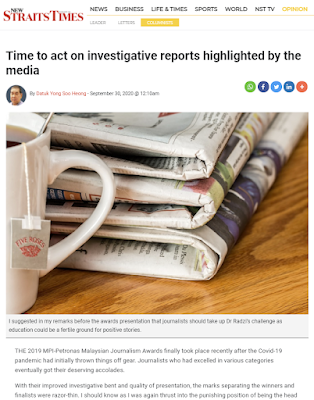
THE 2019 MPI-Petronas Malaysian Journalism Awards finally took place recently after the Covid-19 pandemic had initially thrown things off gear. Journalists who had excelled in various categories eventually got their deserving accolades.

With their improved investigative bent and quality of presentation, the marks separating the winners and finalists were razor-thin. I should know as I was again thrust into the punishing position of being the head of the judging panel! As with many award-winning entries of the recent past, many tend to focus on lax enforcement, mismanagement, corruption and red tape in government. The propensity for in-depth unearthing of such misdeeds was not lost on the guest-of-honour, Senior Education Minister Dr Radzi Jidin, who represented Prime Minister Tan Sri Muhyiddin Yassin at the function.

While urging journalists to uphold journalism’s core values of integrity, authenticity and relevance, Dr Radzi asked — could they turn their attention on positive matters for a change? I suggested in my remarks before the awards presentation that journalists should take up Dr Radzi’s challenge as education could be a fertile ground for positive stories.

While many jaded people would be quick to throw cold water on this much-debated subject, I believe that good education-related materials exist to be unearthed while not forgetting the not-so-good ones as well. On a positive note, one of the winning entries revealed that many urban poor students tend to experience more mental health issues and there was a need for more counsellors in schools!

Education-related matters need further probing to bring to light what needs to be done to provide the best for our leaders and talent of tomorrow. After all, Malcolm X, a Muslim African-American civil rights leader, had reminded us that “Education is the passport to the future, for tomorrow belongs to those who prepare for it today.”

In my view, news organisations don’t go pursuing bad happenings for them to be sensationalised. These news items are for real, had taken place and warranted attention so that action can be taken for the benefit of the people. Media organisations play a central role in recording events and promoting greater awareness about pertinent issues that affect our lives day in and day out as today's news will stand as historical facts for the future.

Having said that, we cannot help noticing some of the unsavoury things that had been highlighted. Like the heart-wrenching tales of illegal migrants being smuggled into the country and forced to live like animals in the forests before they are “safely” transported were rife.

Not only humans were trafficked, animals too, such as the prized pangolins, rumoured to have medicinal powers for pregnant women to lactate even more! Stories about our rivers and reservoirs being polluted were aplenty. And how the health of young schoolchildren was affected by the now infamous Sungai Kim Kim and other filthy rivers in Johor. Or the frequent encroachment into our rich marine waters by foreign fishermen or villagers being exposed to unhealthy levels of lead pollution from processing industrial wastes dumped by developed countries.

I was also attracted to the New Straits Times’ focus on the daily grind of thousands of commuters at the Johor Baru Causeway, either going to work or study in Singapore. These early risers are doing just that because they want bring to a little more food to the table or to have better employment prospects later on.  It’s a crying shame that our people have to endure deplorable conditions each morning.

Now that the Causeway is not as crowded as before because of the Recovery Movement Control Order, perhaps the authorities could do something there fast. Strike while the iron is hot. Democratic governments change because of shifts in voting patterns of voters or in political colours of politicians. But there's little change in the government machinery or personnel.

It would do the rakyat a lot of good if these investigative reports were seriously evaluated by heads of relevant departments and acted upon immediately. After all, our current government's tagline is “Kita Jaga Kita” and William Shakespeare did say: “It is not in the stars to hold our destiny but in ourselves.”

  • Datuk Yong Soo Heong is a former chief executive officer and editor-in-chief of Bernama. Read more about him here.

Wednesday, 29 April 2020

Sleepless in Kuala Lumpur under the MCO

Republished from New Straits Times, April 29, 2020,
with the author’s permission. Read the original here.
By Yong Soo Heong

I’VE BEEN almost sleepless ever since the Movement Control Order (MCO) was introduced. Everything related to my shut-eye patterns crumbled after my creaky bed gave a warning shot sometime back.

This was when a hairline crack appeared at the side bed frame (my side of the bed, not that of my late wife!) and I knew I had to do two things — get a new bed or lose weight. But, fondness of the marital bed was too great, I procrastinated — metal or wooden bed, big-name brand or just anything from the furniture warehouse?

On the night before the MCO, the bed somewhat gave an ominous sign of what’s in store: the central bed base and wooden slats supporting the mattress gave way! With the MCO, there was no way I could get a replacement soon enough. Hesitation paid a heavy price.

So each night, I had to sleep gingerly on the mattress. MCO on the bed as well! A good lesson on decisiveness or the lack of it and Mark Twain's observations of ”good decisions come from experience. Experience comes from making bad decisions” is very telling here.

Ever since the MCO set in, one of the most often asked questions to me was: How are you coping? Many were amused when I said I had been sharpening my marketing and cooking skills! 

For a start, I didn’t need to make a video call like someone did in a supermarket to ask what’s the difference between onions and shallots.

On my shopping trips, I met many well-meaning people advising me that I can cut queue, thanks to my wobbly gait and strands of grey hair; and, service workers also helped me balance my laden trolley when navigating steep gradients. A lot of positiveness still prevails among humanity during these difficult times.

As for my hot-spells in the kitchen, they made me appreciate more the people who toil in close and stuffy confines daily to bring us yummy dishes on restaurant tables without fail. And what I had whipped up to feed me and my son had been fairly decent, nothing close to any Michelin star, but enough to leave me starry-eyed after each meal that I managed to do it!

Being quite aware of another axiom that if you can't stand the heat, get out of the kitchen, I had been faithfully standing in front of a one-burner cooking stove to juggle my stuff. The other burner gave up on me and I was on the verge of getting a new double-burner until the MCO (again!) struck. Again, shilly-shallying was the root cause.

I’ll never forget the date of March 18 when the MCO took effect as I had been geared up for an important task: transferring the ashes of my parents housed in two old semi-outdoor columbaria to an air-conditioned indoor columbarium that at present houses those of my late wife’s.

The ceremony was to have taken place at 9am, but the priests said no go — the law is the law — the prime minister said no religious events. They were right as they adhered to the dictum of “it takes less time to do things right than to explain why you did it wrong”. 

Which is why I don't understand that 14,000 people or more had flouted the MCO’s provisions. At RM1,000 per summons, the government stands to gain some RM14 million! It's not so much the money that’s important, but more so on curbing the spread of the deadly Covid-19 virus.

These unseen enemies are no respecter of people as they had already skirmished Prince Charles and Boris Johnson in the United Kingdom and caused the untimely demise of many prominent people the world over! 

Until we’ve slayed these tiny but lethal beasts, we better stay home and out of harm's way, no matter how stifling it can be. It’s as simple as that and MCO doesn't mean “must come out”!

  • Datuk Yong Soo Heong is a former chief executive officer and editor-in-chief of Bernama. Read more about him here.

Tuesday, 21 April 2020

Saving our frontliners

Republished from New Straits Times, April 21, 2020,
with the author’s permission. Read the original here.
By Yong Soo Heong

IN THE BATTLE against the deadly coronavirus, we have continuously hailed our medical frontliners as heroes and heroines. Credit should be given when it’s due in this grim situation.

But should we be content with praise alone? Certainly not. We should put our money where our mouths are to prove our commitment to these hardworking people, who are sacrificing their lives for the wellbeing of others.

In the combat against the unseen enemy, medical personnel, be they doctors or nurses and other ancillary staff, are much sought-after. But our efforts to acknowledge their moil had been at best sputtering.

If one had been following the narratives on our country’s public healthcare system, it would have been rather demoralising.

Letters penned by doctors in the media give a dismal picture of the treatment they get in terms of permanence of positions, salaries and allowances. And yet we hail them as saviours during these precarious times.

For instance, an estimated 9,000 contract doctors are undergoing housemanship.

About 4,000 of them are given contracts at Grade UD41, thus having the same pay as housemen, but considerably less by about RM8,000 annually compared with their permanently-hired colleagues at Grades UD43 or 44, while doing the same kind of work.

The words of a prominent senior official at the Health Ministry on the state of the healthcare system are telling: “We are currently underfunded, understaffed, underpaid, overworked, overstretched and with facilities overcrowded with patients.

“We all need to try harder to improve the public healthcare system to increase the funding, to increase the number of healthcare workers, to improve the salary scale and availability of jobs and posts in our healthcare facilities, all of which are beyond the control of the Health Ministry.” Need we say more?

It’s not hard to see how things are wrong. Despite the glowing optimism among some quarters to make medical tourism a money spinner, little is being done to ensure a sustainable healthcare eco-system.

We go back to basics. In July 2018, the ministry applied for 21,741 positions to the Public Service Department and Public Services Commission.

However, the ministry was directed to downsize its applications, and 10,675 positions were applied for subsequently.

It meant that what the medical experts had recommended was slashed. In the pandemic, have we heard anyone say that we’ve too many medical personnel?

The wellbeing of the rakyat is not measured by big government buildings, imposing bank towers, large houses or flashy cars.

Their access to good or adequate healthcare is a substantial yardstick. The war against Covid-19 is a case in point.

As a layman, I cannot understand the paradox. Although we clamour for medical tourism and seek adequate healthcare for citizens, we’re not getting enough funding for posts or establishing training hospitals.

We also see much finger-pointing on the proliferation of medical schools in the country, numbering 33, and producing about 3,000 doctors annually.

Another 3,000 Malaysian doctors return from overseas yearly after completing their degrees. That should make us the envy of many countries. But somehow, there are not enough hospitals to absorb them.

Another area of concern is the relatively small number of specialists. With a 33 million population, Malaysia has an estimated 7,000 specialists, a rather insufficient number. A case in point is the National Heart Institute, which treats at least 150,000 heart patients per annum, yet we have fewer than 500 cardiologists.

Consequently, the inability of the public medical system to absorb more permanent doctors puts a damper on specialisation.

Without permanent positions, talented doctors can’t apply for specialist courses. Some may have blamed excessive workload or the long duration of courses for the relatively poor interest to specialise. But if excessive workload is cited, surely solutions can be found?

After the pandemic is over, the government must rectify these faults. Let medical experts make recommendations and leave meddling mandarins or administrators out of the equation.

I pray that solutions will not be plagued by a description in a Chinese proverb, that it’s easy to get a thousand prescriptions but hard to get one single remedy.

  • Datuk Yong Soo Heong is a former chief executive officer and editor-in-chief of Bernama. Read more about him here.

Saturday, 15 February 2020

Myriad reasons why we need media council

Republished from New Straits Times, Feb 15, 2020,
with the author’s permission. Read the original here.
By Yong Soo Heong

THE WHEELS of the long proposed Malaysian Media Council (MMC) have finally been set in motion. After more than four decades of debating the merits of having such a body, how it should be run, what legal and punitive parameters it should possess or even what should be in place before it sees the light of day, the crux of the matter is that at least something concrete has been done to get things moving.

For the proposal to have escalated to this stage, it’s noteworthy that Gobind Singh Deo, the communications and multimedia minister, and Datuk A. Kadir Jasin, the Prime Minister’s Media Adviser, have been instrumental in providing the right impetus.

They’ve gone to great lengths to ensure that it’s not worth keeping ideas in our heads but to simply get on with the task.

Setting up the MMC’s pro tem committee was the best thing to have happened because the beginning is often the half of every action. Without a beginning, we won’t be able to see the fruits of our labour.

Some detractors have thrown cold water on the initial efforts by the government to get the media council going. They argued that some countries don’t even have media councils and asked why Malaysia should have one.

The media council is not only about monitoring journalistic transgressions, taking punitive action or providing arbitration. It’s also about speaking for the local media with one voice besides helping to shore up journalism standards where other bodies may have been found wanting.

It’s really about having a body to breathe fresh air or fire into an industry that may have lost its sense of direction or vigour.

It’s also high time that the Malaysian public was given information that’s well-researched and fact checked against the proliferation of fake news by people with ill intent.

Other wet blankets had lamented that members of the pro tem committee were not representative of the local media landscape or that some experienced old hands or academics, who had spent years breathing media laws in and out, had somehow missed the boat.

All is not lost. The boat can still return to shore to rope them into various capacities in the subcommittees. It’s not as if those in the initial list are like the halo-ed knights of the roundtable with life-long tenures.

Other equally accomplished and proficient personalities may come in later as the pro tem or steering committee, as some have put it, has been enlarged since the initial meeting in Putrajaya.

After all, pro tem comes from the Latin phrase pro tempore, which means “for the time being” in English!

So, for the time being, those who’ve been roped in actually have a heavy burden on them.

Premesh Chandran, the pro tem committee chairman, describes the initial discussions of the committee members after the Lunar New Year as robust.

They had deliberated on the scope of the proposed council, laws that would need to be abolished or amended for it to work effectively and how to incorporate interests of various stakeholders, including the media industry, journalists, government and the public.

Differing perspectives among the stakeholders were acknowledged while affirming that all parties are in favour of an independent, responsible and professional media industry.

For a start, the various sub-committees have been evaluating issues like code of conduct, grievance procedures, legal reforms, membership and structure, and proposed budgets and the secretariat set-up. Lots of areas have to be fine-tuned with various authorities and in particular, the Attorney-General’s Chambers before a proper bill can be drawn up at least by the end of the year.

So, it’s not as easy as it sounds. Having come this far, it’s pertinent to remember what Henry Ford, the man who revolutionised mass car production, said: “Coming together is a beginning; keeping together is progress; working together is success.”

  • Datuk Yong Soo Heong is a former chief executive officer and editor-in-chief of Bernama. Read more about him here.

Wednesday, 22 January 2020

A better safety net for senior citizens

Republished from New Straits Times, Jan 22, 2020,
with the author’s permission. Read the original here.
By Yong Soo Heong

AS WE REVEL in the Lunar New Year celebrations with throaty shouts of “Gong Xi Fa Cai” or “Huat Ah” whenever we meet our friends and relatives or partake in the sumptuous yee sang salads, I can’t help but think about the not-so-fortunate who might not have the means to even celebrate.

In Pandan Indah, Kuala Lumpur, recently, I saw an old Chinese woman of more than 70 years struggling to cross the busy road. Armed with several lanterns intricately-made from ang pow packets, she had obviously employed her skills to earn a little extra.

Just the other day, I met Edwin, a 71-year-old Indian man selling curry puffs and nasi lemak in Wangsa Maju. I was gripped by what he said: “Even at this age, I try to make myself useful. I don’t want to be put in a situation where I have to beg for money. My wife makes them in our house and I come out to sell.”

We noticed many old Malay women squatting nearby drive-through restaurants, selling various kinds of snacks when they should be at home with their grandchildren. This makes you wonder why they’re still struggling to make ends meet.

Malaysian life expectancy is on the rise with males expected to live for 72.5 years and 77.4 years for females. By 2035, 15 per cent of our population would comprise people over 65 years, or about five million people. That’s just 15 years away and that’s a lot of old people.

Last year, Ringgitplus Malaysia, a financial comparison website, conducted a financial literacy survey and found that 21 per cent of Malaysians didn’t save money at all. Of this lot, 11.9 per cent didn’t save or admitted that they spent a lot on lifestyle, including shopping and entertainment.

Another 33.7 per cent revealed that their debt repayments rendered them unable to save, followed by 29.2 per cent who believed their essential expenses were too high, leaving them with too little amount to save, while the remaining 25.2 per cent saved only when there was enough at the end of the month.

Of those surveyed, 35 per cent kept less than RM500 a month, 23 per cent saved RM501 to RM1,000, 13 per cent (RM1,001 to RM2,000) while close to nine per cent said they could set aside more than RM2,000 a month. Interestingly, 89.2 per cent realised that their Employees’ Provident Fund (EPF) savings were not enough for retirement and 54.6 per cent of respondents aged 20 to 29 didn’t have a retirement plan at all.

Introduced in 1951, the EPF scheme made it compulsory for employees to contribute 11 per cent of their salaries to their EPF accounts. Employers contribute the equivalent of 13 per cent of the salaries of employees earning RM5,000 and below, and 12 per cent if salaries are more than RM5,000.

With Malaysians having enjoyed an average dividend of 6.02 per cent return for the last 10 years (2008-2017), the relatively high EPF dividend rate had given many contributors a false sense of long-lasting financial security. It’s time for a relook, seriously.

EPF statistics show that 70 per cent of its contributors who withdraw funds at 55 often use up their savings less than 10 years after retiring. But in recent years, there has been an increasing trend for contributors not withdrawing their EPF at one go.

Only 48 per cent of the labour force of 14.5 million out of a population of about 32 million have active EPF accounts, while 10 per cent work for the government and are eligible for pension. Others in the informal sector or self-employed are not covered by any retirement scheme.

EPF has suggested that the minimum savings that EPF contributors should have at age 55 is RM228,000. What’s startling is that only 18 per cent of contributors have that amount minimum savings target of RM228,000 in their account by 55. At RM228,000, this equates to a monthly withdrawal of RM950 to cover basic needs for 20 years.

In the past, many Malaysians used to depend on their children or grandchildren for incomes after they’ve retired. Some 30 years ago, the pressure on off-springs was not so intense as the burden could be spread around as they’ve usually about half a dozen siblings in a family. Now, people are living longer but have fewer children to support them.

Which brings to mind that there should be other schemes other than the EPF to provide a better safety net for senior citizens. It may be high time to look into private retirement schemes or even a lifelong income scheme for the elderly like in Singapore. In this way, retirees don’t have to outlive their savings, therefore having less reliance on family support once they build up their savings while being employed.

So, there needs to be a serious push to get more people to have better financial literacy to fend for themselves during old age. This is also where the Shared Prosperity Vision (SPV) can also evaluate into providing a wake-up call, especially for people in denial of their financial reality, or even effecting higher incomes for more Malaysians.

As Aesop, the ancient Greek storyteller used to say,”It is thrifty to prepare today for the wants of tomorrow.” Gong Xi Fa Cai!

  • Datuk Yong Soo Heong is a former chief executive officer and editor-in-chief of Bernama. Read more about him here.

Thursday, 5 December 2019

KTMB issues are man-made

Republished from New Straits Times, Dec 5, 2019,
with the author’s permission. Read the original here.
By Yong Soo Heong

AFTER GLEANING through the Auditor General’s Report 2018 Series 2 on Keretapi Tanah Melayu Bhd’s (KTMB) accumulated losses of RM2.829 billion at the end of last year, I thought one of the lesser-known quotes of former United States president John F. Kennedy is most apt to describe the dilemma facing the age-old railway operator.

The statesman, who’s better known for saying “Ask not what your country can do for you, but ask what you can do for your country”, was spot on when he said: “Our problems are man-made, therefore they may be solved by man. And man can be as big as he wants. No problem of human destiny is beyond human beings.”

Similarly, the AG’s report appears to have pinpointed what ails KTMB, and many of the issues were man-made. And they can be solved with enough thinking on what can be done without fear or favour.

KTMB, according to the report, was not given the freedom to make decisions, particularly on the company’s operations and usage of assets. And this had indirectly contributed to a less stable financial position for KTMB.

The audit found inefficient maintenance of commuter trains and significant weaknesses in its ticket system, which were laid bare recently.

The AG felt that the objectives of establishing KTMB by corporatising Keretapi Tanah Melayu had yet to be fully realised.

Improvements would also have to be made at the company secretary level, standard operating procedures, strategic business plans and best-practice key performance indicators.

The crux of the matter is that KTMB relies solely on ticket sales and freight haulage, which are bound by the government’s policy in determining fares and charges. So, who disallows KTMB from making decisions to perform better?

Surely that’s man-made. Can this seemingly Gordian knot of a problem be resolved quickly to allow KTMB to have a fresh start?

Interestingly, the problems that plagued KTMB are not unbeknown to the current leadership, as some of them had issued a strong statement on Aug 9, 2017, on what should be done if they came to power.

Now that they’re in power, they should put their heads together and decide what can be done to make KTMB robust and successful.

After a meeting to discuss matters afflicting KTMB, Pakatan Harapan issued a statement to assail the Railway Network Access Agreement (RNAA) between KTMB and Railway Assets Corporation (RAC), which entailed KTMB transferring all its rolling stocks and land to RAC.

PH had hinted that the deal provides a backdoor for crony companies to use the rail network and undermine KTMB’s core businesses, including the freight and haulage business.

This would surely increase KTMB’s operational costs as RAC would charge KTMB for the use of its rolling stocks.

A matter-of-fact statement was issued by RAC on March 23, 2017, when it said the railway network in Peninsular Malaysia was owned by it — a federal statutory body under the Transport Ministry — and the network was being used fully by KTMB.

In accordance with the Transport Ministry’s policy on multiple railway operators (MRO), the use of the railway network in future would be expanded to other qualified operators, said RAC after it inked an agreement with one party for the latter to use the network, in which RAC is hailed as capable of taking the national railway industry to great heights.

Politicians, who were on the cusp of gaining power some nine months later, had countered that RAC, with only 38 employees, was in no position to manage KTMB’s assets, including the maintenance of rolling stocks and tracks.

Those responsibilities, they claimed, would be sub-contracted to other crony companies.

Well said.

After PH’s election victory last year, the KTMB workers’ union sprang into action a month later and urged the government to restructure RAC and place it under KTMB, so that the latter can be a more multi-faceted business organisation.

By restructuring RAC, the union argued, KTMB would have additional revenue sources through assets, and would not have to depend on operations and the government for assistance. The union also clamoured for a drastic policy change to transform KTMB into a multi-faceted business organisation.

A study by Penang Institute, a think tank in which some members of the administration may be familiar with, had suggested in March last year that the rationale of the RNAA should be examined, and employing Britain’s Network Rail’s experience would be instructive.

It said the separation of ownership and operation did not prevent the British asset owner (then known as Railtrack) from suffering unsustainable financial losses despite serious accidents, such as the Hatfield train crash that killed four people and injured 70 on Oct 17, 2000. Eventually, Railtrack was wound up and replaced with a government entity — Network Rail.

Although the Penang Institute cautioned that the situation in Britain and Malaysia was different, some of the underlying lessons and principles applied to KTMB’s situation, in that the separation of ownership and operations would not necessarily increase the efficiency and transparency of either the asset owner or the operator.

Penang Institute had suggested a less radical approach in reviewing RNAA, and for RAC to return the ownership of rail assets to KTMB. It should not charge the latter for the use of railway tracks or rolling stocks to reduce operational expenses.

A more radical approach would be to return the ownership of the tracks, stations and land back to KTMB, so that it may monetise some assets to subsidise ticket prices.

  • Datuk Yong Soo Heong is a former chief executive officer and editor-in-chief of Bernama. Read more about him here.