Showing posts with label traditional children games. Show all posts

Friday, 30 October 2020

‘Cartoon cards’ or ang kong ngah pai

THE “CARTOON CARDS” or ang kong ngah pai that we played came in perforated sheets (bigger than A4), designed to allow us to tear them into small ones. We ended up with about 20 cards, roughly 2in by 2.5in in size, from each big piece. On one side are reprints of full-colour cartoons and illustrations, probably of Japanese origin. On the other, one-colour graphics.

Such cards were part of the seasonal games in Penang. I suspect now all these could have been orchestrated by importers and distributors – invisible hands. Otherwise how could these seasons have happened with such regularity, widespread distribution of their appendices.

As far as I can remember, there were three ways we played such cards:
  • Shooting the head and tail like marbles (read here). In this version, we switched the marbles for cards.
  • High-five: This was between two players, each holding a card on the palm. They performed a high-five and allowed the cards to drop. If the cards landed with similar sides (full-colour or one-colour) facing up, it was a draw. If they landed differently, both cards would go to the person with the full-coloured side facing up.
  • Currency: In school we were not allowed to gamble, especially with cash. However, seemingly innocuous games like opening books to add up their numbers, tossing coins to guess heads or tails, etc, were indeed gambling, as were the tontin games peddled by street vendors. In some of these we used cards to bet. We didn’t wager with cash so it was okay, I suppose.
© Lim Siang Jin

Monday, 19 October 2020

Chneow au! Kite flying, fighting and chasing

THE WEATHER in Penang in the 1960s was predictable, unlike today. The dry and windy season stretched from year-end through Chinese New Year and slightly beyond. The Westlands School grounds would be parched while some gardens with bougainvillea were at their most colourful. On the streets and in open areas, droves of children would be flying kites, many of them engaging in dogfights with others in the vicinity – depending on the size of their kites and the lengths of their strings, that could be a neighbourhood away. Occasionally shouts of chneow au! (literally “snatch” or “seize” the kite) would send troops of youngsters, even adults, running after one that was floating listlessly downwards. The person who grabbed the string first got to keep the kite.

I chanced upon a chat of 2005 on kite-fighting in the PenangTalk forum. The first guy, “Free Spirit”, very much in favour of reviving kite fighting, said:
Yes, it would be good to bring back the paper-type kites and kite fighting. I was very much a part of that generation in the 1950s and 1960s when kite fighting was at its peak. Different people then had their own recipes for making the glass-coated strings (some of the more exotic ingredients included egg white). Of course, I had my own way of making those strings. 
Invariably, we would use the Griffin brand No 10 string, imported from England. It had just the right thickness and strength for this type of kites. I don't know if this brand and type is still available.
One of the major problems which led to the demise of this highly entertaining sport during that time, was that children and even adults chased vigorously after these kites once their strings were cut. These led to road accidents and even fights. Another problem was that people flew these kites indiscriminately, even by the roadside, thereby posing a danger to passing traffic, particularly cyclists and motorcyclists [Editor’s note: The strings would descend across streets and, when they were 4ft to 6ft above ground, they cut anyone who zoomed past.] 
I think Penangites should bring back this unique form of kites and kite-fighting, found only in this region, both for the enjoyment of the locals and also to attract tourists. The tourism board could organise kite-fighting competitions. With proper controls, like appropriate areas for flying, etc, the dangers mentioned above could be eliminated. 
The other person, “Razor Sharp”, replied:
Thanks for reminding me about the Griffin No 10 [strings] and egg white coating with ground glass from burnt-out bulbs! Those strings, wound on Milo tins, had to be handled very carefully with leather gloves (or garden gloves, even newspaper, whichever was available).
Razor Sharp also talked about “experiments” to weigh down the tail [more later]. As traffic was light and he played in the suburbs or padi fields, he did not, as far as he could remember, meet with road accidents. But he could remember “bruises from falls during chases or from the trees!”. Yes, it was a very serious sport with unwritten but widely-accepted rules and all. The links, unfortunately, have disappeared after the PenangTalk forum became the “new” PenangTalk recently.

I was not allowed to play with kites in school, however, in my area, at the junction of Cantonment Road and Gurney Drive, there were three or four clusters of boys who were heavily involved in the sport. I am sure, given the size of the WPS field, there must have been many kite enthusiasts in the area. In this story, I would like to recount my experience in a few areas with inputs from friends especially Ooi Kar Keat.

Kite designs

See larger image attached at the end of the story
The kites that most of us played with were all variations of the diamond kite with the following parts: (1) spine or tua koot made of bamboo (2) cross-bar also of bamboo (3) bridle, bridle-point and line using Griffin No 10 white string (chap ho snuah in Hokkien) that came in small wooden reels (4) cover made of rice paper and (5) tail(s) to stabilise the kite.
  • Tua au (literally the “big kite”) was the best for kite-fighting because of its strength and manoeuvrability. Its direction of flight, especially of a tailless one, could be changed very frequently because when the line is laxed (when we ulor the line), it twisted and turned a lot. However, when it pointed in a certain direction, usually in a split second, and we pulled back (or angkat) the line, it would move very swiftly in a straight line for a distance – thereby allowing us to attack other kites. Its size and strength also made it possible to fly it a few hundred feet up, such that dramatic kite-fights can be watched from afar.
  • Au kecik or au kniah (literally the “small kite”) was more for younger children, the novice or an elder to teach children. Although it had all the components of bigger diamond kite, it was small (slightly bigger than 1ft square) and had few reinforcements. The rice paper was gummed to the tua koot and the four corners are held together and reinforced only with paper. Many people, to lend stability and for aesthetic reasons, added tails to it – strips of newspaper, rice paper, even crepe. Despite its fragility, it was used for kite fights too, at lower levels. The string used to fly it was lighter too — Griffin No 4.
  • Au ikan (fish-shaped kite). This kite was difficult to make and therefore not common. Its tail-end curled outwards and shaping the bamboo for the correct curve was a task. Two little tails were frequently added to the curved ends for stability.
  • Au katak (frog-shaped kite). This design used the most material with an added inverse cross-bar at the bottom and more string to hold it together. This kite could easily be spotted because, apart being relatively uncommon, it would stand out against others in terms of shape and movement. From what I can remember, it was a bit “temperamental”, refusing to stay steady even as we pulled the line back.
  • Au kangkang. Duduk kangkang in Bahasa Malaysia referred to being seated with wide-open legs. The name of the kite, with its split bottom, was derived from this term. A knot was made at the end of the split to prevent the bamboo from breaking further.
Making kites

See larger image attached at the end of the story
The easiest way to get a kite was to buy one; they were available in large numbers during the kite season from the chai tiam mah (grocery shops) or other roadside kedai runcit. However, one of my neighbour’s uncles guided us on how to make one. The following are some of the steps:
  • Shaving the bamboo: Split dried bamboo into sticks slightly over 1cm wide and shave them down to about 0.5cm thick. The bamboo should be of the green variety found, e.g. along the river in Ayer Itam.
  • Balancing the cross-bar: Make the cross-bar from a piece of bamboo with a node in the middle. Shave both sides and bend to see if they curved evenly on both sides. Tie a thread to the node and hold the stick up to see if it balances – if the weight on both sides are roughly equal.
  • Fixing the frame: Tie the spine and the cross bar together using some sort of lashing knot with the Griffin No 10 cotton line. Face the smooth side of the bamboo (1) upwards for the cross-bar and (2) inwards, against the cover, for the spine. Make notches at both ends of the spine and cross-bar and, using the same string, shape the frame by bending the cross-bar and tying both ends to the spine.
  • Using rice paper as cover: Use rice paper as cover for the kites. Cut the paper to an inch bigger than the frame. Use tapioca starch (or chneow) to glue its edges to the kite by folding against the string along the perimeter. Place some glue on the spine too to stick the paper to it. Rice paper could be bought quite freely then. The best place was probably the Sia Boey area but I cannot recall.
Making glass-covered strings

See larger image attached at the end of the story
Glass-covered kite lines, wound nicely around Milo or Ovaltine tins so they make angular patterns, could be bought at the kedai runcit all over. Their quality was poor. Desperate to get better ones, we made our own – usually under the bright sun.
  • Choosing the line: In our days, the most favoured brand of cotton line for kite-flying in general and kite-fighting in particular was the Griffin brand size 10 cotton string that came in wooden reels suited for use on the Singer Sewing Machine. It was strong (able to handle all the rough handling of a seasoned kite-fighter), absorbent (able to allow glue to sink in and fine glass to stick on) and flexible (able to be pulled back, released and wound back at great speed without knotting up too much). Imported from England, it was also widely available.
  • Pounding the glass: It was common knowledge that only glass from light bulbs (incandescent as well as fluorescent) should be used. It made sense because being very thin and hard, we need not have to pound too much to make the powder consistently fine. Apart from glass, we used some cheap crystal; we could feel its cutting edge on the finger but never tested it against anyone.
  • Cooking the gum: Many secret ingredients, like egg white, have been touted as an adhesive for the pounded glass. The most common was goo phoey kar (gelatin made from boiling down skin and ligaments of animals specifically cattle). It came in pieces (not powdered). We would cook them in tins until they dissolved to the consistency of a syrup. The glass powder was then added along with some powdered dye.
  • Coating the string: The process of coating the line would start by, first, identifying a few points to allow the line to hang while it dried. It could be two badminton posts. Or a combination of a tree trunk, a telephone post and a swing. One end of the line, still in its original reel, was tied to one post and the reel was allowed to drop to the ground. The “coater” then, carrying the tin of cooled glue along in one hand (say, left), dipped the right hand in and collected a handful of the mushy liquid and residue. Grasping the line tightly with right hand, he would walk back – allowing the mixture to stick to the line as it was released from the reel. This is continued from point to point non-stop until the whole line was coated. For example, if two badminton posts were used, a person would have to walk up and down and around the posts about 15 times for a 100-yard line. Care was taken not to coat too much. Or to allow specks of glass residue on the line. It could, like a knot, give your opponent a slicing point on the line.
  • Drying: Lines were dried in the sun and wound properly on a tin so that they could be released quickly in a fight. In reality, once the line was released, there was not much time to wind it back. It was just allowed to fall to the ground carefully so that in the process of pulling back and releasing, it did not get entangled.
Rules of play

See larger image attached at the end of the story
Despite the apparent chaos in the sky and on the ground where chaotic hordes would chase after fallen kites, there were a number of rules governing the game:
  • Cut as near the kite as possible: While the overall objective of the competitors was to cut the line of the opponent, the loss inflicted should be just the kite and as little of the line as possible. Opponents therefore would try to cut the line as near the kite as possible. Cutting lines at very low points have resulted in fights. They were also a bonanza for the kite catchers; some wrongly-cut lines could be long enough to be used to fly other kites, albeit the smaller ones.
  • First one to grab the line gets the kite: The overall purpose of the active and eager spectator-snatchers was to grab the kite that had fallen. It was easy to spot these kites; they drift listlessly and people on the ground would anticipate where they would land. If the places were thought to be near enough, there would be a rush towards them. Boys (the majority of kite flyers were males) would climb over fences, take other short cuts and run across streets, many a time endangering themselves and others. The basic rule in our area was this: The first one to grab the line gets the kite. Beyond that, there would be a multitude of areas of contention:
    1. Some people would grab the line higher, nearer the kite, even after a line had been caught. Quarrels and fights would ensue. The clearest sign of victory was someone running away with a kite in tow and his friends surrounding and running with him to protect him from other groups.
    2. Sometimes, the kite would be caught in trees or on lamp posts. The ensuing struggles to get them often resulted in falls, cuts and bruises. In such a case, the person who got to the kite would claim it.
    3. Unsporting boys, especially when their groups were large enough to fend off others, after failing to get the line, would grab the kites and destroyed them. The pandemonium that ensued would be settled by gangland principles of the survival of the strongest.
Kite-fighting tactics

See larger image attached at the end of the story
While there were rules governing the game, the tactics within play itself were the most interesting, replete with a set of terms based on the Nyonya-Baba Hokkien language of Penang.
  • Lambong the kite or khee au: The first step was to ensure the kite was hoisted or launched. Some people ran with the kite in tow and allowed the wind to catch. Many a time, the competitor would have an assistant who took the kite about 40ft to 50ft away, held it properly against the wind and shouted out to his mate to pull. This was called lambong (derived from lampung or float in Malay?) or khee au (raise the kite).
  • Balance: A second or two after lambong, we would know if our kites were balanced. If it constantly swung to one side, it had to be rebalanced by inserting rice paper as a counter balance.
  • Angkat, ulor and jinam: Angkat meant pull the line. When you did that, the kite would move in the direction the head was pointed. When the kite was pointed down and you angkat, the kite would dive or jinam. Ulor (hulur in Bahasa) was a term used to describe letting the line go and letting the wind pull the kite away.
  • Positioning and directing: The fighting kite was never still. It always moved left and right, faced upward or downward, etc. The flyer had to be very attentive to all its movements. In the split second that the kite was pointed towards a desired direction, say at 45 degrees, he had to pull, sometimes pulled very hard or angkat kuat for the kite to head that directionKites without tails were very responsive, even to slight tugs.
  • Aggressive or not: When you were out for a fight, when you flew close to their line, your combatants would recognise you quickly. They might evade or counter-attack quickly. Those who evaded fights were probably people out to have fun with their children or mates, and they were usually let off. For the mutually aggressive pairs, interesting dogfights of attacks, counter attacks and tactical retreats would ensue.
  • Cutting another line in two ways: The line of an opponent could be cut, as far as I know, in two ways. When we felt that both lines had touched, we could: (1) Angkat kuat or pull back vigorously to slice the opponent’s line. This was usually done when your line was below your opponent’s (2) Ulor quickly at the moment of contact, let the wind pull the line and slice your opponent’s. This was when your line was above, and your opponent was coming at you from below. 
  • Role of the assistant: The assistant played a big part in these duels. He would advise his partner what to do, watch out for other parties that would make a sneak attack and, most important of all, made sure the line did not get entangled.
© Lim Siang Jin. Written with inputs from Ooi Kar Keat


Saturday, 5 September 2020

Marbles or buah guli

EVERY YEAR, usually on Good Friday, a crowd gathers at the carpark of the Greyhound Inn, Tinsley Green in West Sussex for the World Marbles Championship. The game had been played in the county for centuries; the tourney in its present form started in 1932. Bearing striking resemblance with what some of us did as kids, the competition is like this:
  • The game: Forty nine marbles are placed in a ring. Players get a point for each marble their tolley — a shooting marble — knocks out of the ring. The first team to reach 25 points wins.
  • Nose drop: At the start of the game, players perform a “nose drop” i.e. drop their tolleys from their noses to a line drawn in the sand. The player whose tolley lands nearest the line goes first.
  • Knuckling down: When they position their hands for shooting, knuckles must rest on the concrete ring.
  • Fudging: It is a foul to move your hand forward when shooting. This is called “fudging”.
  • Cabbaging: This is another foul – shooting from an incorrect spot.
In 2019, German side “1st MC Erzgebirge” won the World Marbles Championship beating former champions Black Dog Boozers by 39 – 0 in the one sided final. Watch the Youtube video here. Read also here and here.

Marbles: Tiny spheres of fun and innovation
Variations of the game existed in India (read here), Singapore (read here) and Malaysia (read here), no doubt via the colonial influences.

During our school days, the English game did not resonate with us. We played another instead. It went like this:
  • Players would wager equal numbers of marbles each. For example, if there were five players and the wager was five, there would be a total of 25 in the pool.
  • These 25 marbles would be arranged in a straight line. One end was the head and the other, the tail.
  • Play started when each player threw his lunggu (“tolley” in the English game) using the lined marbles as the starting point. The one who threw the furthest got to take first aim at the row of marbles.
  • The object of the game was to hit as near the head as possible. If the first person hit the head, he claimed the entire row. Assuming the head was on the left, if he hit the middle, he took all to the left of the one he hit.
  • One of the tactics of the game was to place the lunggu near the line so that if most people missed you still had a sizeable remainder to win. To give themselves a 100% chance, the lunggu would be placed next to the head.
Some gems of the game
  • The lunggu (or “tolley”) was a prized possession. It was rated for its accuracy. Some people would pay a fair bit (I cannot remember how much) to get hold of a good one.
  • The spin: Sometimes, in order to get the lunggu to hit the line, you could not throw in a straight line. Some people spun the lunggu. Others used the incline of the ground to curve the roll, much like putting a golf ball.
  • Team play: It was not unusual for us to play in a team of two or three. The team would invest together and place all their marbles in a common “bank” to draw from at every game. The tactics were straightforward: At every play, they would have players with their lunggu at different positions to arrive at the best outcome – usually one very far, the second in the middle and the last near the head of the line.
  • Phak chniaw! This means “rob” or “snatch” in Hokkien. In school, just before the bell rang to signal the end of recess, a few boys, usually the more naughty seniors, would gather near the line of marbles. When the bell rang, they would scream phak chniaw! and grabbed whatever they could get. This was robbery, however, for some reason, we accepted it as part of the game.
© Lim Siang Jin

Thursday, 9 July 2020

Game of “tiak”

The carrom middle finger & thumb style used in “tiak”.
Read more from the source of this picture here
UNABLE to gamble with money, we used pain to wager. The game went like this. Open a book to a page and add up the individual numbers that made up the page number (subtract 10 if the total exceeds 10 — only a very thick book would give numbers adding up to more than 20). Page 219 got you “2”, page 134 got you “8” and so on. The winner in this case was the guy on page 134 and he got to “tiak” the guy with 219 the difference i.e. six times.

“Tiak” meant using a finger to hit the finger of another at the bones called “proximal phalanges” — similar to the way we hit a Carrom chip (when the middle finger is held back by the thumb and released with great force). Hit repeatedly on the same spot, the finger would bruise and turn blue-black.

Anyway, it was all for fun. Whenever pain became unbearable, we just dropped out of the game.

© Lim Siang Jin

Wednesday, 1 July 2020

Spider fighting

Thiania bhamoensis: Wiki Commons by
Victor Khoo. Source here
AS A SPECIES, we are deeply fascinated with other animals. We watch them obsessively in the zoo, in the wild and on TV. We domesticate and use them as labour and for food. We treat many as pets. We are inspired by them, often writing eloquently about their various characteristics – especially those of birds. Read here. Strangely, maybe because of this fascination, we also like to watch them fight. As kids, we were most familiar with those involving fish and spiders; probably because they were small and we could not empathise with the pain they went through.

The spider species that we caught and used to fight was Thiania bhamoensis (literally means “From Bhamo”, referring to Bhamo, a city in northern Burma). This is how they are described in Wikipedia:
These spiders build a silken retreat by binding a pair of green leaves together, where they rest, moult and lay their eggs, which is unusual for a jumping spider. Making a single rivet to attach the leaves takes about half an hour. About four to ten rivets are arranged in a roughly elliptical manner. These nests are built by both sexes and juveniles. Although T. bhamoensis can be found on many kinds of plants, it most often chooses Crinum asiaticum (spider lily)… 
Because two males will readily fight each other, either in a natural setting, or if put together, they are commonly known as “fighting spider” in South-east Asia.
Three spheres of activities 

Logo of the spider maintenance kit in Singapore
Those actively involved in spider fighting took part in roughly three spheres of activities:
  • Catching: Tiger lilies were not the most common spider habitat for us. The hibiscus shrubs and leafy hedges were our favourite hunting grounds. Armed with small metal cigarette boxes (“Camel” or “555” brands, for example), we would look for leaves stuck together. Once found, we opened them slightly to peep and see (1) if there was a spider inside and (2) if it were male or female. Only males fought vigorously and we could tell by their bigger size and darker, more vibrant colours. Usually, the females were left alone. If it was a male, we would clasp the two leaves with the cigarette box and pull them away. Our hauls were sorted out only later, in the comfort of the home, where the spiders had fewer avenues of escape.
  • Maintenance: Fighting spiders were kept in match boxes or paper cigarette boxes in which were placed a leaf or two. A drop of water was added every now and then and, for food, we had to catch baby spiders (they are cannibals) or just feed them insects like ants and flies – preferably live. Sometimes, a female would be introduced into the box – for companionship or as prey for food. A Singaporean company has made a kit, complete with instructions, for spider maintenance. Read here
  • Fighting: When two male spiders were placed on a flat surface and they spotted each other, they postured a lot. Usually a fight would ensue. Most fights, as far as I know, did not take too long. The loser usually conceded quickly and ran off, often back to the hand or finger of the owner. There are videos of them fighting for up to 6-7 minutes. Watch here
Like most other pastimes, spider fighting had a season too, in the ever moving cycle of events in the childhood calendar.

© Lim Siang Jin

Sunday, 21 June 2020

Gasing, tops or phak kan lock

Gasing: Still available in the market. Unlike places like
Taiwan, it is no longer widely played in Malaysia anymore
IF YOU HAD become a scientist, especially an engineer, you would have encountered angular acceleration, momentum and velocity, and gyroscopic effect, and reminisce about the younger days when we played with tops or gasing. Read here. For the rest of us, it was just a fine game with a rather crude name, if you were Hokkien: Phak kan lock are words, taken singly, have been parts of many vulgarities.

Our games, with all its variations, bore striking similarities with one in India call “bambaram” which was popular until the 1990s. Watch here. A Wikipedia entry describes how the game was played (read here), however, I have edited using the video above as a reference and some recollections of our own experience:
  • Drawing a circle: Preceding the game, a small circle about 4ft diameter was drawn on relatively hard ground which allowed tops to spin well.
  • Toss, spin and lift to define the first “prisoner”: The game started with a quick competition: On the word “go”, all players would wind their tops, toss and spin them on the ground, before lifting them with the rope and catching them. The last one to complete the process became the “prisoner”. He had to put his top at the centre of circle for others to aim at and hit. There was a trick to winning this competition: Wind the rope as little as possible – even halfway – and do just enough to complete the task.
  • Whacking the “prisoner”: The next phase started when players took aim at and tried to hit the “prisoner”. The aims were to (1) break (gunna in Karnataka slang) the top and (2) drive it out.
  • More and more “prisoners”: Each time a person took aim and tossed, his top must continue to spin until he was able to lift it to his hands – either with the rope or by easing it from the ground. Anyone who failed became a “prisoner” too.
  • Escape: When a “prisoner” top was hit, and it moved outside the circle, it was deemed to have escaped. To qualify as being “outside”, the point of the top must rest outside circle and not touch the line at all.
There were many variations to the game and, many a time, the rules could be changed on the spot by the groups playing.

Parts and the making of a top

The top was made up of the following parts:
  • The wooden part, made up of the crown at the top, shoulder and body, was made from meranti or kayu jambu batu. The former, softer and more easily broken, cost about 30 sen each (1960s). The latter, very durable, were double the price or more. Given the smoothness and evenness of the surfaces of the tops, they were made using a lathe. Watch here (a video from Mexico).
  • The tip or point was made from a 3-inch iron nail.
  • Rope with a button (an aerated water bottle cap, in our case) fixed at one end and knotted at the other.
Skills needed to play the game
  • Underhand toss: In this toss, the player jerked his arm outward quickly (like a ten-pin bowler) and released the top. It was considered a bit feminine by the boys – much like underhand serve of volleyball or the underhand bowl of softball.
  • Tophand toss: For this, the top was raised above the head, somewhat like what a cricket bowler did, and chucked groundwards in a quick but controlled manner.
  • Spin and lift: After a top was spun, a must-have skill was to lift it while it was spinning with the rope placed around it. Most people just caught hold of the top. Some skilful ones, could lift the top and let it continue to spin on the palm.
  • Coaxing a spinning top onto the palm: When the top was spinning on the ground, one could coax it onto the palm, and while it still spun, used it to knock other tops.
  • Low jingki: There was a move called the jingki in which we tossed-spun the top forward and downward, and pulled it back while it was spinning in the air — and then let it land spinning on our palm.
  • High jingki: There was another version which in which we tossed-spun the top forward and upward. Can be seen in the Bambaram video.
  • Repairs and maintenance: Our 30-sen investments needed repairs once in a while – like sanding down chipped wood, straightening and replacing the points (nails), etc. After the purchase of a new one, however, we needed to season the wood with oil (usually Singer Sewing Machine oil). This was to prevent it from chipping easily.
Masters of the game
  • Top spinning continues to be taken very seriously in Taiwan. View here some of the masters in action.
© Lim Siang Jin

Thursday, 18 June 2020

Thart thien choo or capteh

Thien choo that is available locally: Made in China
The Malays call it capteh; Penang Hokkiens, thart thien choo.  I have only recently discovered it is a very old game and is still being played seriously in many countries. In 2003, when Vietnam hosted the SEA Games, for example, it was one of the official competitive sports. A blogger on traditional pastimes has given a detailed description of the game going back over 2,500 years (read here):
The earliest reference to a game of kicking a feathered object dates back to the 5th century BC in China. Later known as ti jian zu or “kick little shuttlecock”, the game was used to train military men. Shaolin monks in Henan during the Tang Dynasty were also known to have practised the game to strengthen their martial arts skills. It remained popular for about two millennia, from the Han (206 BC-200) until after the Sui and Tang dynasties. During the Song Dynasty (960-1278), chien tsu (jianqiu) meaning “arrow” became the game’s more popular name. The name is still used to refer to the “shuttlecock” used in badminton.
The writer also places the game in the modern context where it continues to have a big following:
In Vietnam, the game is known as da cau. In the 2003 SEA Games held in Vietnam, capteh was included as a competitive sport. Internationally, the game is also known as shuttlecock kicking. Featherball Associations in Europe, USA and Turkey also show how international the game has become. In Singapore and Malaysia, the game is known as capteh. The name is thought to be either Malay or Hokkien in origin. Variants of the name include chapteh, chaptek and chatek. The game is still very much alive in Singapore. As recently as March 2009, a capteh competition was organised in Singapore.[Some 16 countries have their own versions of the game with their respective names, as shown in a table in the story.]
 The following are some videos that give an idea of what’s happening now in the world of capteh:
  • A group of boys at SMK Cheras Perdana, Hulu Langat, Selangor, having an informal game of capteh. Quite skilful, I might add. View here
  • Singapore’s “oldest” player at 84 (2017). Inspiring. View here
  • One version of the game: Kick and add up the number of times. The first person to reach 100 wins. View here
How we played it

Capteh, as I recall, was not very popular among us although it was part of the games-children-play annual calendar of Penang. Like the versions above, we tried to outplay each other by seeing who could maintain it in the air as long as possible. The problem was that it took a lot of skills to do that. Moreover, it was an informal game with no tournament that would put aspiring players on the ladder to some level of fame or measure of achievement. In the school setting, we used to string rubber bands across the corridor and played an improvised sepak raga.

Frangipani: An unforgettable experience with the capteh was the use of the frangipani flower as a substitute. If we bunched, say, 15, together, and tied them with a rubber band at the pedicil (the part that connects to a stem, I think), they form a fluffy kicking toy. Upon further use, they turned brown and pliable and, surprisingly durable. Some of us used the top of the forefoot to kick while others used the arch – sepak raga style.

© Lim Siang Jin

Sunday, 14 June 2020

Mata chat, chiak bak and kham bak chieu

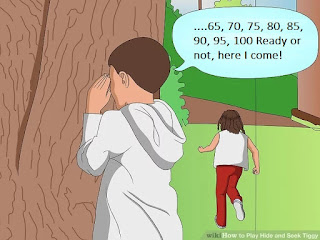
Kham bak chieu or hide-and-seek.
Adapted from Wikihow graphics
THE LARGE field at Westlands Primary gave us a lot of options for play. Football was the official favourite; then there were those for the masses – games that needed few or no equipment, or delineated space, and all could join in. I am referring to mata chat, chiak bak and kham bak chieu (or hide-and-seek).

Mata chat

In mata chat (cops and robbers) we had two teams that were picked via a ritual using two 14-syllable Hokkien rhymes. The selection process started with forming a circle. A leader would start to chant “chui lo chui lo, chui peng peng, chui chui chiak pah cho lang peng” (to select a mata or cop although the peng meant soldier). He would begin the first syllable by pointing to someone and moved to next person with each consecutive term. Somewhat like musical chairs, the person who ended up with the 14th syllable (say, peng) became the cop. To pick a chat or robber, we recited “chui lo chui lo, chui chat chat, chui chui chiak pah cho lang chat”. This would go on until two teams were selected.

There was little correlation between these rhymes, well-known for their fun, frivolity and humour, and the game itself. Roughly translated, the sayings ended with “whoever has eaten a full meal became a cop or a robber”. I had forgotten all about them until I was reminded by Kay Liang and Ong Seng Huat.

Each team had a set of objectives:
  • The mata had a station where they kept all the chat they had caught. Their aim was to chase and catch as many robbers as possible and keep them at the station — it could be by a wall or at a porch for cars. In our case, the wall of the secondary school workshop facing the field served us well; it was strategic and provided some shade from the afternoon sun.
  • The chat, on the other hand, aimed to avoid being caught. They also tried to rescue their comrades from the station. A mere touch of hands by a free team mate allowed any captured chat to run off.
Shirts could be torn in this game where the end-game (with cops capturing all the robbers) was seldom ever reached because of the short time we had during breaks or before and after school.

Chiak bak (literally “consume meat” or, more generally, “inflict pain on the flesh”)

This sado-masochistic game, which could involve groups of 20 to 30, needed only a tennis ball – hard enough to inflict pain but not terribly harmful if we did not hit sensitive parts of the body like our eyes. The objective was straightforward: When you got the ball in your hands, re-direct it at another, to hit him as hard as possible.

The game started with a boy throwing the ball into the air, to be caught by another who would then try to hit someone else. Once you caught the ball, you cannot chase after others with it. One of the most dangerous situations was to find yourself right next to person who had caught the ball. You could try to wrestle the ball from him or curl up like a ball [sic] on the ground and take a hit.

Kar Keat remembers a tactic in which a group would pakat (make a pact): “It was used normally by a small group to bully others. They would form a pact prior to the start. In the game, they would fan out among the crowd of players. When one member got the ball, he would toss it to a partner who was in close proximity to another to cause maximum damage. Many a time they targeted people they wanted to bully.”

On rainy days, when the grounds were moist and muddy, the tennis ball soaked a lot of moisture, resulting in 3-4in mud marks on our white school shirts. It was a sure way of getting a scathing response from our parents when we got home.

Kham bak chieu

The basic kham bak chieu (literally “closed eyes” or, in English, hide-and-seek) was simple. One person closed his or her eyes leaning against a spot on a wall or tree, and counted — sometimes in multiples of five (5, 10, 15 and so on) to, say, 100. In the meantime, the others, which could number more than 10, went into hiding. Upon finishing counting, the “seeker” went around to look for the “hiders”. The moment anyone was spotted, there would be a race back to the counting position. In this way, groups of winners or losers were separated out. Finally, one of the losers would be chosen to be the next seeker. The selection process could involve lalalilatampong or one-two som! (these will be the subject of another story).

Another name of the game was ah chi lok. If I recall correctly, there was a slight variation in the version we played in our community; it involved a chase where the seeker had to chase and grab hold of a hider to pick the next person to seek. Like other traditional games, we could vary the rules as we we went along so it was not unusual to find differences among groups of players.

At home, we had the night-time variation that scared the seekers out of their wits. There were two instances that I remember very well: (1) Under the camouflage of darkness, some of the hiders would gang up and rush to the counting station in a group and left the seeker aghast at the mob rushing out (2) A darkish friend of mine, wearing dark shorts, decided to remove his white T-shirt. It was almost impossible to spot him until he was 20ft away, by which time it was too late for the seeker, caught off guard and shocked, to race back.

© Lim Siang Jin