Thursday, 15 August 2019

When there's no water, there's no life

Republished from New Straits Times, Aug 15, 2019,
with the author’s permission. Read the original here.
By Yong Soo Heong

“THOUSANDS have lived without love, not one without water”, an American poet once said. But for the Klang Valley, we probably need to raise that figure to millions! That explains the value of water in our lives. After all countries have gone to war because of water.

Malaysians are rather blessed as our country is relatively rich in water resources due to its high rainfall, averaging 250cm or 98 inches, with Sabah and Sarawak having higher amounts, according to the Statistics Department.

As a result of its abundance, we tend to take a lackadaisical attitude towards water, especially in its use and conservation because it’s relatively cheap until a crisis strikes. Like recently when most parts of the Klang Valley were affected by river pollution and supply of piped water was disrupted.

Despite the names of several water concessionaires depicting heartwarming themes of satisfaction and felicitations, the nearly eight million residents in the Klang Valley didn’t actually have a splashing time indeed whenever such disruptions occur.

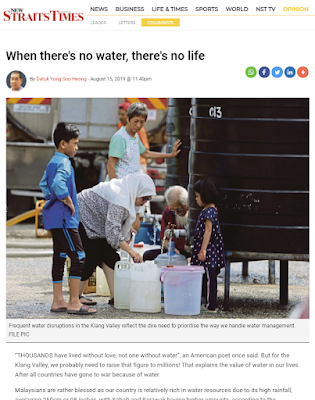
Residents face harrowing times whenever there’s no water to drink, for cleansing or flushing toilets, especially those living in high-rise flats where life is somewhat paralysed. When there’s no water, there’s no life.

The amount of money paid to companies to produce potable water runs into the billions. They include work on infrastructure construction, supply of building materials, pipe-laying and reservoir construction, to name a few. The accent is on infrastructure and very little on proper management if past experiences are anything to go by.

So, we’re still saddled with Third World-like water woes like river pollution as a result of lack of enforcement. Consumers often wonder what safeguards have been put in place by these big water management companies.

Like the recent water cuts, said to be due to sudden river pollution and possibly by saboteurs. So far, we’ve not heard whether the culprits had been apprehended. Amidst the lull, we often tend to forget about those bone-dry water-less situations until the next water disaster strikes.

These disruptions have been happening too frequently. One exasperated consumer with an oil and gas company on the outskirts of Kuala Lumpur says saboteurs ought to be whipped for the misery they’ve inflicted on millions of people. Pollution must be regulated, monitored, controlled and enforced, she said.

Another dismayed consumer from Ampang, fuming over the on-off scheduled water cuts in July after the long four-day water disruption last April, describes the picture of scores of consumers lining up to fetch water from tankers for their daily needs as being more reminiscent of a Third World country struggling with basic infrastructure rather then one heading towards a Vision 2020 dream of becoming a developed nation!

The people behind the water business have described the industry as big. And many want to have a slice of the business. But it’s sad that people think it’s just about drawing water from the rivers, getting it filtered, treated and then piping it to consumers. That’s only one thing.

A more precarious and dangerous scenario is that many of the water concessionaires have their sources of water located near human habitats. Anything can happen in view of the proximity. I wonder when we will ever move up the value chain in terms of better water management.

Dr Xavier Jayakumar, the Water, Land and Natural Resources Minister, said recently that the country’s water industry is in dire straits. A grim assessment indeed.

Although some water concessionaires appear to have that “money or nothing” attitude, it’s time for his ministry to co-ordinate with relevant stakeholders and wield the big stick.

Some non-governmental organisations claim that they’ve heard the same lame excuses being produced whenever there’s a water crisis. It’s high time that these Third World excuses are banished into the ocean.

Malaysia is expected to see its water resources reduced by 20 to 25 per cent between 2025 and 2030. And Dr Jayakumar says despite the looming threat, the country’s water industry is not yet equipped to effectively address the water shortage.

He needs to identify what are the shortcomings so that people in the water business would buck up. By exposing their inadequacies, we as consumers will know where to pinpoint the source of our discomfort should another water crisis erupt.

This brings me to my main point: there’s a need for better water management — 360 degrees in all from water collection, filtration, treatment, distribution and sales.

We need to be cognisant of the current disincentive where people don’t treat water with greater respect because tariffs are relatively low. When tariffs are low, we tend to waste water needlessly. According to an old adage, people won’t know the real worth of water until the well is dry.

Getting people to have access to clean water calls for big investments. It’s not a small business. But the money expended for such endeavours must be well-spent.

We also ought to get tough with businesses so that they won’t argue that higher water tariffs will reduce them to poverty. We can tell them that they still get to drive their flashy limousines but they too must pull their weight and shoulder the responsibility for better water management.

We need to be resolute on this as we have heard plaintive cries from businesses whenever the government wants to raise electricity tariffs or push for greater automation. This has been going on for decades.

One environmental activist who had been hearing excuses for yonks has suggested that when the next major river pollution crisis occurs, the officers in charge of environment in that area should be arrested first for dereliction of duty.

Then the state exco member and federal minister in charge should also be shown the door. It might just work, he says.

  • Datuk Yong Soo Heong is a former chief executive officer and editor-in-chief of Bernama. Read more about him here

Wednesday, 3 July 2019

The elderly need a more efficient support system

Republished from New Straits Times, Jul 3, 2019,
with the author’s permission. Read the original here.
By Yong Soo Heong

MOST MALAYSIANS are proud of the fact that we have a 94-year-old prime minister who travels far and wide at a punishing pace to give noteworthy speeches or media interviews, makes his views known to other leaders or just to witness something useful.

Tun Dr Mahathir Mohamad is a man in a hurry, always yearning to accomplish many things for fellow Malaysians. He’s definitely the only senior in the 90-plus bracket in our country of 32 million, still relatively healthy, mentally alert and working hard, putting many younger people to shame.

Many of his schoolmates and friends would probably have retired. But Dr Mahathir is the exception to the norm — true to the adage that age does not matter so long as the matter does not age!

The same, however, cannot be said for many other seniors in the country. Granted, Dr Mahathir may be aided by a retinue of aides looking after his needs so that he can execute things judiciously at the highest office, but not everyone who has aged would have the privilege of such assistance or the physical and mental make-up. The elderly in the country certainly need a more efficient support system.

With a fast ageing population, the question of who cares for our senior citizens is becoming increasingly crucial. Malaysia’s life expectancy has been rising. Life expectancy at birth in 2015 was projected at 72.5 years for males and 77.4 years for females.

Do we have plans in place to train more people to properly care for the elderly? Where do the elderly turn to if their offspring or relatives are unable to care for them? These are pressing issues which the government has to act on if nothing yet has been done. Gerontology has to be put into sharper focus if we’re to address the well-being of the elderly.

It’s especially compelling for those in the M40 and B40 categories while those in the T20 or with large extended families would have the luxury of caregivers, either in the form of employees or enlisted relatives.

A case in point is someone I know in the public relations industry: Ron is pushing 64 and still unmarried, although he plans to do so soon with the love of his life from Germany. He still has to work and care for his mum in her 80s. But finding the place with the right geriatric care is like looking for a needle in a haystack.

Many have lamented that most so-called geriatric care centres or nursing homes are no more than places for their operators to make big bucks. All they have to do is find a big enough accommodation with beds, television sets, toilet facilities, some able-bodied helpers and a cook or two, and they are in business! Some even equate the vastness of their premises and facilities with top-notch caring capability. But the truth is far from reality.

Fees are hefty and range around RM5,000 a month in Kuala Lumpur and Petaling Jaya. Some who can only afford to spare RM2,000 a month say they’re often in a lurch.

This brings to mind what prominent Malaysian economist Dr Jomo Kwame Sundaram opined two years ago after the Employees Provident Fund (EPF) revealed that about 70 per cent of members who withdraw their funds at age 55 use up their savings less than a decade after retiring. This meant that most EPF savings were not enough to stay out of poverty after retirement, he said.

With 69 per cent of our population of “working age” between 15 and 65, only 48 per cent of the labour force of 14.5 million have active EPF accounts. In 2017, EPF raised the minimum savings target by age 55 from RM197,000 to RM228,000.

But Jomo says that only 18 per cent of members have that much savings, far short of EPF’s target of getting at least half its members to meet the minimum level by 2021. Low investment returns and withdrawals permitted — for housing, health and education — imply even less for retirement.

More than two-thirds (68 per cent) of EPF members aged 54 had less than RM50,000 in EPF savings! Jomo says with the household poverty line income at RM930 monthly, RM50,000 in savings will last only 4½ years. The bottom fifth of EPF members have average savings of only RM6,909!

An exasperated Ron says that despite the hefty fee, the service leaves much to be desired, especially in terms of giving proper exercise to prevent the onset of dementia. He bemoans the lack of focus and enforcement on nursing homes for senior citizens.

If the government has given focus to the kind of training that kindergarten teachers must have, it’s high time that it also paid attention to the other spectrum of the population: the elderly.

Now that we’ve restarted the “Look East Policy”, perhaps it’d be pertinent to look at Japan’s widespread respect for its seniors and a powerful obligation to care for them. With changes to Japan’s demographic structure of society, caring for the elderly is increasingly seen as a social, and not exclusively family concern, according to Iza Kavedzija, an anthropology lecturer at the University of Exeter.

We ought to appraise Japan’s Long Term Care Insurance (LCTI), designed to provide cover to all those over 65.

The LCTI is one of the most comprehensive social care systems for the elderly in the world, aimed at reducing the burden of care on families.

With adequate funding, the market for providing proper geriatric care can perhaps be properly undertaken along with the creation of clear and consistent rules and roles as well as training for caregivers, operators of nursing homes and even the informal networks of volunteers.

  • Datuk Yong Soo Heong is a former chief executive officer and editor-in-chief of Bernama. Read more about him here.


Wednesday, 1 May 2019

Flash back to school

TEOH SOONG KEE is a specialist doctor – an obstetrician – working in a private hospital in Ipoh. He has been there for decades, and often taking pride in the fact that some of the babies that he delivered were now grown-ups and turning to him to deliver their own. But Soong Kee, for all his settling down in Perak, was a product of three schools in Penang: Wellesley School, Westlands School and Penang Free School. Several years ago, he wrote a book, Young Emotion, in which he recalled his schooldays through poems, articles and short stories. Here is one of them.
Both my parents came from China. My father had three years of schooling and could just read the newspapers while my mother was illiterate. I never attended any kindergarten. Yet, schooling in Penang, especially in the Penang Free School, gave me a strong foundation for the years ahead.
Wellesley — Good conduct? 
When I went to Primary One in Wellesley School in 1953, I could not speak more than three words in English. The first words we had to learn were “Teacher excuse me” when I wanted to go to the toilet. However, I was good in arithmetic, perhaps from my coffee shop environment. Within a week, I was given some sums to do, and then I was transferred to Class 1D which was a double-promotion class. We had to do three years work in two. Not surprisingly, I was in 26th position in the first year, but I managed to rise to 10th position in the second year.
I still remember some of my classmates like Tan Poh Seng, Lim Eng Hong, Lee Chaing Hin and Chew Gim Hye. Later I found out that Teh-Tiong Sa was also my classmate then. I nearly got the prize for Best Conduct, but it went to Lim Say Kwee, whom I believed was the nephew to the headmaster. Our class teacher was a Eurasian, Mr Johnson. My mum would give me a raisin bun, a milk drink and ten cents for refreshments during recess. I remembered envying the other schoolmates who could go inside the tuck shop for noodles and ice-cream. Occasionally, a school boy would sell me his coupon for ten cents. It was a treat for me!
Each week, the dental nurses would come to our class to check our teeth. Unlike most pupils, I looked forward to the trip to the dental clinic as I had a pretty-looking dental nurse attending to me. I had not reached puberty yet so there was no erotic fixation! She did an excellent job and kept most of my teeth intact (with the black mercury fillings) till today.
Westlands — General knowledge prize! 
After two years, all of us were transferred to the feeder schools such as Westlands, Francis Light and Hutchings schools. While Wellesley School was only a five-minute walk from my rented room in Swatow Lane (famous for the New World Park ice kacang), I had to sit in a trishaw for a 20-minute ride to Westlands School. The fare was only $3 per month, but sometimes we had to cram six children in the trishaw. 
Since we were from the express class, we went straight into standard 4E. I had chicken pox during the mid-year test and attained 24th position in the class, but fortunately I improved to 5th place by the end of the year. I did better in the next two years, achieving within the top three positions. In Standard Five, I obtained 100 marks in four subjects, and that was in the days when it was not common to get such high marks. There was a special General Knowledge test in which I managed to win the prize. I chose a book titled “100 Great Lives” which is still in my possession. We had to sit for a statewide Form One entrance exam to stream the students to the secondary schools. The top 200 boys would enter Penang Free School. I managed to be the top student from Westlands but was beaten by a few others from Francis Light School including Dennis Lee. 
I was among the shortest kids in the standard. However it was an advantage for me as the children were grouped in four classes within the games houses according to height and not to age. So even when I was in Standard Six, I was placed in Class III, mixing with the younger students. I was even made Captain of the Class I football team! In Standard Five, I was called up to see the headmaster, once for talking during assembly and on another occasion for “fighting”! I remembered that I was in the same group with Oh Siew Leng while Ong Tat Teik was in the rival group. 
We used to have drama lessons every other week. I was rather enthusiastic and remembered how melodramatic I would be, playing the different roles in the sketches. In 1957, the year of our Independence, I was selected to be the voice of one of the characters in a puppet show at the combined schools concert. I acted as a Malay boy and I had to shout “Merdeka” three times in the closing scene. 

Penang Free School

I entered PFS in 1958 in Form 1A under Goh Teong Chye as our form teacher. He would ask all the students to contribute 20 cents per month to buy the daily newspaper, which he would read first. The next day he passed the papers to us to cut out the highlighted news for display on the notice board. I nearly won the prize for National Language (Malay language for the non-Malays).

The Malay boys were not eligible as they had to sit for the Bahasa Melayu test. However, Jammal claimed to be eligible, being an lndian Muslim, and he beat me by two marks for the National Language prize. One morning at the end of the year, there was singing in the class. I remembered singing a Russ Hamilton song “Tip Toe through the Tulips”, but received a lot of laughter. I had mispronounced the words as “Chip Choe through the Chulips”! The best singer that day was Ong Hean Beng. 

The next year in Form 2A, we were under Mr Cheng Hin who had just returned from Brinsford Lodge Teachers College in UK the year before. He was very enthusiastic. At the beginning of the year, he announced that the class project would be to produce a magazine. This was unheard of for such a junior class. However, we did produce the cyclostyled magazine and sold it for 20 cents. In the magazine, there was a quiz which we could send in the answers to him during the school holidays. I got the prize, as apparently I was the only one to mail in the answers. Knowing my interest on the stars, he gave me a book on Astronomy. I managed to achieve 4th position in the whole form, but the Form Teacher’s remarks on my report card were “good but rather playful at times!” 
Somehow I did not remember much about my Form 3 year except that we all had to study hard for our LCE (Lower Certificate of Education). In those days, with an LCE, one could join the government service as a policeman. I was second in the form for the school exam and obtained five As and two Bs in the LCE. 
With my marks, I was placed in the Form 4 Science class. Usually the top 40 students were streamed into the Science class but there were a few top students like Iyer (now Sulaiman) who did not like Science and went to Form 5A. We had to study three science subjects and two mathematics papers. We were glad that History was dropped. Dennis came to 5 Science but was allowed to sit for two science subjects as he took music as an examination subject. Several of us would cycle to Dennis home in Mt Erskine, especially when the rambutans in his garden were ripe. We produced a class magazine which we called “The Mad Mosquitoes”, an unusual name with no apparent reason! 
I managed to do well in Forms 4 and 5, being in 3rd and 5th in the forms respectively. For my Cambridge School Certificate (sometimes called Senior Cambridge) I obtained seven As out of eight, together with Tan Poh Hwa and Koe Chong Aun. I only got a Credit for my English Language but got a distinction A1 in English Literature! Thanks to Mr Bennet who helped us enjoy English poetry written by Keats, Shelley and Byron and even Shakespeare’s “Twelfth Night”. “If music is the food of love, play on!” We just have to pass the national language to qualify for the Malaysia Certificate of Education (MCE). We had to sit for the Sixth Form Entrance exam for eligibility to enter Form Six in January, as the SC Exam results would only come out by March. I was thrilled that I obtained the second highest marks in the state.
Tuition 
I never had tuition in all my school years. My parents could not afford the fees even though they were just about ten to 20 dollars a month. It was a credit to our teachers who taught so well, that tuition was unnecessary. Perhaps our parents were not so kiasu then. The only time when I needed extra help was in Bahasa Kebangsaan. So in Form Five, I enrolled in the evening classes held at Hu Yu Seah night school for just three dollars a month. We were even given a certificate after attending the weekly classes for one year. 
Some of us would meet in one of the homes to study together. More often, especially for those of us who lived in crowded homes, we cycled to the Penang public library to study and consult the reference books such as the Encyclopedia Britannica. We did not have internet Google then!
Teachers 
We still remembered some quirks among our teachers. Lee San Hoe was very superstitious and would become very angry when he saw two white chalks upright on the table. Another teacher Tan Ah Fee would sing out loud “la la la Speedy Gonzales”. Captain Mohd Noor (who used to be in the army) would ask us “how many gantang” when we returned from the toilet. His favourite suit was pink in colour. He also kept his shoes shining bright – some claimed that he would place his shoes under a lady’s skirt! He was particularly stern with the Malay boys. Another Malay teacher, Iskandar, was rotund in size but was very kind and friendly, offering to give free tuition in his home. Our first Malay language teacher was actually a Chinese, Beh Teik Chooi, who had remarried to a Malay lady. He was fond of telling us stories from the Japanese occupation. One teacher would teach us by making us spend the whole period, copying notes which he wrote on the notice board. Ambrose was the earliest to arrive in the school and the first to make announcement during the Monday school assembly. Our Form 4 PE teacher, Teh Keng Chooi, did the unusual, by getting our class photograph taken without our shirts, exposing our scrawny chests! 
Another teacher Khoo Tiang Lim claimed that he did not use soap for bathing, as it might wash away our natural body oil. KTL said to Wee Kyam Hooi, who often made humorous remarks in class, “you are allowed only one joke a year!” Our Biology teacher, Lee Eng Leong, corrected us when we used the word “hole” for the female organ. He insisted it was a “slit”. There was a very fierce teacher Teoh Cheng Hai nicknamed “bulldog”, but he was actually quite pleasant if we worked in his craft class on Saturdays. There were very kind teachers, but there were some who would throw chalks or even the wooden black board dusters at us. We also had our first lady teacher, who came as Miss Tan Cheng Ee, but later disappointed some of us when she became Mrs Oh Eu Kok. We used to make fun of her by sighing “OOOOOh...” Then we had an English retired army major, Edwards, who taught us Physics. His army discipline included a long ruler but tempered with gentle “Oh dear dear dear...” when we gave the wrong answers. 
One type of punishment imposed by many teachers in the lower forms was to make us write repeatedly, for example “I must not eat in class” or “I must not be late for school”. If we were asked to write 10 pages, our writing would be extra large but if we were to write the same sentence 100 times, we would squeeze the 100 lines on one page. On one occasion, we were asked to write the sentence “I must put a full-stop at the end of the sentence.” But a number of us forgot to put the punctuation at the end of some of the lines! C Ponniah would punish by asking the student, in his shrill Tamil accent, “Be mounted”, that is, to stand on the chair. 
Sports 
There were many opportunities to take part in sports and games. Every student learned how to play football, cricket, hockey, badminton and rugby, in rotation throughout the year. Tennis was more for the richer kids. We even had Additional Sports Day where every student had to take part in the  100 yards, 400 yards, high jump and long jump. Points were given for each student who achieve the qualifying standard that was decided according to the age group. I was able to get all the four points, just managing to clear the qualifying standards. One year, I was sick and could not take part. My house (Pinhorn, blue colour) lost the championship by two points! If I had been well, Pinhorn would have won! I was not good in sports but managed to represent my House in football, cricket (but never scored a run) and debate. 
School activities 
In the upper forms, we had to come back to school twice a week for two lessons, followed by extra-curricular activities which could be scouting, cadets, or band followed by games. There were many clubs and societies to join, from Science and History to Music and Drama, Photography, Gardening and Art and Craft classes. There were no religious or cultural societies then, although there was an informal gathering of Christians during the recess once a week in one of the teacher’s houses in the school compound. Dennis used to invite me to join them. On other days, a group of us grouped together during recess to share Smarties sweets, to be purchased by one boy in rotation. 
I took part in the Stamp Club, Craft Class, Science Society and the Music and Drama Society, Historical Society (it made interesting trips) and the National Language Society. For one whole year I was forced to join the Scouts, but I was not interested. I did not wear the scout uniform. However, I passed the Tenderfoot test and enjoyed the camping and hiking trips. 
In Form Lower Six, I was Science Editor for the Outlook magazine but in the following year I was asked to be sub-editor of the School Magazine by Yeo Guan Teik. In those days, we had to type the articles on the typewriter, and the printer used individual metal letters to set the pages. We often had to check the proofs again and again till the wee hours of the night. Even though I was a novice photographer, I managed to capture some images of memorable events, which were included in the school magazine. We started the first PFS Newsletter, a bi-monthly newspaper, but were asked by the headmaster to hand over to another editorial board headed by Srinivasa Iyer. 
The Sixth Form Recreational Activities (SFRA) was formed for those Six Formers who were not involved in any uniformed group or school sports teams. We played the miscellaneous games such as netball (the boys enjoyed playing with the girls, much to the horror of Ambrose), volleyball, table tennis and folk-dance! As chairman of SFRA, I was given the privilege to learn the new game of softball and even became an instructor (at least on the theoretical aspects). 
When we went into Form Six, we faced a different world. There were girls admitted to our class. There were not so many in the Science classes as in the Arts classes, but least most of the Science girls wanted to do Biology rather than Mathematics. The boys had to learn to restrain their pranks and jokes and show chivalry. At the end of the year concert, our Form 6 Sc Class entered a team of four boys and four girls called “Battle of the Sexes”. They sang a couple of humorous songs, (with lyrics adapted by me) entitled ”Woman is Fickle” against ”Man is Flirtatious”. One of the memorable lines was Poh Hwa who sang, “When will you be mine” and Ee Looi replied, “If you got the money, honey, I’ve got the time”! We won the Prize for best group performance!

Saturday, 27 April 2019

Sustaining the right quality of life for individuals with challenging needs in ageing

The elderly: Caring for them can be a viable
industry with expanding job opportunities. 
Source: Johannes Jansson, Wikimedia Commons 
 
By Teoh Ai Hua, Jim Lim Teik Wah & Dr Thomas Khor

MANY ELDERLY people, suffering from age-related disabilities, some of which are substantive, rely exclusively on family members and close community organisations to help tend to their daily needs and well being. A significant number will continue to remain in their own homes and live with their family members. However, it is not uncommon, judging from media reports, that many older people are neglected, living out their twilight years in miserable circumstances or in situations of severe indifference within their households. There have been cases of abuse too. This paper aims to highlight key responsibilities that the government should assume in improving the support and care services for the elderly, including ways to encourage and facilitate new “service providers” to address the needs of this growing vulnerable population. This paper argues that these measures, when comprehensively put in place, will expand and improve services as well as develop the social care industry as a viable sector for new job creation. More importantly, we believe it will eventually lead to improving and sustaining the quality of life for older people living in the community.

  • Teoh Ai Hua is Senior Lecturer, School of Applied Psychology, Social Work and Policy, Universiti Utara Malaysia
  • Jim Lim Teik Wah, Former Director of Social Services in the UK
  • Dr Thomas Khor, Managing Director, Home MediCare, Penang
  • This paper was presented at International Social Work Symposium organised in collaboration with a number of universities and the Malaysian Association of Social Workers (MASW), April 27-28, 2019. Read here.
This is the full paper (3,200 words in all):

INTRODUCTION

Malaysia is estimated to become an “aged” nation by 2030 when 15% of its population will be over 65 years old (United Nations, 2015). The majority of older people will be living with and cared for by their families. In Malaysia, it has been reported that between 60% to 70% of the older persons live with their children or extended family (Pala, 2005; Hamid, 2015; Kooshair, Yahaya, Hamid, Abu Samah and Sedaghat, 2012). While living with their children does not imply dependency on the part of the older persons, there are differences between the main carers for older men and older women. Older men normally rely on their wives and/or daughters while older women rely mostly on their children only (Hamid, 2015). However, the biggest challenge for most families is coping with the care-giving burden for older persons with certain degree of dependency due to frailness or dementia (Choo et al., 2003; Nikmat, Howthorne and Al-Mashoor, 2015)

It is not uncommon to read in the media about older people being neglected, living out their twilight years in miserable circumstances or in situations of severe indifference within their households. The burden of care on caregivers may lead to the abuse of the elderly (Choo et al., 2003). One particular research has shown that 26% of the respondents (older persons) have experienced at least one incident of abuse, with emotional abuse being the most prevalent (Hamid, Abdullah and Yahaya as cited in Hamid, 2015) yet the health professionals demonstrated poor understanding of signs of elder abuse and neglect (Ahmed et al., 2016). Nevertheless, the absence of data on such matters in Malaysia is an indicator of low awareness and priority of the subject matter (Hamid, 2015).

Past research in Malaysia have also focused on the quality of life of older persons in institutions or at their own home, the burden on caregivers, and nursing care and social care services (Aziz and Ahmad, 2017; Choo et al, 2003, Nikmat, Howthorne and Al-Mashoor, 2015, Tey et al, 2016). One report pointed out that having a maid or providing nursing care for the elderly living with their families may not reduce the burden on the caregivers (Choo et al., 2003). However, most were focused on the public sector perspective, and not much has been written on social care services provided by  independent players or the private sector where the elderly or their caregiver can pay for services as an option of care. There is certainly a need for care services for those who can afford to pay for them.

METHODOLGY

The growing population of older people can have a major impact on health and social service provision, including social care. The repercussions, both social and economic, will be major and far reaching if resources are not planned or distributed properly. Some questions that need to be addressed are:
  1. Who can older people with challenging needs (and their families) engage, if they can afford paid home help services?
  2. Are these services available?
  3. Are these services regulated?
  4. What are the qualifications of the caregivers or care workers, if available?
  5. What can the government do to ensure quality and availability?
This paper aims to examine the existing ecosystem of social care services, relevant legislation and training programmes for elderly care in Malaysia. At the end, several recommendations will be presented and implications for social work practice will also be discussed. 

FINDINGS

THE PRESENT SCENARIO

(1) Underdeveloped social care services for elderly care

In general, social care services for the elderly provided by the public sector, i.e. the Department of Social Welfare, can be divided into three types, namely, (i) cash and in-kind benefits, (ii) institutional care, and (iii) home care (Hamdy and Yusuf. 2018). However, the government direct services (provided by its own welfare officers or assistants) are mainly from category (i) and (ii), while home care services are indirect services where the government giving funding to non-government organisations and volunteers to run free home help programmes, activities centres (e.g. Pusat Aktiviti Warga Mas, PAWE) and transportations services (e.g. Unit Penyayang Warga Emas, UPWE). The volunteers involved in home help programmes are mainly retirees or old persons themselves, and the service is still limited to a few areas. As at March 2017, there were 2,150 volunteers providing services to 5,892 older persons (Mohd Salleh, 2017).

The health service also provides care services for older people in the form of outpatient care and hospitalisation. Although there are more private hospitals compared to public ones in Malaysia, over 70% of all admissions are to public hospitals where older persons make up over 20% of the total admissions (Tey et al., 2016).  However, the health service also faces limited resources and they are not able to provide a continuum of care including home care, day care and respite care (Ambigga et al., 2011).

As a result, scarce medical resources may be directed inappropriately. One example is the need to care for older people following admissions via accident and emergency facilities, resulting in what is termed as “bed blocking”. Many hospitals are facing difficulties in discharging these people, sending them home. This is mainly due to the lack of supporting services in the community.

In addition, most of the services provided by the voluntary and private sectors are residential homes (free or low fee) or nursing homes (more expansive). They do not cater to the needs of older people who want to remain at home. In essence, services for older persons with challenging needs who live independently or with their families are rather limited. 

Due to an under-developed aged care infrastructure, many private unlicensed residential homes have sprung up, especially in big cities, to meet the demand. There are glaring examples of such establishments operating without due regard to safe environment or operating safeguards despite the existence of the Care Centre Act 1993 and the Private Aged Healthcare Facilities and Services Act 2018 (Serving seniors requires passion, 2019: para 9). Stories of elder abuse are not uncommon. Other problems include inadequate staffing ratio, depersonalised rooms and unattractive environment and sometimes, they use public hospitals as dumping grounds for residents they are unable to care for.

(2) Undefined qualification of caregivers under existing legislation on elderly care

Offering shelter and care on a commercial basis and operating at standards as yet  undefined or unquantifiable, the care facilities have left many elderly people at some risk. This problem is compounded by the lack of choice. Although the Care Centre Act 1993 and the enactment of the Private Aged Healthcare Facilities and Services Act 2018 have provisions for the government to regulate the service providers in terms of number of residents, staff-resident ratio, health and safety measures etc, monitoring and enforcement remain wanting. 

Moreover, the qualification requirements of staff and care workers remain ambiguous. For example, Section 7 of the Care Centre Act 1993 gives power to the Director General of Social Welfare to impose conditions for registration yet it was undefined when comes to qualifications of persons employed as in 7(b) and 7(c), and without additional schedule or by-law:
“7(b) to ensure that any person employed at the care centre, whether in its management or otherwise, is a fit and proper person, whether as regards age or otherwise, to be employed at the care centre; and 
7(c) to ensure that the care centre will be adequately staffed by a sufficient number of persons with suitable qualifications or experience.”

On the other hand, the Private Aged HealthCare Facilities and Services Act 2018 defines caregiver as “anyone, other than health professionals, who provides personal care to any care recipients” and all licensee of healthcare services must ensure that caregivers are trained and competent (Section 20(b)) and the training of caregivers in basic life support (Section 26(4)), and the licensee can be revoked of his or her license if the licensee employs unqualified person as a caregiver (Section 30(e)). However, it only spelt out healthcare services provided by health professionals and para health professionals (Schedule 1) and qualifications of those healthcare professionals that are currently being regulated by legislation (Schedule 2). Again, no specific qualifications are mentioned for the caregiver.

While nurses are seen as qualified in providing nursing care, experience on the ground has shown that many of the elderly who require home care services may not need nursing care all the time. Research has also shown the importance of social support in achieving better quality of life for those living at home (with proper support) in comparison with those at nursing homes (Nikmat, Howthorne and Al-Mashoor, 2015). The role of caregivers must be valued and their capacity must be enhanced.

(3) Underdeveloped and unregulated training courses for caregivers or care workers

Currently, only one university, Universiti Putra Malaysia, offers a postgraduate programme in gerontology. It does not address the needs of trained care workers. Such needs are normally not addressed at the tertiary level (Hamid, 2015). The National Council of Welfare and Social Development Malaysia (MAKPEM), in collaboration with the Open University Malaysia (OUM), has offered a Professional Certificate for Caregiver which is a 16-module programme (MAKPEM, 2014). However, only one module is on elderly care. The MAKPEM-OUM Professional Certificate serves more as a self recognition for NGO workers. It is not accredited by the Malaysia Quality Agency (MQA). It is also not getting any recognition from the underdeveloped social care sector.
 
Seeing the lack of training and recognition of qualifications in the social welfare sector, the Department of Social Welfare has actually started an initiative to develop relevant training and standards through the National Occupational Skill Standards (NOSS) framework several years ago (Jabatan Pembangunan Kemahiran, 2016). Elderly care (27.4) is placed under Sector 27 Care and Community Services, and three (3) levels of NOSS have been identified: 
  • Level 3: Elderly Care Centre Operation
  • Level 4: Elderly Care Centre Administration
  • Level 5: Elderly Care Centre Management
From the titles given, it seems that the skill standards set for the three (3) are meant for operators or managers of care centres, and not so much for caregivers or care workers. The latter needs Levels 2 and 3 competencies in providing direct care and support for the elderly. In Australia, one needs a qualification in Certificate III in Individual Support (Ageing, Home and Community) to become an aged care worker (www.opencolleges.edu.au). In the United Kingdom, it has set standards at Level 2 and Level 3 Diploma in Health and Social Care (Adult), as well as up to Level 4 Diploma in Adult Care that can be offered through many accredited institutions like City and Guild (www.cityandguilds.com).

In this regard, Malaysia has no social care qualifications set at Levels 2 and 3, the nearest equivalent would be the Professional Certificate for Caregiver by MAKPEM-OUM. Its relevant standards and competencies have yet to be examined and accredited by a regulatory body. 
 
(4) Historical and cultural factors

In Malaysia, as in many other Asian countries, looking after elders is a family duty. It is very difficult to send an elderly person to a residential care home. This familial responsibility is prevalent amongst all the races. Nevertheless, modernisation trends and societal changes are altering mindsets. Lower fertility, higher rates of childlessness, and increases in the number of divorces and people remaining single, have all contributed to a shrinking pool of potential care-givers within the family setting. 

Care for the elderly could be headed for a crisis in terms of the availability and accessibility of essential services. As mentioned earlier, services outside the family remain fragmented. They are also of varying quality and scattered inconsistently across the country. Many families now use foreign domestic helpers as “caregiver”, adding onto their other job tasks. Many of these helpers are not trained or properly compensated, resulting in the elderly person making do with a second rate service.

RECOMMENDATIONS AND IMPLICATIONS

The roles of the government

The government should undertake to improve support and care services for older persons, including ways to encourage and to facilitate new “service providers” to address the needs of this growing vulnerable population. These include:
 
(1) Developing a more active and diversified social care sector

This can be done by generating conducive conditions including developing business-friendly policies in the social care market that encompasses a mix of service provision by the public, private, non-profit and voluntary sectors. This diverse care provision, offering a range of care to meet different needs will be able to offer “choice, appropriateness and sensitivity” in the light of the country’s multi-diverse communities. 

(2) Setting and regulating standards for practice in social care
  1. Enhancing existing legislation, such as the Care Centres Act 1993, by developing regulatory mechanism that sets standards for practice of care workers and for quality service by service providers. Skills applicable include managing elderly people with sensitivity whilst assisting with all aspects of daily living, hygiene, nutrition, mobility and basic one-to-one counselling. Caregivers would also need to cope with those with multiple medical needs. 
  2. Therefore, we would like to propose the establishment of an Inspection and Registration Unit, within the Department of Social Welfare Malaysia. Its main role is in implementing, safeguarding and protection for elderly people living in residential care. As demand for care-giving inevitably rises, the unit must also have adequate powers to apply sanctions on underperforming organisations and on those who employ untrained staff.
(3) Setting and regulating the training courses in social care
  1. The role of a caregiver or care worker must be a recognised occupation, assuming the status of vocational level standards under the National Occupational Skills Standards (NOSS) framework. These caregivers who are trained would have a recognised certificate which they can usefully take with them to another employer, an individual, a family or a residential home. In this regards, the Department of Social Welfare may seek to appoint established educational and training institutions to approve courses. 
  2. Training and accreditation must follow and further education providers must be encouraged to provide basic short courses, encompassing syllabus which are fit for the purpose of individual care-giving. (There are any examples of such courses run in developed countries). Educational pathways should be created for qualified caregivers to pursue more advanced professional qualifications at the tertiary level when they want to move up in their career.
  3. It is important to note that setting training and practice standard as well as creating occupational pathway for caregivers is to get more locals into the social care sector instead of relying on foreign workers or maids to look after the well being of older persons in the country.
(4) Establishing a Commission for Social Care
  1. The government may not regulate social care qualifications through enacting legislation like how the health professionals and para-professionals are being regulated. However, the government can set up a Commission for Social Care as a national body for all forms of social care, so as to (1) ensure that standards are maintained, (2) regulate training of social care workers and (3) provide relevant accreditation. The commission will, through regular monitoring and inspections, ensure that providers undertake service quality improvements. 
  2. Before setting up such a commission, the government may prepare a consultation paper for the care of elderly people and adults with disabilities and should review all current services for elderly people with a view of implementing positive changes to ensure long term sustainability and to enhance individual dignity and purpose.
Implications for social work practice
When the above suggested measures are in place, and the numbers of qualified caregivers have increased, it can actually help to enhance the practice of social work in the following way:
  1. Assessment and care planning: Social workers will be able to do needs assessment which can be met with suitable services as there will be more resources or choices available for social workers to consider in formulating care plan with older persons. 
  2. Interventions: Besides being able to conduct psychosocial assessment and interventions, the skills and practice standards in social care are essential for social workers who provide direct service to older persons. Even if the social worker is not the key worker to the older person, they would be able to supervise family members or other caregivers of proper ways in supporting the daily living of older persons at home.  
  3. Inspection: This can be the role of the social workers in the Department of Social Welfare to ensure quality service delivery by trained caregivers or care workers in institutional or community care for older persons.
CONCLUSIONS

Our elders deserve more and should not be discarded once their working lives are over, as they are entitled to continuing support, care and love for as long as their bodies and mind can sustain them. With great shifts in attitudes and an accompanying increase in recognised community of caregivers, the quality of existence of elderly people will be immeasurably enhanced. This is without a shadow of doubt. We owe it to our elders.

REFERENCES

Ahmed, A., Choo, W. Y., Othman, S., Hairi, N. N., Hairi, F. M., Mohd Mydin, F. H., & Illiani Jaafar, S. N. (2016). Understanding of elder abuse and neglect among health care professionals in Malaysia: An exploratory survey. Journal of Elder Abuse & Neglect, 28 (3), 163-177.

Ambigga, K.S., Ramli, A.S., Suthahar, A., Mohd Tohit @ Mohd Tauhid, N., Clearihan, L., & Browning, C. (2011). Bridging the gap in ageing: Translating policies into practice in Malaysian primary care. Asia Pacific Family Medicine, 10 (1), [2]. https://doi.org/10.1186/1447-056X-10-2

Aziz, N.A. & Ahmad, Y. (2017). The quality of life of aging population: a study among older person who received long term care services at old folks home, Penang. Journal of Administrative Science. Special Edition: Socio-Economic Issue, 14 (3), 1-18. Retrieved from https://jas.uitm.edu.my/images/ SPECIALEDITIONVOL3_2017/5.pdf.

Care Centre Act 1993 (Act 506)

Choo, W.Y., Low, W.Y., Karina, R., Poi, P. J. H., Ebenezer, E., & Prince, M. J. (2003). Social Support and Burden among Caregivers of Patients with Dementia in Malaysia. Asia Pacific Journal of Public Health, 15 (1), 23–29. https://doi.org/10.1177/101053950301500105

Gaughan, J., Gravelle, H., & Siciliani, L. (2015). Testing the bed‐blocking hypothesis: does nursing and care home supply reduce delayed hospital discharges? Health Economics, 24, 32– 44. doi: 10.1002/hec.3150

Jabatan Pembangunan Kemahiran (2016). National Occupational Skills Standard (NOSS) Registry. Putrajaya: Kementerian Sumber Manusia. Retrieved from http://www.jkm.gov.my/jkm/uploads/files/pdf/DaftarNOSSversion4Feb2016.pdf

Kooshair, H., Yahaya, N., Hamid, T.A., Abu Samah, A. & Sedaghat, J.V. (2012). Living arrangement and life satisfaction in older Malaysians: the mediating role of social support functions. PLoS ONE, 7 (8), e43125. doi:10.1371/journal.pone.0043125.

Hamdy, M.S. & Yusuf, M.M. (2018). Reviewing on public long-term care services for older people in Malaysia. Malaysian Journal Of Science Health & Technology, 2 (Special). Retrieved from http://mjosht.usim.edu.my/index.php/mjosht/article/ view/49/24

Hamid, T.A. (2015). Population ageing in Malaysia: a mosaic of issues, challenges and prospects. UPM Serdang: Universiti Putra Malaysia Press. 

Hamid, T.A., Za, S. F., Mansor, M., Yahaya, N., & Ali, Z. (2010). Cohort differences in perceptions of elder maltreatment Paper presented at the The South East Asian Conference on Ageing 2010. Grand Millennium Hotel, Kuala Lumpur, Malaysia. Retrieved from http://seaca2010.files.wordpress.com/2010/07/microsoft-powerpoint-perception-tah-sfzaet-al-17-july-2010.pdf

Hamid, T.A. & Chai, S.T. (2013). Meeting the needs of older Malaysians: expansion, diversification and multi-sector collaboration. Malaysian Journal of Economics Studies. 50 (2), 157-174.

Majlis Kebajikan dan Pembangunan Masyarakat Kebangsaan Malaysia (MAKPEM) (2014). Laporan Tahunan 2014. Kuala Lumpur: MAKPEM.

Mohd Salleh, M.F. (2017, March). Ageing in an inclusive society: social support system for older persons in Malaysia. Paper presented at the Senior Official Meeting of the UNESCO Management of Social Transformations (MOST), Kuala Lumpur Retrieved from https://www.kpwkm.gov.my/kpwkm/uploads/files/Muat%20Turun/MOST/S4_ P1_Tuan%20Hj_%20Fazari.pdf

Nikmat, A.W., Hawthorne, G., & Al-Mashoor, S.H. (2015). The comparison of quality of life among people with mild dementia in nursing home and home care - a preliminary report. Dementia. 14 (1), 114-125.

Pala, J. (2005). Population ageing trends in Malaysia. Monograph series, Population Census 2000. Putrajaya: Department of Statistics, Malaysia.

Private Aged Healthcare Facilities and Services Act 2018 (Act 802)

Serving seniors requires passion and purpose. (2019, March 9). The Star On-line. Retrieved from https://www.thestar.com.my/metro/metro-news/2019/03/09/serving-seniors-requires-passion-and-purpose/

Tey, N.P., Siraj, S., Kamaruzzaman, S.B., Chin, A.V., Tan, M.P., Sinnappan, G.S. & Muller, A.M. (2016). Aging in multi-ethnic Malaysia. The Gerontologist. 56 (4), 603-9. doi: 10.1093/geront/gnv153.

United Nations (2015). World Population Ageing Report. New York: United Nations. Retrieved from https://www.un.org/en/development/desa/population/ publications/pdf/ageing/WPA2015_Report.pdf
Looking back and moving forward: Social work in the new Malaysia

The MASW was set up in 1973
almost half a century ago
By Jim T W Lim and Zaharom Nain**

SOCIAL WORK in Malaysia, we will argue in this paper, unfortunately, has not been accorded much credit, even credibility, for many years up until arguably perhaps today. Indeed, since it was formally and legally established in March 1973, and despite its membership of many international agencies, the Malaysian Association of Social Workers (MASW) and its members, and the profession itself, do not appear to be as well understood by the Malaysian public – and possibly even by the government – compared to more “established” professions, like nursing and physiotherapy. It is as if the problems that social workers attempt to resolve are seen either as unresolvable or too petty to entertain.

In this paper, we critically examine this scenario. It is, we argue, a sad scenario that needs to be addressed urgently by the state (government). Malaysia is part of a global system sharing similar socio-economic structures and institutions all of whom result in social problems of varying complexities as each nation in the system seeks to “progress” and maintain their own social sustainability against the pace of rapid development.

Our paper is made up of three parts. In Part I, we provide a “mapping” of social work in Malaysia, outlining its history, development, possible misconceptions, and contemporary concerns and directions. We ask here: Is there really “buy-in” by the various stakeholders? And if there isn’t, why not?

In Part II, we (re)introduce the almost forgotten, yet admirable, Vision 2020, tabled by Tun Mahathir in 1991, during his first stint as Malaysia’s Prime Minister. More specifically, we focus on just one of the nine challenges, the challenge to create a “caring society” by 2020. Using this as our go-to goal for social work – and looking at specific areas, e.g. children with disabilities, community foster families, safeguarding and protection of children, including bullying and drug addiction and elderly support and care – we examine and evaluate if there is sufficient professional and official concern and support for social work in contemporary Malaysia, and perhaps more suitably, ask if there has been sufficient political will. Our explicit aim here is to highlight these issues and to suggest better attention through “mainstreaming many of those services” as this may be a way to bring about equal justice to the victims, sufferers as well as improved services for the vulnerable sections of the community. Otherwise, they will always be marginalised in terms of any service uptake in a diminished resource pool.

This leads us to Part III, where we map out directions for the future, suggest types of developments which have been successful in neighbouring and international countries. Here we will also outline what would be the ethos and institutional support needed for social work to be provided professionally, for all Malaysians who may need such services.

  • This is an abstract for a paper presented at the MASW-JKM-ISM international Social Work Symposium 2019, Kuala Lumpur, 27-28 April. Read here. Jim TW Lim (read more about him here) was a former Director of Social Services (UK). Zaharom Nain is Professor of Media and Communication Studies at the University of Nottingham in Malaysia.
Read the complete paper below (about 4,000 words):

1. Introduction

Good afternoon, colleagues. Thank you for giving us this opportunity to present what we may call a “think paper”, designed to provoke, to challenge and, hopefully, to suggest some ways forward for the profession of social work in Malaysia.

Our paper begins with the proposition that social work in this country has been woefully “stuck in the middle ages” (to borrow a phrase). We contend that its practice throughout the country remains mostly unseen and unheard – and unappreciated – despite the fact that there are at least nine higher education institutions producing graduates “fittingly” for this profession that is still widely unrecognised amongst the public. Is this an academic study, then, one of choice? Especially when there are few and far between opportunities in pursuance of a worthwhile career?

But, as always, perhaps it is pertinent to start from the beginning.

Zulkarnain and Zarina (2014), in a rather bland and descriptive chapter titled “Social work in Malaysia”, begin with the observation that [1]:

A few decades ago, the majority of the Malaysian public had never actually heard of the term ”social work”. The most familiar terms were for the welfare department, community, and voluntary work (gotong royong), which are closely knitted and often used interchangeably. 

What is evident is that, the situation has hardly changed. Indeed, as the authors themselves state towards the end of their chapter (ibid.), 

Social work as a profession is still relatively unknown to the public. Many still see it as welfare-related work (giving charity and dole-out by ministers’ wives), or volunteer work (gotong royong). There is a paradox among the policymakers; while they are concerned with the affairs of social issues in the country and see the need for social work programmes, there exists a certain vagueness of understanding of what social work education and practice really entails.

Indeed, to elaborate, social work in Malaysia is currently represented in the main platforms. That is to say, the majority of practitioners work in the Department of Social Welfare (Jabatan Kebajikan Masyarakat), now under the Ministry of Women, Family and Community Services. These personnel are followed by hospital-based welfare officers, while the rest of social workers work in civil society organisations (CSOs). There are allied and related occupations in the criminal justice systems and within religious societies/charities serving their particular communities.

Unlike most western countries where family and child care law feature more prominently and social workers’ intervention often influence case outcomes, Malaysia’s family law for Muslims (who make up 60% of the Malaysian population) is largely governed by the Shari’a courts and the civil courts mainly handle such cases for the minority non-Muslim communities. Given this situation, it is not surprising that social work does not feature prominently as a recognised profession nor social workers as recognised professionals.

The Jabatan Kebajikan Masyarakat (JKM) social work “workforce” assesses and dispenses a whole range of assistance to individuals and families. It is commonly reported that many of the kind of assistance available is often not easily publicised and hence, uptake and publicity is through individual initiatives by the social workers.

Just as medical social workers (working from hospitals), undertake their functions strictly within that hospital’s policies (some hospitals, mainly private ones, are known to assess financial circumstances regarding ability to pay for treatment), the CSO-based workforce would operate within the organisation’s main operational service delivery arrangements. 

Likewise, within Malaysia’s criminal justice system, there are staff who perform various duties of probation monitors or parole enforcers, divided between juvenile and adult categories. 

Allied social work occupations may also be found in correctional and training establishments and the many large Government run children’s homes. As a consequence, many people frequently misconceive the social work function with counselling. This may well explain the lack of impetus in defining precisely what is social work and its potential benefits to the communities and to the institutions and agencies in Malaysia.

2. So, what do we have?

Principally, what we have is a range of tasks and activities which closely resemble the “social work function”, but so far have not been fully recognised. Such recognition, we contend, is crucial not so much for formality’s sake, but to ensure that the occupation is formally recognised and legalised. This would go a long way towards protecting the rights and interests of the public, while at the same time, upholding and maintaining the quality competency standards of social workers, like other professions in the service of the public.

Now, evidently, the whole idea and practice of care, protection, nurturing and support for sections of the Malaysian community is not highly regarded. They are, instead, widely seen as activities not for professionals but rather for families; and this usually means women and housewives. There is, thus, of course gender bias.

Since independence in 1957, Malaya – and, later in 1963, Malaysia – quite rightly prioritised its economic development, focusing on its abundant natural resources, later on industrialisation, and now supplementing all that with the service, tourism and other professional industries.

In the rush towards developed status, it would seem that the country’s duty of care for its vulnerable, aside from education, health and child care, has been left largely to community and voluntary efforts. Thus far, these efforts, quite often have had to be shouldered by religious organisations and CSOs.

The Alliance and later the expanded Barisan Nasional (BN) government for the past 60 years evidently saw its role as only intervening for those with the highest need and, perhaps, those who could command huge public concern. There was seemingly little or no thought given to the idea of universality in social or welfare benefits and care.

We would therefore argue, given this scenario that, despite the formation of the Malaysian Association of Social Workers (MASW), almost half a century ago, in 1973 and the setting up of a social work academic programme in 1975, that there is still much to be done.

Indeed, at this stage – and in this first part of the paper – we would argue that there has not been enough “buy-in” by the various stakeholders and communities in contemporary Malaysia, leaving social work and social workers still very much unappreciated, unrecognised and unattractive in a very real sense – as a profession by wider society and as a viable area of study by potential students.

3. So, where can we go from here?

In 1991, during his first stint as Malaysia’s Prime Minister, Dr Mahathir Mohamad, announced his Vision 2020. It captured the imagination of the Malaysian public and the “Vision” was widely discussed, if not adopted, in similar developing countries. Of the nine challenges the nation needed to overcome in order to become “developed”, the challenge to become a Caring Society is instructive and of concern in this part of our discussion.

After he stepped down from his stint as PM in 2003, his Vision clearly took a backseat under both Abdullah Ahmad Badawi and later, the now internationally famous (for the wrong reasons) Najib Abdul Razak. 

But since Mahathir has returned as PM, perhaps it is time to revisit one component of Vision 2020, the creating a Caring Society component, even if 2020 is just around the corner. We believe that the concept of a Caring Society should – and will – go beyond 2020. It should therefore be the basis for the development of potential directions social work can take.

It is a simple enough concept – that apart from economic and political development (also targeted in the Vision), Malaysia and Malaysians also need to be humane and take responsibility for looking after each other, caring for each other. The concept recognises that (Malaysian) society is not monolithic and that, generally, the strong must take care of the weak, the poor, the vulnerable (the elderly, the disabled, the young, for example). The marginalised must no longer remain marginalised. It is to be a commitment and duty by all in Malaysian society.

In a Caring Society, we cannot merely allow “social work” to be narrowly defined as the welfare of charity activities, like those headed by groups like the “wives of ministers” group, publicly committing themselves to performing patronage to various selective social welfare CSOs and “doing their bit”. 

In a Caring Society, the Ministry of Women, Family and Community Services must do more. The ministry was seemingly established for all – often uncontroversial - matters affecting women and families and anything vaguely classified as “community affairs”.

Its history and uneventful performance under the BN government, suggests that it is a convenient ministry which dispenses aid and welfare as circumstances dictate. It has not really plotted viable and sustainable strategies and even policies for social work and social workers, to provide recognition and help elevate the profession and its professionals.

But let us look briefly at what services segments of Malaysian society currently receive and which are found wanting.

3.I Children with disabilities

Services are infrequent and sometimes non-existent depending on where you live. Many parents cope well, often with the families’ own resources and many rely on the charitable organisations or religious groups within their neighbourhood. 

The Welfare Department will only become involved if there is an urgent referral due to a service shortfall. As we know, the key issue with those children living with disabilities is the capacity of the families/carers and we feel that such parents should be given more help and support.

**The strategic aim here must be to professionally and substantially support carers of children who suffer from significant and substantial disabilities. 

There appears to be a trend, seemingly following trends and practices in early western societies, for children at risk, such as orphans and children whose interests are better served away from their natural parents, to be placed (housed) in government homes. These institutions are large and often resemble state “prisons” for children.

We would endorse the efforts of the national charity, Orphan Care, whose key objective is to enable children to remain within families instead of being raised in an institution.

Again, we would urge the new Pakatan Harapan (PH) government to rethink BN regime’s practice of placing children under 18 years into such residential homes. They are inappropriate and deny many children the necessary personal and relationship skills development often found in small family group arrangements. 

We feel that, as a first step, the PH government, must begin a serious audit into both the financial and non-financial costs of maintaining these types of homes, and undertake research into residents’ outcomes.

Alongside this – and perhaps as urgent – is the need for government efforts to promote “fostering” as a worthwhile and legitimate task by the community in caring for the less fortunate. 

Fostering, as an activity, is the provision of a “family substitute” for the child, capable of offering asylum and care. Herein would lie a crucial (new) role for trained social workers – carrying out systematic and rigorous checks and assessments on these “foster families” as is done in many developed countries.

The government, in partnership with CSOs, must begin a campaign to promote the concept of fostering and allocate resources for the task. After all, an “abandoned child” or a “child deemed in need” in the country, must be the responsibility of the government.

**Hence, the strategic aim here is to ensure the all children or young citizens are entitled to – and given  good care and parenting and the majority are satisfactorily cared for by their own families and in their own family settings.

However, where there are those whose less fortunate lives are denied this entitlement, it is incumbent upon the state to take over a corporate parenting role. In the case of Malaysia, it does do that. But we feel that the institutional residential care provided is inappropriate and, instead, such children should be in foster care homes or in registered small family group homes. And professional social workers would play a key role in monitoring and supervising these homes.

Children are vulnerable and they always need protection and they often need safeguarding. By this, we mean that all institutions that cater for children must have operating procedures which do that without compromise. 

Malaysia has legislated for child protection and that is a start. However, it seems to have failed in developing any programme for monitoring its efficacy in enforcing the legislation as there are reported child deaths and injuries either at homes or at institutions which care for children.

So, is the legislation failing? Or is there a deficit in understanding its operational requirements amongst the multi-agencies concerned? We suspect it is the latter. We also feel that at the heart of this is the lack of urgency or importance attached to this amidst the many other functions the agencies undertake. We are referring to schools, children’s centres, clubs and such like. Being CSOs, most are not professionally vetted or even licensed due to confusion and apathy between state and federal agencies. Here again, well-trained teams social workers would be welcome, indeed necessary.

Malaysian secondary schools for older children have been under the spotlight for their failure to protect their own pupils from bullying and intimidation. Reports have surfaced that some teachers turn a blind eye to such instances due to their own fear, or a lack of confidence in their own school management’s ability and desire to deal with such matters. This is unacceptable and it boils down to poor discipline due poor management in such schools which can also result in instances of illicit drug-taking.

** The strategic aim here is to ensure all agencies with children as a service user must be rigorously inspected and monitored, to ensure that children are safeguarded and protected as far as possible. We contend this is currently not being down systematically. And, once again, it is not that difficult to envisage professional social workers coming into the picture and taking up the slack.

3.II Elderly support and care

We contend that many of the services catered for elderly people are either poorly resourced residential establishments or hospitalised care. There is little publicity or priority given to services which may extend an elderly person’s life, based on their own choosing. Or if there was a better range of services. We are thinking of the yet undeveloped area of community based care.

There are many elderly persons who would do anything, if only they could continue to remain in their own homes for as long as they physically and mentally can, but for want of the right support services.

We propose a “care-giver” service that will perform this role. For many, this would be life-changing and it would enhance the quality of the person’s life. This care-giver would perform all the tasks necessary to maintain “aid to daily living” and would act to befriend, to assist and to provide for the individual person.  We need to pursue, in this regard, routes to secure basic training and accreditation for this new workforce, to end in attaining vocational qualifications. 

We wish to distinguish this role from that of being a maid or a nurse. Their primary task is not purely domestic nor is it dispensing action in accordance with a medical treatment plan. Theirs is the role of confidante, a professional companion well versed in the needs of their “client”. Once again, here, we see that crucial role that a trained – and preferably experienced – social worker can and must play.

**The strategic aim here is to extend options in service provision for the elderly in our community, so as to enable them to live life with greater dignity and independence and to enhance their quality of life in their advancing years. Here again, residential confinement should be a preferred last resort.

4. Moving forward Post-GE14

We started by outlining the beginnings of social work in Malaysia. In the second section of our presentation, we discussed some the problems social work faces in contemporary Malaysia, alluding to Vision 2020 as providing a possible road map. We conclude here by trying to chart out directions for the future.

Here we will also outline what would be the ethos and institutional support needed for social work to be provided professionally, for all Malaysians who may need such services. 

Social work, as a profession befitting of an advancing nation like Malaysia, needs full recognition by the various communities and institutions in Malaysian society. The profession needs affirmation by the government of the day.

Given that we now have a new, purportedly reform-minded government, we feel the first step that needs to be taken is to table the languishing and virtually abandoned Social Workers Bill in parliament. This proposed “Social Workers Act” having been scrutinised through its technical committee for years now simply needs passing.

We contend that the passing of this piece of legislation will immediately boost the morale of countless social work personnel in Malaysia. It would give notice that Malaysia recognises the contribution this newly approved profession has made to the peoples of this country, including, but not exclusive to, children and families.

More, those universities which have been running graduate programmes will feel vindicated. Official and legal acknowledgement through the Act, we believe, will help make social work climb up the popularity ladder, thus helping its programme and courses to be presented as “preferred ones”, as opposed to those less popular ones often “still available”.

At the same time, it will help open up new research opportunities in a complex sociocultural and political environment like Malaysia in this long-neglected area of the social sciences. 

This will in all likelihood also signal the beginning of more carefully “thought-out” social services which are safe, appropriate and sensitive to users, almost all of whom are vulnerable and in great need. Importantly it will ensure that mainly, if not, only the committed and genuine, will be “entrusted” with the task of protecting, supporting and caring. This, in turn, will provide opportunities for greater innovation in service delivery from all sectors involved in social care.

The present set-up of government provision, supplemented by the voluntary not-for-profit sector will most likely change, as service users will begin to dictate the changes in provision to suit their needs.

In many developed countries, social work and social care services are localised. They are run by local authorities following prescribed frameworks set by government so that services can be consistent and comparable, in quality terms. The belief behind this is that local people are best placed to identify needs and arrange provision.

Similarly, services will not necessarily be all state provided as other providers oftentimes can do a better job. Hence, a mixed economy of care is often the case in many developed countries.

In the above scenario, which Malaysia could successfully emulate, the federal government will provide service frameworks, set service and practice standards, regulate and monitor management and service delivery, and enable local authorities to deliver services in partnership with a range of local or national specialist social services providers.

In practical terms, the developments will hopefully see the establishment of a professional agency concerned with regulating the profession and with licensing of the services related to this field. 

All social workers will require registration for practice, for employment, just as doctors, nurses, and others do. All service providers, from child services to adult support and to elderly care services will also be subjected to fee licensing and inspections.

This proposed Social Care Commission will also be concerned with determining the minimum standards of education and training and will collaborate with the Education Ministry on accreditation and quality assurance matters. 

We have suggested a road map and a broad workable framework; we hope the government will give the long awaited matter its deserved consideration. We believe this will lead to the wide-scale recognition and development of social work and the enhancement of this area as a deserving profession and its practitioners marked out as respected professionals.

[1] Zulkarnain A Hatta and and Zarina Mat Saad (2014): “Social work in Malaysia”. Book chapter in Christine Aspalter (ed), Social Work in East Asia. Routledge: London. https://ebrary.net/2165/sociology/resources_structure

Wednesday, 24 April 2019

Veteran scouts


THIS STORY appeared in the Metro North section of The Star newspaper on 23 Apr 2019. It is time again to applaud our old Westlands Primary School senior, Datuk Khoo Yeoh Gan Hong, for his scouting achievements. If you peek closer at the picture, you’ll see Ong Seng Huat there too. He’s the current vice-president of the Penang headquarters of the Scouts Association of Malaysia. For those who are unable to read the small print in the newspaper story, it is reproduced here below:
OCTOGENARIAN Khoo Poh Sen was the only woman who received a service medal during the Scouts Service Award ceremony at the Scouts Association of Malaysia’s Penang headquarters in Jalan Scotland.
“I became a Scouts in 1964, and back then my focus was grooming the younger Scouts in schools. I have never felt out of place with Scouts. We were always focused on the activities and projects we were doing together as Scouts,” said the former secondary school teacher after receiving her service medal.
The 83-year-old said she spent the best part of her life providing services to the community through the scouting movement. Khoo, who retired from the movement in 2015, was among 14 Scouts who received medals for their long service.
The oldest recipient was Datuk Khoo Yeoh Gan Hong, who was all smiles when he recalled his days as a Scout. “Once a Scout, always a Scout,” the former Penang Scout commissioner said when receiving his medal for 51 years of service. The 91-year-old has dedicated most of his life providing services to others through the scouting movement which he first joined in 1937.
“I was just nine years old then. It was a simple start, and everything that came later is history. Being a Scout, I realise that I cannot stop just yet, as there are always more inspiring things to do and more people to help,” he said.
National Scout chief Tan Sri Shafie Mohd Salleh, who presented the medals to the recipients recently, said he was touched by the services of the veteran Scouts.
“All of us are very proud of the icons and veterans who have been there with us, and for us. As Scouts, I believe the veterans and previous Scout members will always be close to us even after they have left their posts. We are humbled and appreciative of all the years they have put in as Scouts. We hope the younger Scouts will be able to learn from them,” he said in his speech.

Tuesday, 9 April 2019

Explore new paradigms on work culture

Republished from New Straits Times, Apr 9, 2019,
with the author’s permission. Read the original here.

By Yong Soo Heong

AMERICAN philosopher Henry David Thoreau once said, “It is not enough to be busy. The question is: what are we busy about?”

That certainly is worth pondering over as I am also reminded of that famous Penang Malay aphorism of “pi mai, pi mai, dok tang tu jugak”, which is somewhat similar to a situation of much ado about nothing when things don’t get moving despite a lot of hot air. Like some wisecracks may say, “busy doing nothing”.

A lot of these uncalled for remarks are often misdirected at the country’s 1.6 million-strong civil service. There might be some truth about ineptness and lack of enterprise among a few (or those who are too enterprising when they call the shots at administrative or regulatory “roadblocks”) but the vast majority are really a disciplined and hardworking lot.

Some time in February in the midst of the Lunar New Year festivities, a small but heartwarming news item caught my eye: the Klang Municipal Council (MPK) saved RM1.6 million last year in terms of operational and maintenance costs by just implementing a radical idea. It was certainly something worth shouting about as it was about mindset change and raising productivity at the workplace.

Through a programme known as Smart Employ Decision (SED), MPK decided that its 26 multipurpose halls only needed one person to run instead of four previously! Either that was thinking outside the box for productivity or sheer exploitation, it depends on how one sees it.

MPK’s handyman was deployed to handle multiple tasks on a timetable that starts from 8am to 8pm, with breaks in between, on each working day. He has to undertake tasks ranging from landscaping and cleaning to overseeing the security of the halls. MPK president Datuk Mohamad Yasid Bidin was reported to have said that the SED initiative meant that the cost to operate one hall has been slashed to RM3,880 a month as opposed to RM9,110 previously, without employing extra staff. That meant MPK would save RM62,760 a year from the operational costs of one hall, and RM1,631,760 for all 26 halls!

The numbers were impressive. If all local councils in the country were to adopt what MPK had done, there will be enough money to expend for development and benefit ratepayers in each local council’s jurisdiction. Like repairing public playgrounds or sprucing up public parks that seemed to have been given lesser priority these days under the guise of a shortage in government funds.

As one of MPK’s key initiatives to reduce costs, raise revenue and encouraging manpower effectiveness, SED trained its handyman to manage the halls single-handedly. After six months, MPK’s handyman was promoted and given the title of multipurpose hall manager. Whether he was entitled to a portion of the costs saved, it wasn’t divulged.

MPK’s initiative to instil greater sense of ownership, confidence and trustworthiness in its manpower planning ought to be lauded. Its revolutionary approach has shaken the myth that government entities do not take an entrepreneurial approach in their responsibilities. The above example has shown that leadership is about encouraging people and stimulating them. It is about enabling them to achieve what they can achieve and with purpose. Sometimes an enabling environment helps. Take for example the pledge by Selangor Menteri Besar Amirudin Shari that Selangor state civil servants would be given more than two months’ bonus if they met their Key Performance Indicators (KPIs) this year. They would be evaluated by their departmental and individual KPIs. But he cautioned that some may even get a bonus of only a quarter or half a month’s salary. Last year, every Selangor state government employee, irrespective of performance, received a blanket sum of two months’ bonus. But it is going to be a whole new ball game this year.

That new reward paradigm needs to be expanded elsewhere to shake up the entire civil service. Datuk Seri Ismail Bakar, the Chief Secretary to the Government, said late last year that good leaders within government agencies and ministries were needed to lead and motivate government servants and remind them of their loyalty to the public.

What was even more telling was when he said that government servants should stay neutral and be loyal to the government of the day and, more importantly, the people. Ismail knows that it is going to take some time to change mindsets but it has to start somewhere.

The efficiency of the public sector as a facilitator when dealing with national development cannot be overlooked. Government employees, be they in uniform or otherwise, must take cognisance that they are part of a system that serves as an important catalyst in pushing Malaysia’s aspirations to be a more developed country by facilitating efficient and effective implementation of government policies. Incidentally Malaysia was ranked 23rd out of 137 countries under the World Economic Forum’s 2017/2018 Global Competitiveness Index. A commendable achievement indeed, but certainly Malaysia can punch above its weight if new paradigms on work culture and productivity can take root like those at MPK. That has to start now.

  • Datuk Yong Soo Heong is a former chief executive officer and editor-in-chief of Bernama. Read more about him here