Saturday, 20 November 2021

Mega blockbuster: The Battle at Lake Changjin (NC16) and the Korean War

By Chin Foo Chun

THIS MOVIE is now the second-highest grossing movie (over 5 billion yuan or about US$800 million) of all time in China — after Wolf Warrior 2. In comparison, James Bond’s No Time to Die has grossed over US$700 million so far.

The film boasts three celebrated directors — Tsui Hark, Chen Kaige and Dante Lam — a run time of almost three hours as well as the most intense and bloody battle scenes one can watch that do not involve Mel Gibson, according to John Lui, in his movie review in the Straits Times.

There are three acts to this story, as summarised by John Lui:

The first act is the prelude to the war, showing humble People’s Liberation Army commander Wu Qianli (Wu Jing) returning to his village after the Chinese Civil War with dreams of giving a plot of land to his peasant parents. His break is short-lived, as trouble brews in North Korea.

Actors portray historical figures such as Chairman Mao Zedong and revolutionary leader Zhou Enlai, giving voice to worries about the foreign forces acting with impunity on Chinese soil. Lookalikes also portray the opposing side — for example, General Douglas MacArthur, the American heading the United Nations forces.

The middle portion deals with the infiltration by Chinese troops into North Korea, with the final third chapter showing the battle, known in the West as the Battle of Chosin Reservoir.

John Lui expresses this view:

This expressly patriotic work puts a heavy shine on Chinese military success, while either ignoring or excusing its blunders. In other words, it is no different from most Hollywood war movies celebrating American military triumphs.

Rushing troops to the front without enough food and warm clothing — the cold, reaching 40 deg C below zero, would prove to be as deadly for the Chinese side as enemy weapons — is referenced. It is not shown as an example of poor decision-making, but an act of heroic self-sacrifice.

The patriotic sloganeering will likely leave many viewers cold, but this Chinese movie can be enjoyed as a work of bonkers battle action. It does serve as a welcome antidote to Hollywood war films that have demonised the opposing side as mindless, freedom-hating hordes.

Having watched Wolf Warrior 2 (also starring Wu Jing as the hero) a few years ago, I can appreciate the kind of Chinese patriotic nationalism on display.

In another news commentary, Danson Cheong of the Straits Times has this to say:

The Battle of Lake Changjin — a nationalist shot across the bow.

The Korean War epic is whipping up nationalist sentiments while serving as a warning to the US and its allies that China is not to be trifled with.

This is an example of how China’s propaganda twists history to nurture nationalism and enhance credibility of Mao and CPC [Communist Party of China] — so that people will not question the supremacy of the CPC leadership which has reunified the country and led them to glory.

In reality and fact, the Korean War was a dubious bit of history which led to unnecessary loss of Chinese lives, and undoubtedly was of dubious benefit to China.
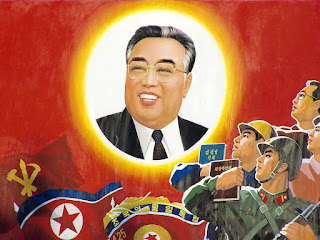
Kim Il Sung poster: Signature depiction
during that era. Source: Wikimedia Commons
Let’s examine Danson Cheong’s comment about this dubious bit of history. I will try to distill the history of the Korean War as a sequence of events:

  1. In 1945, at the end of WWII, Russia/Soviet Union and the US came to a standoff at the 38th Parallel in Korea, following the defeat of Japan (similar to the standoff in Germany with East and West Germany and division of Berlin; here Seoul was firmly in South Korea but vulnerable as it is near the 38th Parallel).
  2. In 1948, both sides agreed to withdraw leaving behind a North Korea heavily armed by the Soviet Union, and a South Korea — ROK (Republic of Korea) — supported by the US. 
  3. By 1950, Kim Il Sung had approached Stalin for support to attack South Korea and reunite Korea.
  4. Stalin agreed to arm, fund and support Kim Il Sung, provided he could convince Mao to support him in this war. Stalin would not contribute Russian/Soviet forces to a war.
  5. At that time, China led and governed by the CPC, was absolutely poor and short of resources to support a war adventure. But in the end, Mao agreed (and overrode dissension and doubts within the People’s Liberation Army [PLA] about engaging in a war, even if China was not funding it), perhaps fearing that if Kim did not win, China would be vulnerable to a US invasion (bear in mind that at that time, McCarthyism and the vendetta against communism/socialism was on the rise in the US — earlier days of Cold War).
  6. On June 25, 1950, Kim Il Sung launched his attack on South Korea — crossing the 38th Parallel, and overwhelmed the forces there (who were caught by surprise) quickly. The South Korean and US forces were pushed to the south-eastern corner at Busan — where they made their stand.
  7. MacArthur, in dark jacket, observing the invasion
    of Incheon. Source: Wikimedia Commons
    Bruised by this surprise attack and with his reputation in tatters, MacArthur was desperate to counterattack and regain the initiative. Against the concerns expressed by his generals, McArthur took the bold decision to launch a dangerous high risk invasion at Incheon (location of the current international airport) — a craggy rocky coastline (and not smooth sands like Normandy). This surprise counterattack succeeded and Kim Il Sung’s forces were encircled. They quickly retreated back above the 38th Parallel. MacArthur turned from being a disgraced general to a war hero (i.e. from WWII hero to zero and back to hero).
  8. Emboldened by this victory, MacArthur’s forces pushed northwards. MacArthur wanted to get rid of Kim Il Sung and push all the way to the Yalu, and create a buffer zone in China for a reunited Korea. He even entertained and promoted the idea of using nuclear bombs to create a “dead zone” in China above the Yalu.
  9. On Oct 15, 1950, Truman flew to Wake Island (nearer Guam, west of Hawaii), to meet MacArthur. This was a major concession from a president to fly out to meet his general — a subordinate, who had not been exactly compliant with Truman’s instructions. Yet MacArthur’s stature as war hero and support in Congress, was an obstacle to Truman gaining absolute control over the strategy to contain and keep the war short. MacArthur assured Truman that the war would be over by Christmas, in order to assuage Truman who was worried that China would enter the war, and that it would become a protracted extended conflict — potentially a World War III.
  10. PLA troops before the Changjin battle.
    Source: Wikimedia Commons
    On Oct 19, 1950, China entered the war, and on Nov 27, 1950, launched the surprise attack at Chosin Reservoir (or Lake Jangjin in Korean). 120,000 Chinese troops attacked the 30,000 UN troops led by the US (contributing majority of the troops). The Battle of Lake Changjin was a key battle — the turning point, which halted the momentum of the US and UN forces. Both sides lost a lot of men, but the PLA suffered hell of a lot more loss of lives, since they were poorly equipped and practically all they had, was the advantage of numbers and the courage of the PLA soldiers.
  11. The US and UN forces retreated to the 38th Parallel. By Dec 1950, Truman had decided to try to end the war, and stop his recalcitrant general from taunting the Chinese and continuing the war. In Apr 1951, Truman finally sacked and recalled him back to the US. McArthur returned home a war hero and there was even a “Thanksgiving Macy-style” parade in New York to welcome him back. MacArthur waved to a cheering and adoring crowd lined along the Manhattan streets. This sacking of MacArthur cost Truman dearly — politically. MacArthur subsequently tried to run for the presidency, but Eisenhower beat him to it and became president, succeeding Truman.
  12. In the meantime, the Korean War continued as a war of attrition for two years until July 27, 1953, when Eisenhower finally managed to end the war as Truman had intended earlier. The Korean Armistice Agreement was signed — keeping the 38th Parallel as the dividing line, thus halting the war but there was no peace treaty.

Kim Il Sung did not achieve his objective to become top Korean honcho with his war adventure, but the cruel collateral damage was extensive loss of lives — Korean, Chinese, American and those of UN forces, and economic debilitation. Stalin gave him arms and funding to fight the war, but did not contribute soldiers to the adventure. Instead, Stalin found a sucker — Mao to do the dirty heavy lifting — sacrificing his impoverished PLA forces who had already suffered so much in their civil war against the Kuomintang. To me, it is a sad and tragic part of PLA history — something to commemorate and reflect on the mistakes and loss of lives. It is not some event to be celebrated or glorified.

Imagine this parallel universe scenario. Let’s say Kim Il Sung had lost the war after the Incheon offensive, Mao had not entered the war, the recalcitrant MacArthur was restrained by Truman and the US/UN forces had stopped before or at the Yalu. The 38th Parallel dividing line would have shifted to the Yalu. Today, we may have a united democratic Korea with a thriving free market capitalist society, trading freely with a Deng-reformed China, living in peace. Would that not be a better outcome than the current situation of an impoverished North Korea ruled by the Kim family dictators, with people malnourished, suffering and living out of fear?

M*A*S*H season premiere, 1974: Different cultural
approach to the Korean War. Source: Wikimedia Commons
As a film/TV buff and a M*A*S*H fan, I find it interesting to note that the Americans (or rather Hollywood) fictionalised a book by Richard Hornberger (portrayed as Hawkeye Pierce by Alan Alda in the series) about his Korean War experience as a medical surgeon, to make a comedy series with the backdrop of the trials and tribulations of war. In comparison, the Chinese (through three top notch directors guided by Beijing’s wishes) chose to use a Korean war film to inspire and arouse Chinese nationalism and patriotism. It says something too about the different cultural approaches of these two superpower countries with different socio-political systems. Danson Cheong quoted Shanghai-based military analyst Ni Lexiong in relation to the film in the context of current Taiwan tensions:    

When it comes to preparing for war, there are two things to do: first is preparing materials and hardware, the second is psychological and mental preparation... These movies tell people that if a conflict does happen, they don’t have to be afraid.

Let’s hope these preparations are unnecessary and this week’s Xi-Biden virtual summit has helped to tone down the rhetoric of conflict. (In Hokkien “pai kiah” angry rhetoric lingo, it is time to ease off on the “dare or not” taunts…)

  • The Battle at Lake Changjin (NC16), 176 minutes, opened in Singapore on Nov 11, 2021
  • Chin Foo Chun is a former investment banker working for three global banks (JPMorgan Chase, BNP Paribas and CIBC) with regional responsibilities in the Asia-Pacific. Read more about him here.

Wednesday, 17 November 2021

‘Give back to our children the spirit of adventure’

By Quah Seng Sun

WOULD YOU allow your son or daughter to take part in wholesome outdoor school activities like Scouting and Guiding? During our time, it would be an unqualified “Yes”! Today, it is a rhetorical question. 

Molly Ooi, who taught at Penang Free School in the 1980s and was Group Scout Leader (GSL) of 8th Georgetown (South) Sea Scouts Group and also Ranger Guider, laments that these activities have lost their shine.

“It’s such a shame that camping is now confined to the school field and not many students want to be Scouts anymore. The Scouting light doesn’t shine brightly anymore and Coronation and Jubilee Camps are both gone. Scouting and Guiding are both internationally recognised uniformed movements which prepare young people holistically for their futures.” 

Molly Ooi with the Sea Scouts of Penang Free School
in the 1980s
Together with her husband, David Hwang Hong Shi, who himself taught at Westlands Primary School in the 1950s and Penang Free School in the 1960s, she tries to burn the torch for these activities: “Parents should encourage their wards to participate. Don’t make them lose their sense of adventure.” 

Molly’s accounts highlight a few differences between then and now. One is the change in attitude, a sharp turn towards taking less risk among all the parties involved. Another is the diminished trust among students, teachers, parents and the various levels of administration. 

“Malaysian kids today have lost their sense of adventure. Many prefer to be hooked to their handphones. Parents are too worried about letting them out even for a nature walk. Teachers are afraid of taking them out in case accidents happen and parents sue them. And principals don’t want the hassle of paperwork and answering to the Education authorities in case something happens. Kids get to camp in the school field only when they can get a teacher to stay with them at nights — which is rare,” she says.

Molly Ooi with the Rangers of Penang Free School
“When I was young, we cycled everywhere and our teachers took us for all kinds of hikes and excursions. We visited factories and ate cookies, chocs and got other goodies, went to tin mines, all kinds of estates, farms and orchards (again free vegetables and fruits there), got special passes for movies like The Sound of Music and other interesting children’s literature and lots more. We had no handphones but we had fun outdoors with our wonderful, caring teachers whom our parents trusted.”

Molly’s own adventure with Scouting started in the 1970s. In a recent posting on her Facebook, she wrote that she had taken her Woodbadge Course while teaching in Malacca during those years. She became a Sea Scout Leader of the Open Sea Scouts troop there which comprised both Boy Scouts and Girl Guides. There were camping and canoeing at Tanjong Keling Beach. Today, there are no more stretches of clean white sand as the beach has been obliterated by hotels and apartments.

When she was transferred to Penang Free School, she became the warranted Group Scout Leader (GSL) of 8th Georgetown (South) Sea Scouts Group and also Ranger Guider. “Those were interesting years of camping at Camp Coronation, numerous hikes to Muka Head and Gertak Sanggul, over the Ayer Itam hill to Balik Pulau, Penang Hill and other adventurous activities and combined training camps together with 1st Georgetown (South) GSL Mr Khoo Poh Kheng and 7th Georgetown (South) Rover Scout Leaders (RSLs).

She offered two Internet links to Scouting: Importance of Scouting and Guiding in Schools and Scouting and World Development.
  • Quah Seng Sun is one of three people who maintain this WPS blogsite. Recently he authored two books, Let the Aisles Proclaim: The First Two Hundred Years of Penang Free School 1816-2016 and Ten Thousand Prosperities: The Story of Ban Hin Lee Bank. Read more about him here.

ADDENDUM

A comment on facebook put the picture as taken after the PFS Scout Show in 1984. "It was one of those rare occasions that the Sea Scouts were in uniform (white shirt and navy blue pants). The whites were outstanding but the Scout Commissioner wasn't too pleased as this was against the norm. But somehow we survived," the writer* recollected as a response to this story.

He continued, "Sadly, those were the transition times from camping in the wild to camping in school, and the beginning of parental consent and the fear of the dangers of sea activities. We chose the former and at the end, our numbers were whittled down to what you see in the picture. Most of the time - practically every Saturday - that bunch of nutcase Sea Scouts were either at Pantai Keracut or Muka Head or canoeing round the island. We rowed canvas canoes. They were like bloody logs in the water!!! But with the choppy currents around Muka Head, it was a blessing.

"Those were the days... camping, backwoodsman, odd-job weeks, washing cars, cutting hedges for funds, Scout shows, Scout car racing, naval training, whacking our own paths to Pantai Acheh, licking limestones at Muka Head because we ran out of water, night hikes to Pantai Keracut, caught by the Police for sleeping in the cemetery with parangs after tiring out trying to grab the best bamboos, transporting 15-feet bamboos tied to two bicycles, and dragonboats. Camping at Youth Park was considered degrading to us. Yes, those were the days."

* The writer wished not to be named.

Monday, 8 November 2021

Globalisation, technology, Elon Musk and the Romance of the Three Kingdoms

By Chin Foo Chun

WHAT HAS globalisation, technology, Elon Musk and Romance of Three Kingdoms got to do with one another?

Let’s start with Elon Musk, the richest man in the world, while Tesla’s stock price stays where it is today.

On 2 Nov 21, he tweeted a Chinese poem from the classic, Romance of Three Kingdoms, about Cao Cao’s sons, Cao Pi and Cao Zhi, contesting for power. Some say it is an oblique reference to the spat between the dodgy Dogecoin and the newer, perhaps less dodgy, Shiba Inu, which has overtaken Dogecoin in market value. Apparently, some consider Shiba Inu to be a token which aspires to be an Ethereum-based alternative to Dogecoin.

Musk has often in the past been a frequent advocate for Dogecoin. So what could be his message behind the poem. Let’s take a look.

The posted tweet was titled “Humankind” by Musk, although it is commonly known as the “Quatrain of Seven Steps,” the allegorical poem attributed to Cao Zhi. Legend goes that Cao Pi, freshly crowned king, was suspicious that his more popular brother was trying to usurp his rule. Cao Pi forced Cao Zhi to produce a poem that would proclaim his innocence, within seven strides. The poem is as follows:

Beanstalks are ignited to boil beans
The beans in the pot cry out.
We are born of the self-same root
Why should we incinerate each other with such impatience?

It is kind of curious that Elon Musk would refer to this Chinese poem. Where could he have learnt of this? I have two conspiracies to offer:

  1. Tesla’s largest factory is now the Shanghai Gigafactory. Perhaps over drinks or dinner, one of his Chinese executives told him the story, which caught his imagination?
  2. Leo KoGuan, who is now Tesla’s third largest individual shareholder (after Elon Musk and Larry Ellison), has met Musk before. He is a former Chinese Indonesian, inspired by the Xuan Yuan’s Chinese rule of law, and now a Professor at Tsinghua. He has the KoGuan School of Law at Shanghai JiaoTong University, and the Leo KoGuan Law Building at Tsinghua University, named after him. Maybe he told Musk the story?   

Both Elon Musk and Leo KoGuan are children of globalisation.

Elon Musk was born in Pretoria, South Africa. His father was a South African engineer, entrepreneur and property developer. His Canadian mother was a model and dietitian. He grew up and was schooled in Pretoria. Moving to Canada, he entered Queens University in Kingston, Ontario before transferring to UPenn. After graduating with BSc in economics and BA in physics, he was accepted to pursue a PhD in materials science at Stanford. After two days at Stanford, he dropped out and started his tech and business career – eventually becoming part of the PayPal mafia. He left PayPal and launched Tesla and Space X, and in the process became the richest man in the world.

Leo KoGuan is nowhere as rich as Elon Musk, but his stake in Tesla is worth a humbling US$7 billion or more. His story is much less known. He was born in Indonesia, studied international affairs at Columbia and then law at NYU. In 1989, KoGuan bought steeply discounted assets of a bankrupt New Jersey-based software supplier that became the basis of SHI – an IT solutions, product and services company. He ran the company with his then-wife, Thai Lee, who was the first Korean-American woman to enter Harvard Business School. By the time they divorced in 2002, it was pulling in annual revenues exceeding $1 billion. She is still currently CEO and SHI’s annual revenues are now US$11 billion. KoGuan remains as non-executive Chairman.

Leo KoGuan’s name came into the limelight when he bought the triplex penthouse apartment on top of the 65-storey Guoco Tower in Singapore from James Dyson – UK’s richest man. Guoco Tower was built and developed by Quek Leng Chan, a Chinese Malaysian tycoon.

Let’s consider the virtuous circle/cycle of globalisation here (my apologies if I stretched my imagination a bit). Chinese consumers buy Tesla cars made in the Shanghai Gigafactory by Chinese workers. This contributes to Elon Musk’s wealth which is propelled by buoyant US stock markets. This rubs off on an astute investor like Leo KoGuan who prospers with huge bets, as Tesla’s stock price catapults upwards. With a teeny weeny bit of his wealth, he purchases the Guoco Tower penthouse from James Dyson (whose wealth is generated in part through his factories in the Philippines and Malaysia). The success of the Guoco Tower development, in turn makes Quek Leng Chan richer, reinforcing his resources and ability to invest in more businesses like his semiconductor assembly & test business, packaging auto-chips going into cars – though not into Tesla cars, at least not yet. (It contributes to creating jobs and wealth for the middle class in Malaysia.)

So we have come full circle – a virtuous one, as Chinese consumers contribute to the flow of business and resources across the globe and leading to jobs which help drive consumption in Malaysia too. It is a wonderful story of the power of free market capitalism and Adam Smith’s “invisible hand” in a global context, as we connect the dots or beans as metaphorically referred to in the Romance of the Three Kingdoms. Unlike the beans in that famous poem, here the beans are enablers. Instead of incinerating one another, they work together seamlessly (without prior intent) across the globe – demonstrating the “shock and awe” power and synergies of globalisation.

  • Chin Foo Chun is a former investment banker working for three global banks (JPMorgan Chase, BNP Paribas and CIBC) with regional responsibilities in the Asia-Pacific. Read more about him here.

Friday, 10 September 2021

We should seriously study, legislate a future generations law

Republished from New Straits Times, Sep 10, 2021,
with the author’s permission. Read the original here.
By Yong Soo Heong

AS WE LOOK back at what our country has achieved in the last 64 years, there’re certainly many triumphs and also failures that we may as well not dwell on, lest they bring us more heartaches.

We could’ve achieved much more. So it’s best to look to the future as Soyen Shaku, a Japanese Zen monk, discovered when he found a way out of past failures by saying, “Do not regret the past, look to the future”.

Perhaps this is akin to the popular saying of no use crying over spilt milk.

Much has happened in our beloved country, especially in the past two years or so. Besides the arduous health and economic challenges, we’ve also been treated to a giant spectacle of political upheavals and manoeuvring on a scale we’ve never seen before.

The familiar refrain of “where do we go from here?” is often heard among those who care about the future of this land we call home.

While we’ve been engrossed in much political infighting, some neighbouring countries that had once lagged behind have even overtaken us.

Take our automobile industry, for example, which we had often boasted about when we got off the starting blocks as early as 1985.

But we’ve not made much headway since then, especially in selling our wares to big international markets, except for making millions of Malaysians happy with their relatively cheap locally made vehicles compared with competing overseas rivals.

Of course, we enriched some local parts producers along the way in the name of localisation.

And look at the South Koreans: one of their marques started about the same time as us, and look where they are now.

Their cars, viewed with disdain by some snooty automobile makers then, have found a niche in the garages, driveways and parking lots of many North American and European homes with their stylish designs, advanced engineering and fuel economy.

Even one-time war-torn Vietnam will start marketing home-grown electric SUVs to the industrialised West in November. Enough said.

But I pray there’s still hope yet for our future generation as I’m captivated by this line of optimism: The past is your lesson. The present is your engine. The future is your motivation.

It may be wishful thinking on my part to hope for radical changes in the next 100 days or so that could bring forth many solutions or answers to the multitude of challenges that we now face.

Who or what could lead us out of the quagmire? Do we sink further into mediocrity?  

I’m drawn to Dr Roman Krznaric, a Briton described as a public philosopher, who had expounded on the need to reinvent democracy for the long term.

He argues that when politicians fail to look beyond the next election — or even the latest tweet — they are neglecting the rights of future generations.

He depicts such flaws as short-termism and presentism.

Governments, he declares, typically prefer quick fixes, such as putting more criminals behind bars rather than dealing with the deeper social and economic causes of crime.

Nations bicker around international conference tables, focused on their near-term interests, while the planet burns and species disappear.

Like Krznaric, I’m intrigued by what the government of Wales in the United Kingdom had done in an interesting attempt to right the wrongs, although it may not be a fool-proof panacea.

Premised on “acting today for a better tomorrow”, Wales had established a Future Generations Commissioner as part of the 2015 Wellbeing for Future Generations Act.

Sophie Howe, described as one of the United Kingdom’s changemakers and top businesswomen, was appointed to the important role in 2016.

Her responsibility is to ensure that public bodies in Wales make policy decisions looking at least 30 years into the future.

The Guardian newspaper describes her as the “world’s first minister of the unborn”.

In a nutshell, the far-sighted Welsh law requires public bodies to think about the long-term impact of their decisions, to work better with people, communities and each other, and to prevent persistent problems such as poverty, health inequalities and climate change.

This legislation has been attracting interest from other countries as it offers a huge opportunity to make a long-lasting, positive change to current and future generations.

Do we dare take such a giant step for the wellbeing of future Malaysians?

  • Datuk Yong Soo Heong is a former chief executive officer and editor-in-chief of Bernama. Read more about him here.

Monday, 30 August 2021

Straits Echo


THIS IS quite a well-known picture, a three-storey building that once housed the venerated Straits Echo Press newspaper. I have no idea when the newspaper located its operations here but very long ago, it used to operate from a shophouse in Beach Street. In the 1960s, I do remember seeing the building at this spot – the corner of Penang Road and Dato Koyah Road – but never in my wildest dreams then could I foresee that one day in the 1970s, I would have this newspaper as my first employer, albeit only for a short six-month stint.

I said venerated because where the Press was concerned, this English language daily was the pride of Penang. Often, it carried news that the more national-level The Straits Times, with its headquarters in Singapore, was unable to report first-hand. Before the Second World War, The Straits Times occasionally had to rely on re-printing news that had earlier appeared in the Straits Echo. Thus in a way, the latter, despite its regional coverage, was seen as an ultimate source of authority for news about Penang.

Like The Straits Times, the Straits Echo newspaper was a broadsheet which was a large format and somewhat unwieldy to hold. To keep up with the times, but more to challenge The Star newspaper which hit the streets in 1971, the Straits Echo transformed into a tabloid in the 1970s. With it came a new name, The National Echo, and blue was adopted as its colour for the masthead in contrast to The Star’s red. The competition with The Star was keen and at one stage, an evening edition – the so-called street edition – of the newspaper was introduced so that readers could read that day’s news on the same day. Later, The National Echo opened an office in Kuala Lumpur and shifted its centre of operations there. Unfortunately, it could not compete with the likes of New Straits Times, The Malay Mail and The Star, and The National Echo folded in 1986.

When I worked there in the 1970s, the newspaper was owned by someone named KK Liew. The editor was a Eurasian named Wilson de Souza while the senior editors were Cheah Cheong Lin and Sunny Tan. The chief reporter was a very loud man named G Ratnam. Among my peers were people like Kee Thuan Chye, Ung Mah Pheng, Ong Thean Seang and Ooi Kee Beng. The last named is now the Executive Director of Penang Institute.

© Quah Seng Sun

Updates and add-ons:

Lim Siang Jin: 

  • My great grandfather, Lim Cheng How, used to manage the company that owned the Straits Echo. This is from my grandfather’s memoirs: “Attached to the Criterion Press, Ltd, former proprietors of the Straits Echo, the premises of which were at Nos 226 and 228 Beach Street, presumably as an assistant, my father rose to the appointment of manager with, I believe, a salary of $100/- pm which was then considered excellent pay having regard to the fact that the cost of living was cheap”.
  • In the mid-1980s, the late Soo Ewe Jin (later one of the Deputy Executive Editors of The Star)  and I were approached to come up with a plan to revive The National Echo, perhaps take it back to Penang and focus on news from the north again. We were both working for ISIS Malaysia then. Both from Penang, we were quite excited about the project, however, nothing came out of it.

Friday, 27 August 2021

Resilience


THIS WAS a story from The Star newspaper last Wednesday, the 25th of August. Although it correctly stated that Hwang Hong Shi taught at the Westlands School, the translation into SMK Westlands was wrong. SMK Westlands is Westlands Secondary School which opened in 1957. Westlands School was the primary school which is today the Westlands Centre for Sports Excellence, the premises still located in Victoria Green Road. But Master Hwang did indeed teach at both schools: Westlands School in the 1950s and Westlands Secondary School in the 1970s.

GEORGE TOWN: Having hid in the jungles of Sitiawan, Perak, as a child over four long years during the Japanese occupation, octogenarian Hwang Hong Shi has cherished every day of his life since.

Recalling the dark chapter, the 87-year-old retired teacher said he was only eight when he fled into the wilderness with his family.

“We heard they were beheading Chinese school teachers, and both my parents were teachers.

“They weren’t very good at farming and being the eldest, I had to help out as much as I could.

“My father would dig up the ground and I would plant paddy seeds.

“I also learnt to fish in the river,” he said, adding that the family lived in fear inside a hut they had built.

Hwang said there was often not enough food for the family of five.

“We had to make do with what we could get our hands on, like sweet potatoes, tapioca and plain rice to stay alive,” he said at his home in Taman Sri Nibong.

He said he could never forget his anxiety back then.

“The times we sneaked into the neighbouring towns fearing execution, to the times we ate tree roots out of hunger – we had to be resilient to be able to survive,” he said, adding that these were the qualities he applied in his daily life throughout his career as a teacher, then a general manager.

Hwang said that when the British took over, things improved.

“I began my schooling, but it still felt like we were living under someone else’s roof. Our future was uncertain,” he said.

He was a 23-year-old teacher in 1957 when Merdeka was declared.

“I did not know much about national affairs then, so I didn’t understand the political aspect of it, but to me, Independence meant better opportunities for all and freedom from conflict,” he said.

Born in Sungai Siput, the Perakian dedicated 37 years of his life to teaching in several schools, including the then Westland School (now SMK Westlands), Sekolah Umum Permatang Pasir in Seberang Prai, Penang Free School and the International School of Penang (Uplands).

Wednesday, 25 August 2021

Ten Thousand Prosperities

HOW MANY Old Westlanders from both the primary and secondary schools were customers of Ban Hin Lee Bank (or BHL Bank) in the past? I guess many of us were. To a great extent, BHL Bank was part of our daily lives: we either borrowed money from the bank or deposited our money with it. Then there were the coinboxes. Too many to mention but all have become collectors’ items. 

At the height of its banking business in the 1990s, its visibility among the local community was considered second to none. Among my batch of primary schoolmates (Class of 1965), I know of only two – Khoo Kay Liang and myself – who were in the bank’s employment. We joined in the mid-1970s and continued until BHL Bank was merged into Southern Bank in 2000. A total of 23 years in my case, a very long time indeed. I wouldn’t have stayed if working conditions and social activities were not right in this One Big Harmonious Family. In the 1980s and 1990s, many of the staff that joined were barely out from their school uniforms. The bank took them in if their Form Six academic results were good enough but many were also selected for their sport prowess. 

Today, more than 20 years have passed since the merger. With the passing of time, the memories that my friends and former colleagues harbour of the bank are at risk of being forgotten. Recognising that more memories could be lost in the future, I had embarked on a project two years ago to collect a verbal history of BHL Bank’s halcyon days. Penang’s most loved home-grown bank is now remembered in this book which I’ve aptly called “Ten Thousand Prosperities: The Story of Ban Hin Lee Bank.” The “ten thousand prosperities” in the title comes from the literal translation of the bank’s name in Hokkien: 萬興利  

The video below gives a quick flip through my old memories. A small slice of Penang's history. Hope you enjoy it. 

© Quah Seng Sun

Sunday, 1 August 2021

Protecting children: Four disadvantaged groups to focus on

By Jim Lim

MALAYSIA may have acceded to the Convention for the Rights of the Child in 1995 and passed the Child Act in 2001, but key challenges remained and have to date, shown few signs for optimism.

At the heart of the problem lies the country’s vague definition of “nationality” as derived from its founding Constitution, resulting in complex and exaggerated inconsistencies and contradictions over children in general. These problems are particularly acute in marginalised communities and among those from disadvantaged groups.

The difficulties can be seen at the legislative level on private law on children and on public law. This is where the definition of, criteria for and access to fundamental rights and services become even more confusing.

Orang Asli children: The community lacks in educational facilities and development
investments. Source: Muhammad Adzha, Wikimedia Commons

Legal practitioners will attest to the complexities and the absence of transparency in child care law, especially in fundamental rights and duties. For example, there is a disproportionate high number of years for a child to apply for and attain citizenship, only because Malaysia does not grant automatic citizenship by birth and its differential treatment on the sex and national status of the parents.

This private law conundrum above is not the purpose of this paper. However, it is the provisions and the denial of services through a fundamental human rights’ deficit in the public law aspects that is the subject of our current attention.

We refer to the situation of children at greatest disadvantage or “marginalised” by the circumstances of their birth, upbringing or status. The following groups have come to our attention and their current situation:

  • Children, mostly orphans, brought up in state-run children’s homes,
  • Children from the refugee communities,
  • Children from rural and poor communities, e.g. the Orang Asli community
  • Children in wedlock.

Children brought up in care in residential institutions

Orphans raised in care homes are common practice. They are placed in establishments run by private entities, by voluntary (NGO) groups, usually religious organisations, and by the social welfare department.

In general, children who become orphans fall under those abandoned or abused and would normally end up in residential establishments. The length of stay can range from a few weeks to many years, including up to 18 years old. As there is no formal legislative procedure for the rescue and safeguarding of vulnerable or children “at risk”, many different stakeholder agencies intervene in their own way to help.

There is no requirement (legislative compliance) on standards of care for these  establishments looking after/caring for such socially dislocated children. Whilst many home owners and management provide excellent to good care, there is no way to prevent abuse, physical, emotional or sexual, by a minority unsuitable care staff, especially against a backdrop of wider cultural  paternalistic views about children. There have been voices raised by some of the children themselves on their abuse.

Much of these concerns have come from “Perbak” (Pertubuhan Kebajikan & Sosial Malaysia) an organisation set up by an ex-resident child in care. The high-profile leader, Muhammad Khairul Hafiz Abdullah, had stayed at a place where it is alleged that there are hundreds of abused children now adults. They have come to recall their painful experiences. It is the government-run orphanages that Perbak is referring to, in this instance, and the majority are Malay-Muslim boys.

Furthermore, many of these former children in government care are deemed either undocumented or stateless. Being “stateless” means that access to many government services is denied. Moreover, most are left to fend for themselves once they reach the age of 18.

Read more about Perbak here, here and here in reports by The Star. Also a letter by this author here.

Children who have suffered abused whilst in “public care” should be appropriately compensated for the suffering endured. Nothing is worse than having one’s childhood heartlessly taken away. Discharging formal responsibility at the age of 18 or abandoning such young adults to fend on their own and further denying them “citizenship” undermines any concept of civility in a developed nation.

In terms of alternative substitute parenting and care, the concept of “family fostering” or professionally-paid fostering support is not well developed in Malaysia. In many developed countries, such family substitute care is widely promoted through government investment, with its suitability and popularity endorsed by child care experts over often large institutional/residential care.

Children from the refugee communities

Refugees in Malaysia are normally accredited through the UN resettlement programme and almost all are awaiting disposal to a third safe country as Malaysia restricts the numbers it accepts. Therefore, many are resident in situ pro-tem until a country in the West takes them.

Refugee children are sadly denied access to local schools and any education provided to them is from voluntary NGOs or local religious organisations like the church. Adult refugees are allowed to take some employment and local work but on limited reduced hours.

Children from the Orang Asli community

The plight of the Orang Asli (OA) community in Malaysia is well documented and the government’s acknowledgment is a positive sign that some help and resources are available. In short, this indigenous community is widely acknowledged as amongst the rural poor.

However, it remains the case that there is systemic discrimination against the community throughout the country and their resultant marginalisation has a negative impact in aspects of health outcomes, educational and positive social outcomes.

The OA community is largely in rural communities in most states of peninsular Malaysia and in East Malaysia. Most are employed in the agriculture sector although many OA are emerging as community activists campaigning for equal participation and representation and greater allocation of resources for their community. The government’s paid lip service over the years has gone hand-in-hand with the private sector continued labour-exploitation within the agricultural sectors. NGOs have complained bitterly about the disproportionate and unequal allocation of educational resources and lack of investment for the development of the community.

Child marriage

The issue of child marriage is a controversial one. The UN raised this as a concern as far back as 1995. The United Nations Sustainable Development Goals is calling for “global action to end this human rights violation by 2030” (read here). A pertinent matter in many Muslim countries is around the dual legal systems of civil law and shariah law; the latter permitting marriage in exceptional circumstances for a child. A local prominent NGO, “Voice of the Children” (read more here) publicised the issue as recent as 2013, together with “Girls not Brides” (read more here), a global organisation on girls being forced in wedlock.

The PH Government began to address the issue of child marriage, as well as reinforced “Help lines” for child safety. However, with the new PN government’s more conservative outlook, the outright ban widely sought for appears “on hold”.

Child marriages are abhorrent. It is a human rights issue. They deny and take away a child’s right to growing up and there is no rationale for not ending the practice by passing legislation and banning it outright.

Conclusion

It is difficult to defend the government’s record in matters on safeguarding and the protection for children. There remains a lack of regulation for the care of vulnerable groups in our society and much reliance is inappropriately placed on the shoulders of the voluntary or religious groups and where business and profits are to be made, on the private sector. Therefore, enforceable regulation and strict standards in operation when private sector companies provide services is necessary to promote safeguarding and well being.

With regards to legislative framework there is much to be getting on with, the Sexual Exploitation Act 2017 following from laws on prohibitive child employment, care centres, domestic violence etc but there is little evidence of effective co-ordination or collective responsibility on enforcement action. In short, existing laws are not effectively enforced and proposed social policy legislation suffers from inertia and delays.

Strikingly absent is also regulation for those seeking employment as care givers, care workers or wardens in residential institutions. For example, are they suitably qualified to care for children? Are those staff members adequately vetted?

Lack of compliance and enforcement on premises suitable and fit for purpose, i.e. safety access, fire escapes, was a contributory cause to the tragic fire at a tahfiz school or madrasa resulting in the deaths of 21 children and two teachers. Although it was a criminal act, there was evidence of neglect and non-compliance by the building owners. Read more here.

Finally, the much overdue recognition of social work as a profession, the Social Workers’ Act, all up and ready for legislative consent has been delayed yet further as the government ponders and treads along its various priorities.

Besides putting a proper framework for social care and assistance to vulnerable groups in society such as children, there is an equal need to obtain social justice for the country’s disadvantaged children most of whom were brought up in institutional settings as opposed to, in family settings.

  • Jim Lim is a former Director of Social Services in a London Borough, a former CEO of a charity. He is retired and is from Penang. He is a Member of the Malaysian Association of Social Workers. Read more about him here


Wednesday, 14 July 2021

Time to act firmly against underachievers, saboteurs

Republished from New Straits Times, Jul 14, 2021,
with the author’s permission. Read the original here.
By Yong Soo Heong

FOR THE past few weeks, I’ve been feeling numb, not so much from getting those precious vaccine shots, but more from the idiocy that has enveloped our beloved country.

I don’t find any comfort from witnessing the unproductive actions of certain people in positions of power and decision-making as many matters could have been avoided.

If only people had common sense to act rationally. Perhaps too much information on a single day has caused us to lose our common sense, as alluded by novelist Gertrude Stein.

When the Emergency was proclaimed earlier this year, there were high hopes that we would be seeing strict lockdowns to get the coronavirus off our backs. But it was not to be.

Waves upon waves of dithering have caused the country to be nowhere it wanted to be as seen from the daily Covid-19 cases that surpassed 11,000 yesterday! The numbers could even be higher as some cases go unreported.

An audio clip of frontliners in government hospitals in the Klang Valley crying for help from their never-ending toil from last year choked me to tears. Think about it seriously — they have been firefighting daily and yet, there are parties who are feeding the flames by being lax about the pandemic.

From the audio clip, a doctor could be heard saying: “When is this going to end?”

This will not end if we are still unsure of what to do next amid the pussy-footing with the Covid-19 standard operating procedures as this column had emphasised in the past!

We are now in a war against Covid-19 and yet we are not on a war footing, so to speak. Politicians and policymakers have always said that the country has always been battle-ready, but what readiness is there when our Intensive Care Units are overwhelmed, coupled with a severe shortage of medical staff and oxygen supply?

And in the midst of this, we can’t even handle the issue of the country’s more than 23,000 contract doctors, who have been toiling since Day One. They will always be useful to our country. The "dog-in-the-manger" attitude among top administrators can't go on forever.

This also brings to mind the issue of the recent felling of 15,000 durian trees in Raub, the country’s musang king hub. While the authorities may have their reasons — as they claimed that the trees had been illegally planted on government land — it was tantamount to economic sabotage and bodoh sombong.

Why now? Why didn’t they take action when the land was initially cleared? Why fell fruit-bearing trees? Some win-win solutions could have been found, but common sense didn't prevail.  

Vegetable farmers in highlands have also been dumping their produce of late because they can’t send them to markets in the lowlands as lorries have been stopped from travelling by the authorities.

This is despite the fact that some Malaysians do not even have enough to eat because of the prolonged lockdown, which has led to people losing jobs and sources of income. Why do we allow this state of hopelessness to fester?

Brigadier-General Dr Mohd Arshil Moideen, who heads the armed forces’ Health Service Division, courageously called a spade a spade recently.

I salute him for being forthright when he said: “In a war, like the war against Covid-19, we need a single standardised strategy line of command that everyone can abide by.” A clear chain of command is certainly lacking for the rakyat’s wellbeing.

Malaysia needs to see light at the end of the tunnel. We can’t go on like this with ministers going off on a tangent on their assessment of the economy.

We can’t have little Napoleons ruining businesses and the lives of the rakyat from frequent raids, dodgy summonses and flippant SOP.

Dear prime minister, please act firmly against these underachievers and saboteurs. Sometimes the hardest thing and the right thing are the same.

You know you have made the right decision when there is peace in your heart. The rakyat await.

  • Datuk Yong Soo Heong is a former chief executive officer and editor-in-chief of Bernama. Read more about him here.


Sunday, 14 March 2021

WPS staff in the mid 1950s


THE STAFF of Westlands Primary School in the mid-1950s. Only a handful of the teachers are recognisable. In the front row: Iskandar Md Ismail (second from left), K Balram (fourth from left) and Teoh Chooi Hor (ninth from left). In the middle row: Thomas Khor (second from left), Teoh Chye Teik (fifth from left), Hwang Hong Shi (sixth from left), Tan Eng Chuan (10th from left) and Lim Ah Loke (11th from left). In the back row, possibly Tan Seng Aun (ninth from left).

Balram was later to become the Headmaster of Westlands Primary. Iskandar, Teoh Chye Teik, Hwang Hong Shi, Lim Ah Loke and Tan Seng Aun were transferred to Penang Free School in subsequent years.

Tuesday, 3 November 2020

Malaysia needs to clean up recruitment practices

Republished from New Straits Times, Nov 3, 2020,
with the author’s permission. Read the original here.
By Yong Soo Heong

I HAD OFTEN wondered when the lopsided conditions for migrant workers that had prevailed for years in our country would attract the attention of those who might give greater weight to justice and fairness.

Strangely, that recognition did surface recently, but it wasn't from our own volition, but from foreign countries instead!

The floodgates were broken recently when the United States and New Zealand singled out a Malaysian glove manufacturer that had forced migrant workers (mostly women from Bangladesh, Myanmar and Nepal) to work long hours, sometimes as long as 12 hours a day, seven days a week! On top of that, these workers often paid huge sums to secure jobs in Malaysia and the practice usually left them with huge debts they cannot pay back.

It is estimated that such fees may account for up to four to seven months of a worker’s salary! In another area where Malaysia had often beamed with pride – palm oil – a local company’s products were also banned by the US for transgressions in – again – the hiring and treatment of migrant workers.

These importers decided to act as they had found reasonable evidence of forced labour in the production process. These workers aren’t robots or machines. Do spare a thought for these people who might be a father, brother, mother, sister, uncle or aunt to someone. They certainly didn’t want to be trapped in such oppressing conditions, but circumstances forced them to leave the comforts of their homeland to eke out a living here.

The time has come for Malaysia to clean up its act. How long must Malaysians deny or pretend that conditions for low-level migrant workers are “all right”? How can we allow our reputation to be sullied by these repressive regulations or conditions? What if we faced more sanctions from developed nations? We can't consume all the rubber gloves and palm oil that we produce, can we?

There must be some basis to the complaints, which had often been shrugged away or swept aside in the past. There's no smoke without fire. Now, the glove manufacturer that had been targeted had reportedly paid back US$12 million to its workers concerned and had also started paying recruitment agencies the necessary fees instead.

What a turn of events! Such compensation wouldn't cause a big dent in its revenue, as demand for gloves had surged by almost 50 per cent due to this year's Covid-19 pandemic, while share prices of Malaysian glovemaking companies had also soared by as much as 400 per cent on Bursa Malaysia of late! To paraphrase Tom Perez, an American politician, it would be unfair if workers baking the pie of prosperity were not sharing the dividends.

It takes two hands to clap and the issue of migrant labour also takes into account the government’s stance on the matter. The authorities must also bear some of the responsibility for this poor state of affairs. We’ve to really take a long hard look at our immigration policies and question ourselves: do we need foreign workers or not? If no is the answer, then do away with them and let Malaysians take up all the responsibilities from A to Z.

If the answer is yes, it’s time to stop pussy-footing. Make the recruitment conditions as transparent as possible so that any employer need not rely on runners, agents, go-betweens and intermediaries and what-have-yous (it’s almost an industry by itself in Malaysia!)

In 2008, the then Chief Secretary to the government, Tan Sri Mohd Sidek Hassan, initiated an embracing policy known as the “No Wrong Door”. It ensured that the public would no longer be turned away even if they approached the wrong department or agency and the government servants there would forward the customers' needs to the relevant office.

Has that policy been thrown out of the window because of changes in the top civil servant’s job or it found little currency as it eliminated the need for a “runners’ culture” to thrive? Now, who wants to start the ball rolling again?

  • Datuk Yong Soo Heong is a former chief executive officer and editor-in-chief of Bernama. Read more about him here.

Friday, 30 October 2020

‘Cartoon cards’ or ang kong ngah pai

THE “CARTOON CARDS” or ang kong ngah pai that we played came in perforated sheets (bigger than A4), designed to allow us to tear them into small ones. We ended up with about 20 cards, roughly 2in by 2.5in in size, from each big piece. On one side are reprints of full-colour cartoons and illustrations, probably of Japanese origin. On the other, one-colour graphics.

Such cards were part of the seasonal games in Penang. I suspect now all these could have been orchestrated by importers and distributors – invisible hands. Otherwise how could these seasons have happened with such regularity, widespread distribution of their appendices.

As far as I can remember, there were three ways we played such cards:
  • Shooting the head and tail like marbles (read here). In this version, we switched the marbles for cards.
  • High-five: This was between two players, each holding a card on the palm. They performed a high-five and allowed the cards to drop. If the cards landed with similar sides (full-colour or one-colour) facing up, it was a draw. If they landed differently, both cards would go to the person with the full-coloured side facing up.
  • Currency: In school we were not allowed to gamble, especially with cash. However, seemingly innocuous games like opening books to add up their numbers, tossing coins to guess heads or tails, etc, were indeed gambling, as were the tontin games peddled by street vendors. In some of these we used cards to bet. We didn’t wager with cash so it was okay, I suppose.
© Lim Siang Jin

Saturday, 24 October 2020

Fake news purveyors say they are journalists too

Republished from New Straits Times, Oct 24, 2020,
with the author’s permission. Read the original here.
By Yong Soo Heong

IN AN EVER-CONFUSING world of legitimate news criss-crossing with fake news, I’m just wondering how long Donald Trump, the chief promoter of fake news, will continue to spew bad vibes about the mainstream media.

When less is said of fake news, such labelling will hopefully evaporate.

But will it? Especially now that Trump has given greater legitimacy to the wicked forces of fake news by saying such news is everywhere. Prior to late 2016, murmurs of news being manipulated made the rounds but never at the frequency that Trump easily belched “Fake News!” whenever issues weren't in his favour.

Fake news has become a big thing, especially on social media. When fake news is repeated, it becomes really difficult for the public to discern what's real and what’s not.

Real news practitioners have resigned to the fact that fake news and rumours had thrived online because few can verify what's real. And more so when people tend to veer towards content that reinforces their own biases.

Granted that the media had been frequently used by the four Ps — politicians, propagandists, publicists or public relations practitioners — in the past. I won’t say that lies had been thrown about and the media readily gulped them up. To be fair, it’s how the information is treated (or slanted) and disseminated. But with the advent of social media, that’s another kettle of fish!

Let’s take a moment to reflect what a young Pakistani politician, Bilawal Bhutto Zardari, said: “Propaganda, misinformation, and disinformation have always been part of political warfare. Social media and other new platforms have given it a new life and reach through which the fake news phenomenon can reach everywhere.”

Now if a politician such as Bilawal had admitted that those ingredients had always been part of the political machinery, then perhaps we’ve to exercise greater caution when digesting information from politicians. Maybe not with a pinch of salt but several spoonfuls, perhaps! 

Whether Trump gets re-elected as president remains to be seen. But, ever since he took office in January 2017, he has been assailing the mainstream media for producing fake news.

As a journalist for a number of decades, I’ve always abhorred that kind of labelling. True blue journalists may take a certain stand, stance or bias but certainly won't stoop so low as to produce something that's not real. That’s the domain of fiction writers or mercenary writers imbued with a mission.

By and large, journalists in mainstream news organisations have been steadfast in their profession. But sadly, fake news is now a new menace in the public space as their purveyors also proclaim themselves to be journalists too and taint the noble profession in the process.

I concur with Jim Acosta, who reports for CNN at the White House, when he said: “Yes, Barack Obama had his clashes with the press. I witnessed those first-hand covering the second term of his administration. But we did not have Obama on almost a weekly basis referring to the press as the enemy of the people and accusing reporters of treason and calling legitimate stories fake news.”

The use of social media to implant falsehoods by latching on the legitimacy of mainstream media organisations is rather appalling. With no lack of creative people and the juicy goings-on in Malaysia these days, satirists have been having a field day.

But, what’s worse is that some have even resorted to “hijacking” some media organisation's online platforms to pass on disinformation for their benefit, and frequently saying a public holiday had been declared or that the government was going to pay out bonuses to its employees. Such ruses occur whenever some state or national team had emerged victorious in some popular sports events and during Budget time.

And Bernama, the national news agency, hadn’t been spared such manipulation. What’s even more ruinous is when some people tend to shatter Bernama’s reputation and level of journalistic competency by using their own interpretation of events or some online auto translating tools to post some purported news items on social media.

Bernama has reported this to the police several times but these envious perpetrators have yet to be trapped. I hope these journalist-wannabes can be exposed soon!

  • Datuk Yong Soo Heong writer is a former chief executive officer and editor-in-chief of Bernama. Read more about him here.

Monday, 19 October 2020

Chneow au! Kite flying, fighting and chasing

THE WEATHER in Penang in the 1960s was predictable, unlike today. The dry and windy season stretched from year-end through Chinese New Year and slightly beyond. The Westlands School grounds would be parched while some gardens with bougainvillea were at their most colourful. On the streets and in open areas, droves of children would be flying kites, many of them engaging in dogfights with others in the vicinity – depending on the size of their kites and the lengths of their strings, that could be a neighbourhood away. Occasionally shouts of chneow au! (literally “snatch” or “seize” the kite) would send troops of youngsters, even adults, running after one that was floating listlessly downwards. The person who grabbed the string first got to keep the kite.

I chanced upon a chat of 2005 on kite-fighting in the PenangTalk forum. The first guy, “Free Spirit”, very much in favour of reviving kite fighting, said:
Yes, it would be good to bring back the paper-type kites and kite fighting. I was very much a part of that generation in the 1950s and 1960s when kite fighting was at its peak. Different people then had their own recipes for making the glass-coated strings (some of the more exotic ingredients included egg white). Of course, I had my own way of making those strings. 
Invariably, we would use the Griffin brand No 10 string, imported from England. It had just the right thickness and strength for this type of kites. I don't know if this brand and type is still available.
One of the major problems which led to the demise of this highly entertaining sport during that time, was that children and even adults chased vigorously after these kites once their strings were cut. These led to road accidents and even fights. Another problem was that people flew these kites indiscriminately, even by the roadside, thereby posing a danger to passing traffic, particularly cyclists and motorcyclists [Editor’s note: The strings would descend across streets and, when they were 4ft to 6ft above ground, they cut anyone who zoomed past.] 
I think Penangites should bring back this unique form of kites and kite-fighting, found only in this region, both for the enjoyment of the locals and also to attract tourists. The tourism board could organise kite-fighting competitions. With proper controls, like appropriate areas for flying, etc, the dangers mentioned above could be eliminated. 
The other person, “Razor Sharp”, replied:
Thanks for reminding me about the Griffin No 10 [strings] and egg white coating with ground glass from burnt-out bulbs! Those strings, wound on Milo tins, had to be handled very carefully with leather gloves (or garden gloves, even newspaper, whichever was available).
Razor Sharp also talked about “experiments” to weigh down the tail [more later]. As traffic was light and he played in the suburbs or padi fields, he did not, as far as he could remember, meet with road accidents. But he could remember “bruises from falls during chases or from the trees!”. Yes, it was a very serious sport with unwritten but widely-accepted rules and all. The links, unfortunately, have disappeared after the PenangTalk forum became the “new” PenangTalk recently.

I was not allowed to play with kites in school, however, in my area, at the junction of Cantonment Road and Gurney Drive, there were three or four clusters of boys who were heavily involved in the sport. I am sure, given the size of the WPS field, there must have been many kite enthusiasts in the area. In this story, I would like to recount my experience in a few areas with inputs from friends especially Ooi Kar Keat.

Kite designs

See larger image attached at the end of the story
The kites that most of us played with were all variations of the diamond kite with the following parts: (1) spine or tua koot made of bamboo (2) cross-bar also of bamboo (3) bridle, bridle-point and line using Griffin No 10 white string (chap ho snuah in Hokkien) that came in small wooden reels (4) cover made of rice paper and (5) tail(s) to stabilise the kite.
  • Tua au (literally the “big kite”) was the best for kite-fighting because of its strength and manoeuvrability. Its direction of flight, especially of a tailless one, could be changed very frequently because when the line is laxed (when we ulor the line), it twisted and turned a lot. However, when it pointed in a certain direction, usually in a split second, and we pulled back (or angkat) the line, it would move very swiftly in a straight line for a distance – thereby allowing us to attack other kites. Its size and strength also made it possible to fly it a few hundred feet up, such that dramatic kite-fights can be watched from afar.
  • Au kecik or au kniah (literally the “small kite”) was more for younger children, the novice or an elder to teach children. Although it had all the components of bigger diamond kite, it was small (slightly bigger than 1ft square) and had few reinforcements. The rice paper was gummed to the tua koot and the four corners are held together and reinforced only with paper. Many people, to lend stability and for aesthetic reasons, added tails to it – strips of newspaper, rice paper, even crepe. Despite its fragility, it was used for kite fights too, at lower levels. The string used to fly it was lighter too — Griffin No 4.
  • Au ikan (fish-shaped kite). This kite was difficult to make and therefore not common. Its tail-end curled outwards and shaping the bamboo for the correct curve was a task. Two little tails were frequently added to the curved ends for stability.
  • Au katak (frog-shaped kite). This design used the most material with an added inverse cross-bar at the bottom and more string to hold it together. This kite could easily be spotted because, apart being relatively uncommon, it would stand out against others in terms of shape and movement. From what I can remember, it was a bit “temperamental”, refusing to stay steady even as we pulled the line back.
  • Au kangkang. Duduk kangkang in Bahasa Malaysia referred to being seated with wide-open legs. The name of the kite, with its split bottom, was derived from this term. A knot was made at the end of the split to prevent the bamboo from breaking further.
Making kites

See larger image attached at the end of the story
The easiest way to get a kite was to buy one; they were available in large numbers during the kite season from the chai tiam mah (grocery shops) or other roadside kedai runcit. However, one of my neighbour’s uncles guided us on how to make one. The following are some of the steps:
  • Shaving the bamboo: Split dried bamboo into sticks slightly over 1cm wide and shave them down to about 0.5cm thick. The bamboo should be of the green variety found, e.g. along the river in Ayer Itam.
  • Balancing the cross-bar: Make the cross-bar from a piece of bamboo with a node in the middle. Shave both sides and bend to see if they curved evenly on both sides. Tie a thread to the node and hold the stick up to see if it balances – if the weight on both sides are roughly equal.
  • Fixing the frame: Tie the spine and the cross bar together using some sort of lashing knot with the Griffin No 10 cotton line. Face the smooth side of the bamboo (1) upwards for the cross-bar and (2) inwards, against the cover, for the spine. Make notches at both ends of the spine and cross-bar and, using the same string, shape the frame by bending the cross-bar and tying both ends to the spine.
  • Using rice paper as cover: Use rice paper as cover for the kites. Cut the paper to an inch bigger than the frame. Use tapioca starch (or chneow) to glue its edges to the kite by folding against the string along the perimeter. Place some glue on the spine too to stick the paper to it. Rice paper could be bought quite freely then. The best place was probably the Sia Boey area but I cannot recall.
Making glass-covered strings

See larger image attached at the end of the story
Glass-covered kite lines, wound nicely around Milo or Ovaltine tins so they make angular patterns, could be bought at the kedai runcit all over. Their quality was poor. Desperate to get better ones, we made our own – usually under the bright sun.
  • Choosing the line: In our days, the most favoured brand of cotton line for kite-flying in general and kite-fighting in particular was the Griffin brand size 10 cotton string that came in wooden reels suited for use on the Singer Sewing Machine. It was strong (able to handle all the rough handling of a seasoned kite-fighter), absorbent (able to allow glue to sink in and fine glass to stick on) and flexible (able to be pulled back, released and wound back at great speed without knotting up too much). Imported from England, it was also widely available.
  • Pounding the glass: It was common knowledge that only glass from light bulbs (incandescent as well as fluorescent) should be used. It made sense because being very thin and hard, we need not have to pound too much to make the powder consistently fine. Apart from glass, we used some cheap crystal; we could feel its cutting edge on the finger but never tested it against anyone.
  • Cooking the gum: Many secret ingredients, like egg white, have been touted as an adhesive for the pounded glass. The most common was goo phoey kar (gelatin made from boiling down skin and ligaments of animals specifically cattle). It came in pieces (not powdered). We would cook them in tins until they dissolved to the consistency of a syrup. The glass powder was then added along with some powdered dye.
  • Coating the string: The process of coating the line would start by, first, identifying a few points to allow the line to hang while it dried. It could be two badminton posts. Or a combination of a tree trunk, a telephone post and a swing. One end of the line, still in its original reel, was tied to one post and the reel was allowed to drop to the ground. The “coater” then, carrying the tin of cooled glue along in one hand (say, left), dipped the right hand in and collected a handful of the mushy liquid and residue. Grasping the line tightly with right hand, he would walk back – allowing the mixture to stick to the line as it was released from the reel. This is continued from point to point non-stop until the whole line was coated. For example, if two badminton posts were used, a person would have to walk up and down and around the posts about 15 times for a 100-yard line. Care was taken not to coat too much. Or to allow specks of glass residue on the line. It could, like a knot, give your opponent a slicing point on the line.
  • Drying: Lines were dried in the sun and wound properly on a tin so that they could be released quickly in a fight. In reality, once the line was released, there was not much time to wind it back. It was just allowed to fall to the ground carefully so that in the process of pulling back and releasing, it did not get entangled.
Rules of play

See larger image attached at the end of the story
Despite the apparent chaos in the sky and on the ground where chaotic hordes would chase after fallen kites, there were a number of rules governing the game:
  • Cut as near the kite as possible: While the overall objective of the competitors was to cut the line of the opponent, the loss inflicted should be just the kite and as little of the line as possible. Opponents therefore would try to cut the line as near the kite as possible. Cutting lines at very low points have resulted in fights. They were also a bonanza for the kite catchers; some wrongly-cut lines could be long enough to be used to fly other kites, albeit the smaller ones.
  • First one to grab the line gets the kite: The overall purpose of the active and eager spectator-snatchers was to grab the kite that had fallen. It was easy to spot these kites; they drift listlessly and people on the ground would anticipate where they would land. If the places were thought to be near enough, there would be a rush towards them. Boys (the majority of kite flyers were males) would climb over fences, take other short cuts and run across streets, many a time endangering themselves and others. The basic rule in our area was this: The first one to grab the line gets the kite. Beyond that, there would be a multitude of areas of contention:
    1. Some people would grab the line higher, nearer the kite, even after a line had been caught. Quarrels and fights would ensue. The clearest sign of victory was someone running away with a kite in tow and his friends surrounding and running with him to protect him from other groups.
    2. Sometimes, the kite would be caught in trees or on lamp posts. The ensuing struggles to get them often resulted in falls, cuts and bruises. In such a case, the person who got to the kite would claim it.
    3. Unsporting boys, especially when their groups were large enough to fend off others, after failing to get the line, would grab the kites and destroyed them. The pandemonium that ensued would be settled by gangland principles of the survival of the strongest.
Kite-fighting tactics

See larger image attached at the end of the story
While there were rules governing the game, the tactics within play itself were the most interesting, replete with a set of terms based on the Nyonya-Baba Hokkien language of Penang.
  • Lambong the kite or khee au: The first step was to ensure the kite was hoisted or launched. Some people ran with the kite in tow and allowed the wind to catch. Many a time, the competitor would have an assistant who took the kite about 40ft to 50ft away, held it properly against the wind and shouted out to his mate to pull. This was called lambong (derived from lampung or float in Malay?) or khee au (raise the kite).
  • Balance: A second or two after lambong, we would know if our kites were balanced. If it constantly swung to one side, it had to be rebalanced by inserting rice paper as a counter balance.
  • Angkat, ulor and jinam: Angkat meant pull the line. When you did that, the kite would move in the direction the head was pointed. When the kite was pointed down and you angkat, the kite would dive or jinam. Ulor (hulur in Bahasa) was a term used to describe letting the line go and letting the wind pull the kite away.
  • Positioning and directing: The fighting kite was never still. It always moved left and right, faced upward or downward, etc. The flyer had to be very attentive to all its movements. In the split second that the kite was pointed towards a desired direction, say at 45 degrees, he had to pull, sometimes pulled very hard or angkat kuat for the kite to head that directionKites without tails were very responsive, even to slight tugs.
  • Aggressive or not: When you were out for a fight, when you flew close to their line, your combatants would recognise you quickly. They might evade or counter-attack quickly. Those who evaded fights were probably people out to have fun with their children or mates, and they were usually let off. For the mutually aggressive pairs, interesting dogfights of attacks, counter attacks and tactical retreats would ensue.
  • Cutting another line in two ways: The line of an opponent could be cut, as far as I know, in two ways. When we felt that both lines had touched, we could: (1) Angkat kuat or pull back vigorously to slice the opponent’s line. This was usually done when your line was below your opponent’s (2) Ulor quickly at the moment of contact, let the wind pull the line and slice your opponent’s. This was when your line was above, and your opponent was coming at you from below. 
  • Role of the assistant: The assistant played a big part in these duels. He would advise his partner what to do, watch out for other parties that would make a sneak attack and, most important of all, made sure the line did not get entangled.
© Lim Siang Jin. Written with inputs from Ooi Kar Keat