Wednesday, 9 March 2022

Boosting Penang's musical heritage as an attraction

Republished from New Straits Times, Mar 9, 2022,
with the author’s permission. Read the original here.
By Yong Soo Heong

ON THE fourth floor of Komtar Complex in downtown George Town, Penang, lies a cultural oasis that showcases various “gems” related to the state’s pre-eminence in the performing arts and broadcasting industries.

Unfortunately, its prominence is masked by stores selling computer peripherals, fried chicken and souvenir knick-knacks before visitors can locate an escalator that takes them to this extraordinary place. 

Known as the Penang House of Music (PHoM), it’s a jewel in the crown among local music aficionados who care about Penang's musical heritage, and a labour of love by its founder, Paul Augustin, a self-taught 62-year-old Eurasian musician from the state, now a musical “historian”, curator, researcher and archivist.

The “house” promotes Penang as the motherland of musicians in the country. It came into being on Nov 21, 2016 under the Penang Musical Heritage Project in line with the state government's aim and vision to establish a heritage and creative arts city.

It traces facets of Penang’s musical journey from the 1900s when the British colonials held sway, Japanese Occupation in early 1940s, return of the colonials in the mid-1940s, the halcyon days of pre-Independence, the glory days of the Swinging Sixties right up to the Buoyant Seventies.

Of course, no presentation would be complete without its most revered star, P. Ramlee.

The legendary actor-singer (along with his heart-throb, Saloma) holds a special place among many better-known Penang-born or raised entertainers like Ahmad Daud, Ahmad Nawab, Zainal Alam, Rubia Lubis, Jimmy Boyle, Ooi Eow Jin, Albert Yeoh, Richard Hoon, Lee Yee and David Arumugam, to name a few.

PHoM also captures the journey of how the local populace entertained themselves in the past, how the different local communities celebrated their festivals with music and performances thrown in, including Penang's famed song, dance and tongue-in-cheek satirical routine — the boria.

Special mention must be made of the presence of a radio studio where visitors can briefly be deejays and record audio presentations for keepsakes and a diorama of a coffee shop in the 1960s complete with a jukebox and a Rediffusion audio box.

It wouldn’t be out of place to say that a fair number of the exhibits mirrored what people usually saw in 1960s, when Paul himself grew up with a host of top-notch musicians, as well as pursuits like requesting their favourite songs to be played on the airwaves.

Also on display are the then immensely popular magazines like Movie News and Majallah Filem that highlighted soon-to-be screened films and sizzling celebrity gossip.

Two exhibits stood out: one, a cubicle where you could listen to golden oldies by pressing a song list on a tiny computer screen at the side; the other, a modern audio-visual screen depicting the Chinese “wayang” puppet shows where the costumes could “change” at will with every movement of the viewer's hand!

Moving forward and thinking aloud, a more strategic location befitting its strategic role could be the old Penang City Council building near the Esplanade, or the rather neglected AIA Building in Lebuh Bishop or one of the bungalows belonging to Penang Institute in the leafy suburbs of Jalan Brown.

The first two locations would add lustre to the touristy attractions in downtown George Town and augment PHoM’s foot-traffic.

The suggestion to be in Penang Institute's serene environs, besides its ample space for exhibits and visitors, is also to complement the latter's research into what makes Penang tick since PHoM had also ventured into research, documenting and digitalising its collection.

PHoM’s archival efforts reflect Paul's mission about building Penang’s (and subsequently Malaysia's) musical repository for posterity to benefit future generations.

Such noble endeavours could also complement the work done by local universities as PHoM’s treasure trove is constantly sought after by researchers on the state’s illustrious local musical journey.

It all depends on how the powers-that-be in Penang aspire to boost PHoM as a musical heritage attraction while the “house” also sifts through an increasing storehouse of valuable documents and artefacts to augment the state's contributions to Malaysia’s “musical treasures”.

  • Datuk Yong Soo Heong is a former chief executive officer and editor-in-chief of Bernama. Read more about him here.

Friday, 21 January 2022

There must be better explanation for fatal cases

Republished from New Straits Times, Jan 21, 2022,
with the author’s permission. Read the original here.
By Yong Soo Heong

“UNREASONABLE haste is the direct road to error” was a quote that came to mind when I read that some clear-minded thinkers in our local medical fraternity were cautioning against the rollout of a second booster shot under the Covid-19 National Immunisation Programme.

That quote belonged to 17th century French playwright Jean-Baptiste Poquelin, better known by his stage name Moliere, as he expounded the virtues of deliberation before acting in haste.

The New Straits Times had cited several people well-versed in medical science that Malaysia ought to study all relevant data on the efficacy of the booster shot, which has yet to reach the arms of many.

I subscribe to that view as many cases unpleasant to the ears had surfaced of late with regard to casualties after getting the booster shot, elegantly classified as Adverse Event Following Immunisation (AEFI).

There has to be greater clarity as I believe all authorised Covid-19 vaccines must have the highest degree of efficacy and safety.

What if the lines of safety are blurred because we've not undertaken a serious study ourselves and had blindly kept in step with the Joneses?

Datuk Dr N.K.S. Tharmaseelan, a former Malaysian Medical Association president, said more data was needed and even the World Health Organisation (WHO) had yet to endorse a global rollout of booster shots.

WHO says: “Safe and effective vaccines are a game-changing tool: but for the foreseeable future we must continue wearing masks, cleaning our hands, ensuring good ventilation indoors, physical distancing and avoiding crowds.

“Being vaccinated does not mean that we can throw caution to the wind and put ourselves and others at risk, particularly because research is still ongoing into how much vaccines protect not only against disease but also against infection and transmission.”

We’ve to probe deeper, especially our own environment. As things stand, 26 million or close to 80 per cent of our population had received the first dose and 25.6 million or 79.6 per cent had taken the second. Nearly 30 per cent or 9.7 million had the third dose.

I'm drawn to morbidity or mortality cases following the third dosage.

There have been several high-profile cases of late. The usual culprit is often blamed on heart attacks. As easy as that? Clarity on how these fatal cases came about is sorely lacking.

Now we have been alerted to another high-profile case involving the father of a state-level religious figure. The authorities told us that the National Pharmaceutical Regulatory Agency is investigating after the religious official revealed that his father vomited, became weaker and even had a stroke after the third dose.

Why is this so when medicines are supposed to fortify one's body? Perhaps as a layman I wouldn't know why.

I’m just asking like any normal person why a trip to the clinic or hospital has to end like that. Someone must explain convincingly.

While we’e bent on achieving herd immunity, I suppose not everyone can be corralled into that herd. Although there's compensation from a fund for extended AEFI cases between RM50,000 and RM500,000, no amount of money will placate the loss of a dear one.

I support the proposal by Dr Zainal Ariffin Omar, chairman of the Volunteers for Community Engagement and Empowerment for Covid-19, who called for the formation of an independent technical committee to address vaccine hesitancy.

There’s still 20 per cent of the population who have yet to be jabbed and another 70 per cent to go for the booster.

Amidst all these, I’m terribly amused by a recent father and son conversation. Daddy told his son that he was better off getting Covid-19. His son was non-plussed at the sudden remark.

His dad then said he had at least a fighting chance of staying in conversation and be alive for three weeks or so in combating the virus before he succumbs. And, if he is lucky, he will get to stay alive.

But with the booster shot, it may boost his chances of meeting his Maker faster! It’s a sobering matter we’ve to consider seriously.

  • Datuk Yong Soo Heong is a former chief executive officer and editor-in-chief of Bernama. Read more about him here.

Sunday, 2 January 2022

Sara and the Towkay

Manicasothy Saravanamuttu was a Ceylonese who arrived in Penang to become the editor of the Straits Echo newspaper in 1931. He lived an extraordinary life and suffered the Japanese Occupation of Penang personally. His experiences during the War years and beyond were documented in his memoir, The Sara Saga, which was originally published by Cathay Printers in 1970. I recall that the former Chief Reporter of Straits Echo in the 1970s, G Ratnam, used to mention a lot about Saravanamuttu. The out-of-print book was reprinted by Areca Books in 2010 and it can still be purchased from the Areca Books website. Price is only RM40, which I consider to be very good value for a precious re-print.

I can't remember when I purchased a copy of this book: it could have been soon after the reprint became available but like many other books I own, they normally ended up in the cupboard unread until I really have a use for them. So it was with The Sara Saga. Recently, I brought it out for some air because I had to refer to the chapters on the Japanese occupancy of Penang, this year being the 80th anniversary of the invasion of Penang.

There's also a chapter on Penang's personalities, another area of history that continues to intrigue me. Turning to page 78, my attention was immediately rivetted to the picture of Towkay Yeap Chor Ee and Malcolm MacDonald. Now recently, Yeap Chor Ee had been a subject of interest to me as he was the founder of Ban Hin Lee Bank. 

I thought that I had already known quite a bit about him from public records, private conversations and also from the book, The King's Chinese, which was authored by one of the Towkay's great-granddaughters, Daryl Yeap. However, I discovered that Saravanamuttu's memoir also contained some details of Yeap Chor Ee's generosity that was unknown to me earlier. It was this generosity which made Yeap Chor Ee so well-known in Penang even decades after his death in 1952. 

Below, I reproduce an excerpt from the Saravanamuttu memoir that dealt with Yeap Chor Ee. But overall, The Sara Saga is a most interesting book on many important periods of Penang's past and a must for any student of local history to own. Click here to visit the Areca Books website.


Perhaps the most outstanding Chinese in Penang in those days was Towkay Yeap Chor Ee, who came to Penang as a penniless orphan at the age of 18. He was in his fifties when I arrived in Penang, and he was already the richest man in the settlement. His wealth was acquired by hard work, thrift and a fair share of good luck.

He first started with a small shop in Prangin Road, which was stocked with goods on consignment supplied through the good office of the compradore of one of the leading British importing houses of Penang. Young Yeap Chor Ee kept the accounts scrupulously and settled with his patron without fail at the end of each month. In this manner he built up a small capital. At that time Caledonia Estate in Province Wellesley was a sugarcane plantation and produced crude sugar. Yeap Chor Ee purchased stocks of this crude sugar and sent them to the refineries of the famous Java Sugar King, Oei Tjiong Ham, at Sourabaya, and sold the refined sugar in Penang at a substantial profit.

The story is told that Oei, sensing that the young man in Penang was likely to become a rival to him, did not submit the bills for the refining for an extended period. But Yeap Chor Ee, with that strict honesty which was an integral part of his make-up, deposited the cost of refining from the profits of his sales in the bank instead of, as in the accepted manner, reinvesting it to make more profit and thereby run the risk of losing it. Thus, the Sugar King suddenly presented a bill for some $2 million, expecting to find the young Penang businessman unable to pay and thereby take over his business. To his surprise, the full bill was promptly settled. Oei Tjiong Ham at once came to Penang to call on this remarkable young businessman and a friendship was established which culminated in two of his daughters marrying two of Yeap Chor Ee's sons. Another justification of the old adage: "Honesty is the best policy"!

Then came the rubber boom of the 1910s in which Yeap Chor Ee speculated with outstanding success and was soon acknowledged as one of the leading businessmen in Penang. He acquired considerable property following the old Chinese belief that land was the safest investment and was justified when after his death some of his lands fetched over a thousand times what he had paid for them.

He showed his faith in the future of Penang by putting up the magnificent Ban Hin Lee Bank building during the days of the "Great Slump" in the early 1930s. Another notable action of his in those days was when the tin price hit the bottom. He continued to buy on the falling market and at one time held as much as 2,000 tons of tin in his godown. When the price of tin began to rise after hitting the bottom at £170, he sold in small parcels at a time. It is said that he cleared nearly $2 million on this transaction alone.

Till the time of his death Towkay Yeap Chor Ee could not speak English and I remember when, in recognition for his donation of $10,000 to the Silver Jubilee Fund, I tried to secure for him naturalisation papers as a British subject but failed owing to his lack of knowledge of English. By that time, he had established his own bank and was one of the largest property owners in Penang.

My first contact with him was in 1932, soon after the Japanese invaded China. Some of his jealous business rivals started a story that he was a Taiwanese (native of Taiwan or Formosa, which was then under Japanese rule) and there was a movement to boycott his business. As editor of the local paper I was invited to call on him and when I went to his bank he threw his Chinese passport at me. It showed that he was born in Fukien Province. Taiwan was part of Fukien Province before the Japanese took it over and this was made the basis for the false report.

I asked Towkay Yeap to give me his passport, made a block of the page giving his place of birth and printed the picture in the Straits Echo the next day without any further comment. Many Chinese thought that, in the accepted Chinese custom, I had received a handsome present for doing this but I did it merely as a piece of truthful reporting. I think it was this that won me his confidence and he used to consult me often after that whenever he was in doubt over a public matter.

Later I was able to persuade him to give a donation of $100,000, which he later increased to $250,000, for the Chinese section of the library of the University of Malaya in Singapore, now renamed the Singapore University, a proposal that was attractive to him as a non-English speaking Chinese.

The story behind this donation bears repeating. The Resident Commissioner of Penang, i.e. the Head of Administration, was Arthur Aston, an Oxford contemporary of mine and a typical old colonial type. When the appeal for donations to the proposed University in Singapore came out in 1948 Aston sent for Towkay Yeap and blandly suggested he should give a donation of a million dollars! (Incidentally, one of his sons, Dato Yeap Hock Hoe, later donated a million dollars to the Penang University College). When Towkay Yeap made a counter offer of $10,000, Aston was very rude to him and told him he was not going to carry all his millions with him to his grave; all he would get was a stone over his head. Now to speak of his death to an old Chinese (Yeap Chor Ee was over 70 at the time) is considered very bad luck.

The old man sent for me and told me the story. I was very angry and offered to go and scold Aston. His reaction was typical of the old Malayan Chinese. He said, "Don't do that. He may get annoyed, but you can tell him that I was very hurt." Then he went on to say that the biggest donation for the University so far was $50,000 by Lee Kong Chian, a Singapore millionaire, and he was willing to cap it with a donation of $75,000. On the spur of the moment I replied, "Towkay, 10,000, 50,000 and 75,000 are all five figures. Why not be the first to give a six-figure donation?" The old man twigged it at once and readily consented. Remembering his lack of knowledge of English, I suggested that he should specify his donation be utilised for books for the Chinese section of the University Library and a plaque placed to perpetuate his name. This pleased him immensely. So I went over Aston's head and made the offer direct to Malcolm MacDonald, who was Chairman of the Donations Committee. The latter came down to Penang to accept the cheque personally from Towkay Yeap. And I made Aston sanction the grant of a private burial ground for Towkay Yeap and his family, which could be done only for outstanding public service, When he died in 1952, he was buried on this plot on a hill in his Green Lane Estate from where he could look down on the bank he established.

  • Quah Seng Sun is one of three people who manage this WPS blogsite. Read more about him here.

Sunday, 19 December 2021

The Japanese invasion of Malaya, 1941

In December 1941, the darkest days in Penang's history unfolded. Days after the Japanese military had begun their invasion of Malaya through Kota Bharu, there was widespread mayhem and destruction in George Town when Japanese bombs were dropped amidst simultaneous heavy machine-gun fire on the local population. 

I guess we shall never know today what happened to Westlands School during the war - the people who could remember that period may be too old or no longer around - but in 1965 when my friends in this blog were in the final year of our primary school education there, it was only 20 years since the Japanese surrendered control of the land back to the British. Although we boys missed the trauma of the war years, our parents did not. They went through much suffering, and life in the 1950s and 1960s was still difficult enough for most of them. And while it impacted us as young boys, we ourselves didn't know better due to our own childhood ignorance. In our own ways though, we remained resourceful. Left to our devices, we fell back on traditional children's games to entertain ourselves.

These are the five stories I wrote elsewhere to commemorate the 80th anniversary of the Japanese invasion of Malaya in 1941.

80th anniversary (1): Japanese invasion

Today, 08 December 2021, marks the 80th anniversary of a very significant event in Malaysia's history. At 00:30 (that is, 30 minutes past midnight) on the eighth of December 1941, Japan launched their offensive on the Malayan peninsula. This was the beginning of almost four full years of hellish dark days of the Japanese Occupation from 19 December 1941 till their surrender on 02 September 1945. Earlier, they had sailed from southern Indo-China and their fleet of warships dropped anchor 3km from the coast of Kota Bharu.  Read more here.

80th anniversary (2): The bombing of George Town

Previously, I had related how George Town had awoken on 08 December 1941 to the first sounds of Japanese enemy aircraft flying over the town. Three days later on the 11th of December 1941, terror rained down on the inhabitants of George Town. Terror in the shape of bullets and bombs. It was truly a rain of terror. Not yet a reign of terror, no, it had yet to begin, but literally, a rain of terror. Without warning, the Japanese aircraft dropped their bombs and trained their machineguns on the people who congregated in the Chinese quarter of the Beach Street area. Read more here.

80th anniversary (3): Silent evacuation

On the 13th of December 1941, the first of four quiet evacuations of the British from Penang soil took place. Although not apparent at that time, these evacuations also signalled that the British Empire itself could be unravelling in South-east Asia. Never mind that Britain came back to administer Malaya after Japan had surrendered in Penang on 02 September 1945, it was never to be the same again. The seeds of nationalism planted, a movement for Independence and self-governance began taking root. Read more here.

80th anniversary (4): White flag

Eighty years ago on the 16th of December 1941, the Japanese military invaded Malaya and bombed Penang. It is quite safe to say that many families in Penang, if not all, were affected by the atrocities. I know that mine were displaced. On my maternal side, my grandparents fled to the hills, the chau huan that I had mentioned in Part 2. My paternal grandparents probably did the same too and they never really recovered after the Occupation was over. My father continued with his education at Penang Free School after the War but because of the pressing economic circumstances, he had to quit within the year to find work and support the family (at that time, comprising his parents and a sister.) Such sacrifices were not uncommon as the local population tried everything to rebuild. Read more here.

80th anniversary (5): From the Japanese perspective

At four o'clock in the afternoon of the 19th of December 1941, the first Japanese troops landed on Penang island. This was a result of Penang surrendering after nine days of continuous bombardment by Japanese enemy aircraft and the quiet evacuation of the British military garrison and European civilians. With the island now totally defenceless, it fell upon the local civilians to fly the white flag to signify Penang's surrender to the Japanese military. In today's 80th anniversary story, the last of my five-part commemoration of the sad occasion, I shall reproduce two stories from The Syonan Shinbum newspaper. Read more here.

© Quah Seng Sun

Saturday, 11 December 2021

Joan Baez and William’s tour de force at 22

Unique story on the back page of
The Malay Mail, Oct 19, 1979
By Lim Siang Jin

ONE DAY in October 1979, something unheard of happened at The Malay Mail. The back page lead, always the domain of sport, was stripped. In its place was a story, “GLORY B! This was something”. It was a memorable day for most of us at the production desk, seeing our irrepressible editor, Chua Huck Cheng, make another innovative and inspiring move.

As for the writer, the person who put this “critique” together, he lived one of the wildest dreams any young reporter could have. William de Cruz was 22 when Joan Baez came to town for her only concert in Southeast Asia. Dubbed the Lady with the Flowers, she had become world renowned and, around that particular time, she was also campaigning for the “boat people”, refugees from Kampuchea. What made chasing this story even more dramatic was that Baez had only one night in Kuala Lumpur in her ultra-tight schedule; she was due to fly off to Anambas Islands (Indonesia) the next morning at 8am.

Like many other enthusiastic professionals, William was there at the get-go, attending a press conference at the Subang International Airport, connecting well with Baez and making himself conspicuously known — so much so that at their next contact, at the backstage right after the concert, she gave him a peck on the cheek and a bunch of flowers. That would have been a heaven-sent for an ordinary fan. But it was not nearly quite adequate for a journalist sensing a gigantic scoop looming before him.

Joan Baez: “Disarming feminine charisma”
Source: Wikimedia Commons, 1973
Getting to the story proved to be a bit tricky though. After some niceties at the backstage, all requests for an interview were turned down, albeit politely. There would not be a post-concert party either. The principal rep of the organisers, Jack D’Silva of the Red Cross, even quipped “with tongue in both cheeks” that he would be going to a girlie joint.

Baez was then packed off into a car which headed away for her hotel. William’s deep desire for a scoop, however, couldn’t be satiated. He told me recently: “About an hour later, the journalist in me couldn’t rest. I happened to know at which hotel she was staying. I went there [The KL Regent], walked up to the reception with the flowers Baez had given me. I handed them over to the concierge, and said: ‘Please give these to Joan Baez. I know she’s staying here’.”

William then took a seat in some far off corner. It was late at night and the lobby was relatively empty. With him were Helen Heng and Sheila Natarajan, our colleagues at The Mail who had gone for the concert with him. Ardent professionals themselves, they realised this was William’s moment to relish and remember, and left all the initiative to him. 

Soon after, the scheme started to play out. “I watched the concierge, flowers in hand, take the lift, which only stopped at one floor, and came back to ground level. After a respectable wait, the three of us caught the lift, as discreetly as possible, and I hit the button for the floor the concierge got off at.”

At the floor, they headed for the only suite and rapped on the door. Anne, one of Baez’s assistants, opened it and William said: “If Joan Baez is staying here, please tell her the guy who sent up the flowers is at her door.” Anne excused herself and went back in.

“When the door opened again, there she was — Joan Baez herself,” said an excited William. He recounted that she greeted him like an Indian would, palms held together at her chest, followed by “Come in, Sahib”. Scanning the room, they could see that Baez was having her midnight supper of eggs Benedict and a glass of wine. Jack D’Silva was there too, sipping on a scotch. “I knew it would be you,” he remarked, to which William retorted: “Pretty exclusive girlie joint.”

They were let in for a two-minute chat but it stretched to many more, thanks also to Baez’s kind heartedness and obvious recognition of William’s sincerity, perseverance and knowledge of music — he is a musician and songwriter himself schooled in the respected tradition of buskers and gig performers of the 1960s. The full write-up of the interview, including references to Dylan, her campaign for refugees, etc, can be read here.

I was at the desk at 4.30am when an exhausted William submitted the story to Huck Cheng. Along with me and other colleagues, our editor had also attended Baez’s solo concert at Dewan Universiti Canselor. As the early hours wore on, I sensed something special was being done to the story. I cannot remember who was tasked with subbing it, however, at the paste-up floor, I saw the unusual headline on the back page.

William deserved this very special treatment. He enriched and contextualised our experience of the night and made it so much more meaningful. The words he wrote speak for themselves: 

Hers [Baez’s] was not the long ways of the Streets of London, or the cries of Anak or even the grandiose hopes of Bringing In The Ship — hers was the voice of a generation gone by; one that had thrived on the essence of the Bob Dylans, the Pete Seegers, the Woody Guthries… Four and twenty ears ago, they had only their guitars. Today, she still sticks to hers while others have found an easier way out. 

Particularly, that was the feeling she radiated last night — in her simple midnight blue embroidered caftan, her 75-year-old Martin guitar, a pocketful of songs written so long ago they still apply today, and a disarming feminine charisma that brimmed with character and humanity. 

Bit by bit, the person in Baez kept creeping out — the mother, the lover, the sensitive, the forlorn, the human — and the songs spoke for her. As she sang The Weary Mothers Of The World Shall Rest, one felt almost palpably the experiences of the war-torn and the dislocated. It was powerful idiom delivered with the fondness of the feeling of care. But even for them she had her own ray of hope: “We may never be the poor, for no one owns us anymore...” 

And, yes, she had her less-than-reverential remembrance of Dylan in her rendition of his Love Is Just A Four-Letter Word — complete with her instantly recognisable mimicry of the slur and scraggly diction of the one-time high priest of youth.

Not one song escaped the injection of the message she wanted to put across — not The Beatles' Yesterday, not The Night That Drove Old Dixie Down, not Diamonds And Rust. They all had the Baez interpretation, the Baez cause — sung as if they were meant to be sung that way. No one noticed the greying hair; no one noticed the overpowering voice; no one noticed the absence of a back-up group. It was, simply Joan Chandos Baez, 38, singing her cause.

William enthused that the concert, which 3,000 attended, rivalled “the most mammoth of rock happenings… even if not in number, diminishing the electric parodies of the Today Era with the simplicity of yesterday's flower revolution.” Read his story in full here.

The making of GLORY B!, the story, was a special act in the play of Malaysian entertainment journalism, an interplay among its three protagonists: a passionate and driven writer, an open-minded editor who gave the story what it deserved notwithstanding the age and lack of seniority of the author and, most of all, a star brimming with warmth who, amidst “her unbelievably tight time schedule”, opened her heart to a near stranger.

                                                                 ****

  1. William and I have been great friends since 1980-81, when I was seconded to head the entertainment desk of The Malay Mail while the section editor went on long leave. He and the other team members, like Aishah Ali and Lim Kim Bee, persuaded me to do a weekly series on veteran musicians in Malaysia. It ran for about two months and covered, among others, Frankie Cheah, Ahmad Nawab, Alfonso Soliano, Ooi Eow Jin, DJ Dave and Saloma. It was a memorable exercise, especially for me because I got to know the stories behind these music greats.
  2. From then until now, there have been many milestones in his life. The following are two major ones: 
    • Becoming the founding president of Global Bersih, leading and co-ordinating its activities from Sydney with a deeply-committed group of Malaysians from the diaspora. William gave me a short account at first but decided to expand it to give a better picture of “The Road to Global Bersih”.  It is certainly a story that needs telling. Read here. 
    • Writing Love is the Pill, “the biggest story of my life”, after his encounter with cancer. William’s experience with the disease was nothing short of dramatic, as can be read in his introduction to the blog-book or “blook”. Called “Gifts are for giving”, his comments to lend context to his project can be read here. He had been thinking about writing this “book of thanksgiving” for some time after his recovery. It was during an outing to Kuala Selangor with me and another friend in early 2019 that he finally made a firm commitment to do it. Our pictures from that trip are carried here.
  • Lim Siang Jin is one of three people who manage this WPS blogsite. Read more about him here.

Monday, 6 December 2021

Community mediation: From the perspective of Penang’s Justices of the Peace

This paper on our blogsite was published in The Edge,
Dec 6, 2021, with minimal editorial changes.
By Ong Seng Huat

MEDIATION as a means to resolve disputes is not new. It has been practised in the ancient Greek and Roman civilisations. It was also commonly employed in India, China and neighbouring Japan and Korea. Different words had been used to describe the practice and, in each area, local beliefs have had an influence on how it was carried out. In the East Asian region, for example, Confucianism had a strong influence. 

Mediation was being used to resolve disputes in Peninsular Malaya prior to the introduction of laws and the judicial system by the British in 1807. Indeed, the Malays, Chinese and Indians who resided here have been practising it since at least the 15th century.

The Malays used sulh (which in Arabic means “end of arguments or compromise”, translated as “conciliation”). The mediators were local chiefs (imam, penghulu and ketua kampung), administrators of specific areas or jurisdictions. They were appointed by the local people and endorsed by the Sultan. 

Panchayat, practised by the Indians, centred around a village council of elders (usually numbering five) who were acknowledged by the community as a governing body. Brought from India, the system facilitated decision-making with regard to the social issues confronted by the villagers. 

As for the Chinese, tiaojie (调节), which literally means mediation, was the primary mode of dispute settlement adopted by the early settlers. Used for thousands of years in traditional China, its theory and practice had been influenced by the Confucian philosophy. It was recorded in Malaya, for example, that a temple, EngChoonTohTeoGan in Malacca (1949), included mediation processes in its rules and regulations.

Justices of the Peace in colonial Penang: The office of the Justices of the Peace (JP) was a British creation. Eminent persons of communities were appointed as JPs to assist the Crown in the preservation and maintenance of peace of their communities. In Penang, a Straits Settlements state (1826-1948) under the British administration prior to Independence, JPs were appointed to mitigate the shortage of magistrates then. In addition to their statutory roles, the JPs then also acted as mediators in community conflicts and disputes. 

RECENT DEVELOPMENTS IN MEDIATION IN MALAYSIA

Mediation has assumed some prominence in Malaysia of late. It is in this light that I would like to discuss the practice. The following are some recent milestone events:

Community mediation: This “alternative dispute resolution” practice was initiated formally by the Department of National Unity and Integration (DNUI) in 2007. The DNUI was previously under the auspices of the Prime Minister’s Department, as a mode to help residents of geographical communities (neighbourhoods) to amicably and promptly settle their differences and disputes. Apart from preventing conflict, it also aimed to foster better inter-ethnic and intra-ethnic relations. Since then, the DNUI has been training “community mediators” to serve their respective Rukun Tetangga (RT) sectors throughout the country.

Rukun Tetangga (RT) Act 2012: This Act underscores the role of the “community mediator”. Section 8 stipulates that RT sector committees are “to provide community mediation for the purpose of conciliation or otherwise settle any dispute or difference amongst the members of community”, that is, within their neighbourhoods.

Mediation Act 2012: This piece of legislation was enacted as “an Act to promote and encourage mediation as a method of alternative dispute resolution by providing for the process of mediation, thereby facilitating the parties in disputes to settle disputes in a fair, speedy, and cost-effective manner and to provide for related matters”. It governs the conduct of mediation in Malaysia, particularly ad hoc mediation whereby parties to a civil or commercial dispute voluntarily submit their dispute to be mediated without or prior to commencing litigation in court. 

Practice Direction on Mediation 4/2016: This “practice direction”, issued by the Chief Registrar of the Federal Court, was aimed at encouraging disputing parties to choose pre-action mediation or to seek amicable settlement before trial or appeal. By this Direction, the courts may now also refer the disputing parties to appoint a mediator or mediators to undertake court annexed mediation as directed by the judge or magistrate during pre-trial civil case management. As per Paragraph 5, the modes of mediation could be conducted (a) with the judge leading it (b) via the Kuala Lumpur Regional Centre for Arbitration (KLRCA) or (c) via other mediators agreeable by both parties. Mode 5(c) is categorised as other mediation institutions or ad hoc community mediation.

Covid19 Act 2020: The proviso in Section 9 mirrored the procedure laid out in the Mediation Act 2012 (MA 2012). It states that “any dispute in respect of any inability of any party or parties to perform any contractual obligation arising from any of the categories of contracts specified in the Schedule to this Part due to the measures prescribed, made or taken under the Prevention and Control of Infectious Diseases Act 1988 to control or prevent the spread of Covid-19 may be settled by way of mediation”.

Covid19 Mediation Centre: The subsequent creation of the “Covid19 Mediation Centre” reaffirms the government’s commitment to not only acknowledge the benefits of mediation but also assist the affected parties, particularly the lower income groups to resolve their disputes amicably, speedily and cost effectively. A timely test now is to gauge if there are sufficient trained mediators to undertake the unprecedented tasks. Though the Covid19 Bill 2020 is independent of the MA 2012, disputants are free to decide on their preferred mediation option via MA 2012. In this instance the JP Council community mediators are prepared and will avail themselves for national service when called upon.

With these new developments, mediation in Malaysia is no longer interpreted as an informal alternative dispute resolution process that is not binding by law. It is now enshrined as one of the processes of dispute resolutions in the Malaysian legal system.

COUNCIL OF THE JUSTICES OF THE PEACE, STATE OF PENANG

The Council of the Justices of the Peace, State of Penang, was established in 1962 to provide a platform for Penang JPs to coordinate and pool their resources to serve the local community more effectively. It is a registered entity with the Registrar of Societies. With no new appointment since 1990, the membership stands at 60 comprising eminent community leaders including retired senior civil servants, industrialists, merchants, accountants, medical doctors, surveyors, planters, corporate directors and other trade practitioners.

Transformation of council into a mediation institution: Due to changes in certain statutes after Independence, the role of JPs in Penang has been greatly diminished. Although Sections 98 and 99 of the Subordinate Courts Act 1948 allowed for the appointment of JPs as “second class” magistrates, no JP has thus far been given the position. Recent developments in mediation, however, have raised the possibility of re-engaging these community leaders, appointed by the state authorities, to act as mediators to resolve community disputes. They are ideal for the role.

Penang JPs have been involved in mediation since the 19th century. One notable example was Foo Tye Sin JP who acted as mediator in local community conflicts and disputes during British rule. 

Some time in 2014, the JP Council received a paper entitled: “Transformation of the institution of Justices of the Peace of Penang” from High Court judge Yang Arif Dato’ Lim Chong Fong, then an advocate and solicitor in private practice. Inspired by the ideas outlined and convinced after meeting the writer in person, the council, at its 2016 annual general meeting, resolved to transform the office of the JP to include mediators. This is besides continuing with its limited statutory roles and functions. Consequently, the council’s constitution was amended to include mediation as one of its objectives. As a mediation institution, JP mediators can be appointed as ad hoc mediators pursuant to Part III of the MA 2012.

Mediation skills course: Pursuant to Section 7(2)(a), MA 2012, a mediator shall “possess the relevant qualifications, special knowledge or experience in mediation through training or formal education”. To secure recognition, competency and practical experience for its members, the council approached Ir Harbans Singh (currently panelist of the Asian International Arbitration Centre or AIAC).  He in turn pitched the council’s proposal to the then Director of Kuala Lumpur Regional Centre for Arbitration (KLRCA), Datuk Sundra Rajoo, for support and endorsement. KLRCA has been renamed AIAC. The first JP-KLRCA (AIAC) mediation skills course was held in August 2016. Our collaboration with AIAC to train community mediators continues to this day.

COMMUNITY-BASED PHILOSOPHY

In line with a broad community-based approach, trainees for community mediators are both JPs and non-JP community leaders from diverse background including those from sectors like medical, legal, engineering, construction, finance, trade, commerce and other industries. Apart from the ad hoc mediation, two JP mediators have also served in the Penang High Court annexed mediation in 2016. 

Mediation Bureau: As the mediation service involves non-JP mediators, the council established a bureau to allow it to be semi-autonomously managed. With the tacit support of the state government, the Mediation Bureau was officially launched by His Excellency, the Governor of the state of Penang, Tun Dato’ Seri Utama (Dr) Haji Abdul Rahman Bin Haji Abbas, on 20 July 2017. The bureau has a rented office located at the Caring Society Complex and has a panel consisting 25 JP and non-JP mediators (local community leaders) representing different strata of the community. Currently, the bureau provides pro bono pre-action mediation services to the local community. Pursuant to Court Practice Direction 4/2016 paragraph 5c, the council has offered to assist the courts in alleviating the burden of pending cases, particularly those related to community disputes.

Community mediation and social harmony: Community mediation serves as an important means to keep a community harmonious. They do so by resolving conflicts or disputes — no matter how petty — speedily before they develop into full-blown cases that eventually ended up in the courts. By having mediators within these communities, we are also empowering their leaders to manage their interests and well-being from within, apart from maintaining peace. Further, the JP Council’s idea of engaging local community leaders means that the people involved in the mediation processes are familiar with other on-the-ground issues that may help or hinder conflict resolution. 

MOVING FORWARD

We are grateful to all the directors, past and present, of AIAC for their encouragement and support to train community mediators in Penang. The endorsement provided not only the necessary knowledge and skills but also a mark of recognition of their competency as mediators. Unfortunately, due to the pandemic and its related restrictions, the last scheduled training was aborted. Nevertheless, we look forward to bring the collaboration to the next level.

Community mediation symposium: An understanding with the state Department of National Unity and Integration Department (DNUI) to collaborate and share resources to serve the local community was established in 2019. With the DNUI endorsement, the JP Council successfully hosted a community mediation symposium on 10 November 2019. It was unfortunate that due to the pandemic, the scheduled MOU on 5 April 2020 was deferred. 

Road map for promotion: In reaching out to the community at large, we have created a road map to promote, educate and disseminate the benefits of mediation within their own respective communities. Our first collaborator in this road map is Min Sin Seah, a century old local socio-educational organisation.

Accessible and affordable training module: Work is currently in progress with an institution of higher learning to design and develop a training module to make learning both easily accessible and affordable. Meanwhile, we are prepared to work with other interest groups or organisations for mutual benefits and professional advancement.

One-stop centre: In addition, we are striving to establish a state-level one-stop dispute resolution centre with the state government’s participation and support. 

In sum, this low-cost and effective assisted negotiation between two disputing parties with the help of a neutral third party, is here to stay. It should be given much greater prominence to create greater social harmony and more empowerment to the community, especially its leaders.   

  • Dato’ Ong Seng Huat JP is Honorary Secretary, Council of Justices of the Peace, State of Penang. Read more about him here.

Saturday, 4 December 2021

Don’t overstay when the writing is on the wall

Republished from New Straits Times, Dec 4, 2021,
with the author’s permission. Read the original here.
By Yong Soo Heong

MY late mother, from Dongguan, Guangdong Province, in southern China, Low Ah Hup, had this advice for me to survive the rat race, bracing for life’s challenges or tip-toeing on social etiquette: choot moon thai theen sek, yap moon thai min sek.

It simply meant when going out the front door of a house, look at the colour of the sky; when entering a house, assess the colour of the host’s face.

How right she was! If we see dark skies, then we ought to be prepared and bring an umbrella in case a thunderstorm starts.

The second part of her tip was even more telling: if we enter a house for a tete-a-tete with someone, it’s time to vamoose to avoid overstaying the welcome, lest we see scowls or dark faces.

The most “celebrated” case we’ve seen so far was the riot on Capitol Hill in Washington, DC on Jan 6.

That was when a mob of unruly supporters of former president Donald Trump attacked the United States Capitol building to overturn his defeat in the 2020 presidential election by disrupting a joint session of Congress to count electoral votes that would formalise President Joe Biden’s victory.

Amid the shocking scenes, the Capitol was locked down and lawmakers and staff evacuated, while rioters assaulted law enforcement officers, vandalised property and occupied the building for several hours. 

What was bizarre was that Trump resisted sending the National Guard to quell the mob and again asserted that the election was “fraudulent”.

But, common sense later prevailed when the Capitol was cleared to allow for the counting of electoral votes, which was completed in the early hours of Jan 7.

Much has also been happening in Malaysia since May 2018 and even right up to about a month ago in Melaka, when politicians schemed to regain or stay in power, depending on how one looks at the convoluting scenarios.

After all, American diplomat, Walter Annenberg, did say that “the greatest power is not money power, but political power”.

Over the last 50 years or so, we’ve seen what political power can do for the political elites in the name of grandiose-sounding policies.

This is especially so when political power easily translates into money power.

And this fact has not been lost among non-politicians as well. Many dishonest leaders of non-governmental organisations, charity foundations, trade unions, cultural federations, clan associations and vocational trades guilds, especially those with plenty of lolly in the kitty through subscriptions, endowments and fundraisers, have been known to follow the rule book of double-dealing politicians.

An ongoing case in point revolves round a state clansmen association for the Hainanese community, a Chinese dialect group noted for its civility and politeness (besides their chicken chop and chicken rice).

But, temperatures among some of them have been rising when key office bearers allegedly sought another another three-year term by amending the association constitution.

These people, who’ve led the association for two terms, claimed they wanted to complete the association’s “unfinished business” as they were stalled by the Covid-19 pandemic.

But, their detractors begged to differ, as they claimed that one shouldn’t measure one’s life by its duration but by contributions to society.

One of them said: “Individuals, no matter how powerful or popular, cannot be indispensable. When the time comes for them to take a back seat or retire, they should do so with dignity by welcoming the next generation of leaders who can then emerge with fresh ideas and even bring about new changes to augment the good work undertaken by the elders before them.”

The association’s annual general meeting is, surprisingly, scheduled over Christmas Day and Boxing Day.

Let’s hope good sense will prevail among members without sparks flying or punches being thrown.

  • Datuk Yong Soo Heong is a former chief executive officer and editor-in-chief of Bernama. Read more about him here.

Saturday, 20 November 2021

Mega blockbuster: The Battle at Lake Changjin (NC16) and the Korean War

By Chin Foo Chun

THIS MOVIE is now the second-highest grossing movie (over 5 billion yuan or about US$800 million) of all time in China — after Wolf Warrior 2. In comparison, James Bond’s No Time to Die has grossed over US$700 million so far.

The film boasts three celebrated directors — Tsui Hark, Chen Kaige and Dante Lam — a run time of almost three hours as well as the most intense and bloody battle scenes one can watch that do not involve Mel Gibson, according to John Lui, in his movie review in the Straits Times.

There are three acts to this story, as summarised by John Lui:

The first act is the prelude to the war, showing humble People’s Liberation Army commander Wu Qianli (Wu Jing) returning to his village after the Chinese Civil War with dreams of giving a plot of land to his peasant parents. His break is short-lived, as trouble brews in North Korea.

Actors portray historical figures such as Chairman Mao Zedong and revolutionary leader Zhou Enlai, giving voice to worries about the foreign forces acting with impunity on Chinese soil. Lookalikes also portray the opposing side — for example, General Douglas MacArthur, the American heading the United Nations forces.

The middle portion deals with the infiltration by Chinese troops into North Korea, with the final third chapter showing the battle, known in the West as the Battle of Chosin Reservoir.

John Lui expresses this view:

This expressly patriotic work puts a heavy shine on Chinese military success, while either ignoring or excusing its blunders. In other words, it is no different from most Hollywood war movies celebrating American military triumphs.

Rushing troops to the front without enough food and warm clothing — the cold, reaching 40 deg C below zero, would prove to be as deadly for the Chinese side as enemy weapons — is referenced. It is not shown as an example of poor decision-making, but an act of heroic self-sacrifice.

The patriotic sloganeering will likely leave many viewers cold, but this Chinese movie can be enjoyed as a work of bonkers battle action. It does serve as a welcome antidote to Hollywood war films that have demonised the opposing side as mindless, freedom-hating hordes.

Having watched Wolf Warrior 2 (also starring Wu Jing as the hero) a few years ago, I can appreciate the kind of Chinese patriotic nationalism on display.

In another news commentary, Danson Cheong of the Straits Times has this to say:

The Battle of Lake Changjin — a nationalist shot across the bow.

The Korean War epic is whipping up nationalist sentiments while serving as a warning to the US and its allies that China is not to be trifled with.

This is an example of how China’s propaganda twists history to nurture nationalism and enhance credibility of Mao and CPC [Communist Party of China] — so that people will not question the supremacy of the CPC leadership which has reunified the country and led them to glory.

In reality and fact, the Korean War was a dubious bit of history which led to unnecessary loss of Chinese lives, and undoubtedly was of dubious benefit to China.

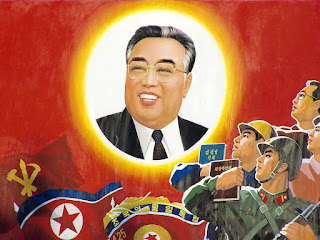
Kim Il Sung poster: Signature depiction
during that era. Source: Wikimedia Commons
Let’s examine Danson Cheong’s comment about this dubious bit of history. I will try to distill the history of the Korean War as a sequence of events:

  1. In 1945, at the end of WWII, Russia/Soviet Union and the US came to a standoff at the 38th Parallel in Korea, following the defeat of Japan (similar to the standoff in Germany with East and West Germany and division of Berlin; here Seoul was firmly in South Korea but vulnerable as it is near the 38th Parallel).
  2. In 1948, both sides agreed to withdraw leaving behind a North Korea heavily armed by the Soviet Union, and a South Korea — ROK (Republic of Korea) — supported by the US. 
  3. By 1950, Kim Il Sung had approached Stalin for support to attack South Korea and reunite Korea.
  4. Stalin agreed to arm, fund and support Kim Il Sung, provided he could convince Mao to support him in this war. Stalin would not contribute Russian/Soviet forces to a war.
  5. At that time, China led and governed by the CPC, was absolutely poor and short of resources to support a war adventure. But in the end, Mao agreed (and overrode dissension and doubts within the People’s Liberation Army [PLA] about engaging in a war, even if China was not funding it), perhaps fearing that if Kim did not win, China would be vulnerable to a US invasion (bear in mind that at that time, McCarthyism and the vendetta against communism/socialism was on the rise in the US — earlier days of Cold War).
  6. On June 25, 1950, Kim Il Sung launched his attack on South Korea — crossing the 38th Parallel, and overwhelmed the forces there (who were caught by surprise) quickly. The South Korean and US forces were pushed to the south-eastern corner at Busan — where they made their stand.
  7. MacArthur, in dark jacket, observing the invasion
    of Incheon. Source: Wikimedia Commons
    Bruised by this surprise attack and with his reputation in tatters, MacArthur was desperate to counterattack and regain the initiative. Against the concerns expressed by his generals, McArthur took the bold decision to launch a dangerous high risk invasion at Incheon (location of the current international airport) — a craggy rocky coastline (and not smooth sands like Normandy). This surprise counterattack succeeded and Kim Il Sung’s forces were encircled. They quickly retreated back above the 38th Parallel. MacArthur turned from being a disgraced general to a war hero (i.e. from WWII hero to zero and back to hero).
  8. Emboldened by this victory, MacArthur’s forces pushed northwards. MacArthur wanted to get rid of Kim Il Sung and push all the way to the Yalu, and create a buffer zone in China for a reunited Korea. He even entertained and promoted the idea of using nuclear bombs to create a “dead zone” in China above the Yalu.
  9. On Oct 15, 1950, Truman flew to Wake Island (nearer Guam, west of Hawaii), to meet MacArthur. This was a major concession from a president to fly out to meet his general — a subordinate, who had not been exactly compliant with Truman’s instructions. Yet MacArthur’s stature as war hero and support in Congress, was an obstacle to Truman gaining absolute control over the strategy to contain and keep the war short. MacArthur assured Truman that the war would be over by Christmas, in order to assuage Truman who was worried that China would enter the war, and that it would become a protracted extended conflict — potentially a World War III.
  10. PLA troops before the Changjin battle.
    Source: Wikimedia Commons
    On Oct 19, 1950, China entered the war, and on Nov 27, 1950, launched the surprise attack at Chosin Reservoir (or Lake Jangjin in Korean). 120,000 Chinese troops attacked the 30,000 UN troops led by the US (contributing majority of the troops). The Battle of Lake Changjin was a key battle — the turning point, which halted the momentum of the US and UN forces. Both sides lost a lot of men, but the PLA suffered hell of a lot more loss of lives, since they were poorly equipped and practically all they had, was the advantage of numbers and the courage of the PLA soldiers.
  11. The US and UN forces retreated to the 38th Parallel. By Dec 1950, Truman had decided to try to end the war, and stop his recalcitrant general from taunting the Chinese and continuing the war. In Apr 1951, Truman finally sacked and recalled him back to the US. McArthur returned home a war hero and there was even a “Thanksgiving Macy-style” parade in New York to welcome him back. MacArthur waved to a cheering and adoring crowd lined along the Manhattan streets. This sacking of MacArthur cost Truman dearly — politically. MacArthur subsequently tried to run for the presidency, but Eisenhower beat him to it and became president, succeeding Truman.
  12. In the meantime, the Korean War continued as a war of attrition for two years until July 27, 1953, when Eisenhower finally managed to end the war as Truman had intended earlier. The Korean Armistice Agreement was signed — keeping the 38th Parallel as the dividing line, thus halting the war but there was no peace treaty.

Kim Il Sung did not achieve his objective to become top Korean honcho with his war adventure, but the cruel collateral damage was extensive loss of lives — Korean, Chinese, American and those of UN forces, and economic debilitation. Stalin gave him arms and funding to fight the war, but did not contribute soldiers to the adventure. Instead, Stalin found a sucker — Mao to do the dirty heavy lifting — sacrificing his impoverished PLA forces who had already suffered so much in their civil war against the Kuomintang. To me, it is a sad and tragic part of PLA history — something to commemorate and reflect on the mistakes and loss of lives. It is not some event to be celebrated or glorified.

Imagine this parallel universe scenario. Let’s say Kim Il Sung had lost the war after the Incheon offensive, Mao had not entered the war, the recalcitrant MacArthur was restrained by Truman and the US/UN forces had stopped before or at the Yalu. The 38th Parallel dividing line would have shifted to the Yalu. Today, we may have a united democratic Korea with a thriving free market capitalist society, trading freely with a Deng-reformed China, living in peace. Would that not be a better outcome than the current situation of an impoverished North Korea ruled by the Kim family dictators, with people malnourished, suffering and living out of fear?

M*A*S*H season premiere, 1974: Different cultural
approach to the Korean War. Source: Wikimedia Commons
As a film/TV buff and a M*A*S*H fan, I find it interesting to note that the Americans (or rather Hollywood) fictionalised a book by Richard Hornberger (portrayed as Hawkeye Pierce by Alan Alda in the series) about his Korean War experience as a medical surgeon, to make a comedy series with the backdrop of the trials and tribulations of war. In comparison, the Chinese (through three top notch directors guided by Beijing’s wishes) chose to use a Korean war film to inspire and arouse Chinese nationalism and patriotism. It says something too about the different cultural approaches of these two superpower countries with different socio-political systems. Danson Cheong quoted Shanghai-based military analyst Ni Lexiong in relation to the film in the context of current Taiwan tensions:    

When it comes to preparing for war, there are two things to do: first is preparing materials and hardware, the second is psychological and mental preparation... These movies tell people that if a conflict does happen, they don’t have to be afraid.

Let’s hope these preparations are unnecessary and this week’s Xi-Biden virtual summit has helped to tone down the rhetoric of conflict. (In Hokkien “pai kiah” angry rhetoric lingo, it is time to ease off on the “dare or not” taunts…)

  • The Battle at Lake Changjin (NC16), 176 minutes, opened in Singapore on Nov 11, 2021
  • Chin Foo Chun is a former investment banker working for three global banks (JPMorgan Chase, BNP Paribas and CIBC) with regional responsibilities in the Asia-Pacific. Read more about him here.

Wednesday, 17 November 2021

‘Give back to our children the spirit of adventure’

By Quah Seng Sun

WOULD YOU allow your son or daughter to take part in wholesome outdoor school activities like Scouting and Guiding? During our time, it would be an unqualified “Yes”! Today, it is a rhetorical question. 

Molly Ooi, who taught at Penang Free School in the 1980s and was Group Scout Leader (GSL) of 8th Georgetown (South) Sea Scouts Group and also Ranger Guider, laments that these activities have lost their shine.

“It’s such a shame that camping is now confined to the school field and not many students want to be Scouts anymore. The Scouting light doesn’t shine brightly anymore and Coronation and Jubilee Camps are both gone. Scouting and Guiding are both internationally recognised uniformed movements which prepare young people holistically for their futures.” 

Molly Ooi with the Sea Scouts of Penang Free School
in the 1980s
Together with her husband, David Hwang Hong Shi, who himself taught at Westlands Primary School in the 1950s and Penang Free School in the 1960s, she tries to burn the torch for these activities: “Parents should encourage their wards to participate. Don’t make them lose their sense of adventure.” 

Molly’s accounts highlight a few differences between then and now. One is the change in attitude, a sharp turn towards taking less risk among all the parties involved. Another is the diminished trust among students, teachers, parents and the various levels of administration. 

“Malaysian kids today have lost their sense of adventure. Many prefer to be hooked to their handphones. Parents are too worried about letting them out even for a nature walk. Teachers are afraid of taking them out in case accidents happen and parents sue them. And principals don’t want the hassle of paperwork and answering to the Education authorities in case something happens. Kids get to camp in the school field only when they can get a teacher to stay with them at nights — which is rare,” she says.

Molly Ooi with the Rangers of Penang Free School
“When I was young, we cycled everywhere and our teachers took us for all kinds of hikes and excursions. We visited factories and ate cookies, chocs and got other goodies, went to tin mines, all kinds of estates, farms and orchards (again free vegetables and fruits there), got special passes for movies like The Sound of Music and other interesting children’s literature and lots more. We had no handphones but we had fun outdoors with our wonderful, caring teachers whom our parents trusted.”

Molly’s own adventure with Scouting started in the 1970s. In a recent posting on her Facebook, she wrote that she had taken her Woodbadge Course while teaching in Malacca during those years. She became a Sea Scout Leader of the Open Sea Scouts troop there which comprised both Boy Scouts and Girl Guides. There were camping and canoeing at Tanjong Keling Beach. Today, there are no more stretches of clean white sand as the beach has been obliterated by hotels and apartments.

When she was transferred to Penang Free School, she became the warranted Group Scout Leader (GSL) of 8th Georgetown (South) Sea Scouts Group and also Ranger Guider. “Those were interesting years of camping at Camp Coronation, numerous hikes to Muka Head and Gertak Sanggul, over the Ayer Itam hill to Balik Pulau, Penang Hill and other adventurous activities and combined training camps together with 1st Georgetown (South) GSL Mr Khoo Poh Kheng and 7th Georgetown (South) Rover Scout Leaders (RSLs).

She offered two Internet links to Scouting: Importance of Scouting and Guiding in Schools and Scouting and World Development.
  • Quah Seng Sun is one of three people who maintain this WPS blogsite. Recently he authored two books, Let the Aisles Proclaim: The First Two Hundred Years of Penang Free School 1816-2016 and Ten Thousand Prosperities: The Story of Ban Hin Lee Bank. Read more about him here.
ADDENDUM

A comment on facebook put the picture as taken after the PFS Scout Show in 1984. "It was one of those rare occasions that the Sea Scouts were in uniform (white shirt and navy blue pants). The whites were outstanding but the Scout Commissioner wasn't too pleased as this was against the norm. But somehow we survived," the writer* recollected as a response to this story.

He continued, "Sadly, those were the transition times from camping in the wild to camping in school, and the beginning of parental consent and the fear of the dangers of sea activities. We chose the former and at the end, our numbers were whittled down to what you see in the picture. Most of the time - practically every Saturday - that bunch of nutcase Sea Scouts were either at Pantai Keracut or Muka Head or canoeing round the island. We rowed canvas canoes. They were like bloody logs in the water!!! But with the choppy currents around Muka Head, it was a blessing.

"Those were the days... camping, backwoodsman, odd-job weeks, washing cars, cutting hedges for funds, Scout shows, Scout car racing, naval training, whacking our own paths to Pantai Acheh, licking limestones at Muka Head because we ran out of water, night hikes to Pantai Keracut, caught by the Police for sleeping in the cemetery with parangs after tiring out trying to grab the best bamboos, transporting 15-feet bamboos tied to two bicycles, and dragonboats. Camping at Youth Park was considered degrading to us. Yes, those were the days."

* The writer wished not to be named.

Monday, 8 November 2021

Globalisation, technology, Elon Musk and the Romance of the Three Kingdoms

By Chin Foo Chun

WHAT HAS globalisation, technology, Elon Musk and Romance of Three Kingdoms got to do with one another?

Let’s start with Elon Musk, the richest man in the world, while Tesla’s stock price stays where it is today.

On 2 Nov 21, he tweeted a Chinese poem from the classic, Romance of Three Kingdoms, about Cao Cao’s sons, Cao Pi and Cao Zhi, contesting for power. Some say it is an oblique reference to the spat between the dodgy Dogecoin and the newer, perhaps less dodgy, Shiba Inu, which has overtaken Dogecoin in market value. Apparently, some consider Shiba Inu to be a token which aspires to be an Ethereum-based alternative to Dogecoin.

Musk has often in the past been a frequent advocate for Dogecoin. So what could be his message behind the poem. Let’s take a look.

The posted tweet was titled “Humankind” by Musk, although it is commonly known as the “Quatrain of Seven Steps,” the allegorical poem attributed to Cao Zhi. Legend goes that Cao Pi, freshly crowned king, was suspicious that his more popular brother was trying to usurp his rule. Cao Pi forced Cao Zhi to produce a poem that would proclaim his innocence, within seven strides. The poem is as follows:

Beanstalks are ignited to boil beans
The beans in the pot cry out.
We are born of the self-same root
Why should we incinerate each other with such impatience?

It is kind of curious that Elon Musk would refer to this Chinese poem. Where could he have learnt of this? I have two conspiracies to offer:

  1. Tesla’s largest factory is now the Shanghai Gigafactory. Perhaps over drinks or dinner, one of his Chinese executives told him the story, which caught his imagination?
  2. Leo KoGuan, who is now Tesla’s third largest individual shareholder (after Elon Musk and Larry Ellison), has met Musk before. He is a former Chinese Indonesian, inspired by the Xuan Yuan’s Chinese rule of law, and now a Professor at Tsinghua. He has the KoGuan School of Law at Shanghai JiaoTong University, and the Leo KoGuan Law Building at Tsinghua University, named after him. Maybe he told Musk the story?   

Both Elon Musk and Leo KoGuan are children of globalisation.

Elon Musk was born in Pretoria, South Africa. His father was a South African engineer, entrepreneur and property developer. His Canadian mother was a model and dietitian. He grew up and was schooled in Pretoria. Moving to Canada, he entered Queens University in Kingston, Ontario before transferring to UPenn. After graduating with BSc in economics and BA in physics, he was accepted to pursue a PhD in materials science at Stanford. After two days at Stanford, he dropped out and started his tech and business career – eventually becoming part of the PayPal mafia. He left PayPal and launched Tesla and Space X, and in the process became the richest man in the world.

Leo KoGuan is nowhere as rich as Elon Musk, but his stake in Tesla is worth a humbling US$7 billion or more. His story is much less known. He was born in Indonesia, studied international affairs at Columbia and then law at NYU. In 1989, KoGuan bought steeply discounted assets of a bankrupt New Jersey-based software supplier that became the basis of SHI – an IT solutions, product and services company. He ran the company with his then-wife, Thai Lee, who was the first Korean-American woman to enter Harvard Business School. By the time they divorced in 2002, it was pulling in annual revenues exceeding $1 billion. She is still currently CEO and SHI’s annual revenues are now US$11 billion. KoGuan remains as non-executive Chairman.

Leo KoGuan’s name came into the limelight when he bought the triplex penthouse apartment on top of the 65-storey Guoco Tower in Singapore from James Dyson – UK’s richest man. Guoco Tower was built and developed by Quek Leng Chan, a Chinese Malaysian tycoon.

Let’s consider the virtuous circle/cycle of globalisation here (my apologies if I stretched my imagination a bit). Chinese consumers buy Tesla cars made in the Shanghai Gigafactory by Chinese workers. This contributes to Elon Musk’s wealth which is propelled by buoyant US stock markets. This rubs off on an astute investor like Leo KoGuan who prospers with huge bets, as Tesla’s stock price catapults upwards. With a teeny weeny bit of his wealth, he purchases the Guoco Tower penthouse from James Dyson (whose wealth is generated in part through his factories in the Philippines and Malaysia). The success of the Guoco Tower development, in turn makes Quek Leng Chan richer, reinforcing his resources and ability to invest in more businesses like his semiconductor assembly & test business, packaging auto-chips going into cars – though not into Tesla cars, at least not yet. (It contributes to creating jobs and wealth for the middle class in Malaysia.)

So we have come full circle – a virtuous one, as Chinese consumers contribute to the flow of business and resources across the globe and leading to jobs which help drive consumption in Malaysia too. It is a wonderful story of the power of free market capitalism and Adam Smith’s “invisible hand” in a global context, as we connect the dots or beans as metaphorically referred to in the Romance of the Three Kingdoms. Unlike the beans in that famous poem, here the beans are enablers. Instead of incinerating one another, they work together seamlessly (without prior intent) across the globe – demonstrating the “shock and awe” power and synergies of globalisation.

  • Chin Foo Chun is a former investment banker working for three global banks (JPMorgan Chase, BNP Paribas and CIBC) with regional responsibilities in the Asia-Pacific. Read more about him here.

Friday, 10 September 2021

We should seriously study, legislate a future generations law

Republished from New Straits Times, Sep 10, 2021,
with the author’s permission. Read the original here.
By Yong Soo Heong

AS WE LOOK back at what our country has achieved in the last 64 years, there’re certainly many triumphs and also failures that we may as well not dwell on, lest they bring us more heartaches.

We could’ve achieved much more. So it’s best to look to the future as Soyen Shaku, a Japanese Zen monk, discovered when he found a way out of past failures by saying, “Do not regret the past, look to the future”.

Perhaps this is akin to the popular saying of no use crying over spilt milk.

Much has happened in our beloved country, especially in the past two years or so. Besides the arduous health and economic challenges, we’ve also been treated to a giant spectacle of political upheavals and manoeuvring on a scale we’ve never seen before.

The familiar refrain of “where do we go from here?” is often heard among those who care about the future of this land we call home.

While we’ve been engrossed in much political infighting, some neighbouring countries that had once lagged behind have even overtaken us.

Take our automobile industry, for example, which we had often boasted about when we got off the starting blocks as early as 1985.

But we’ve not made much headway since then, especially in selling our wares to big international markets, except for making millions of Malaysians happy with their relatively cheap locally made vehicles compared with competing overseas rivals.

Of course, we enriched some local parts producers along the way in the name of localisation.

And look at the South Koreans: one of their marques started about the same time as us, and look where they are now.

Their cars, viewed with disdain by some snooty automobile makers then, have found a niche in the garages, driveways and parking lots of many North American and European homes with their stylish designs, advanced engineering and fuel economy.

Even one-time war-torn Vietnam will start marketing home-grown electric SUVs to the industrialised West in November. Enough said.

But I pray there’s still hope yet for our future generation as I’m captivated by this line of optimism: The past is your lesson. The present is your engine. The future is your motivation.

It may be wishful thinking on my part to hope for radical changes in the next 100 days or so that could bring forth many solutions or answers to the multitude of challenges that we now face.

Who or what could lead us out of the quagmire? Do we sink further into mediocrity?  

I’m drawn to Dr Roman Krznaric, a Briton described as a public philosopher, who had expounded on the need to reinvent democracy for the long term.

He argues that when politicians fail to look beyond the next election — or even the latest tweet — they are neglecting the rights of future generations.

He depicts such flaws as short-termism and presentism.

Governments, he declares, typically prefer quick fixes, such as putting more criminals behind bars rather than dealing with the deeper social and economic causes of crime.

Nations bicker around international conference tables, focused on their near-term interests, while the planet burns and species disappear.

Like Krznaric, I’m intrigued by what the government of Wales in the United Kingdom had done in an interesting attempt to right the wrongs, although it may not be a fool-proof panacea.

Premised on “acting today for a better tomorrow”, Wales had established a Future Generations Commissioner as part of the 2015 Wellbeing for Future Generations Act.

Sophie Howe, described as one of the United Kingdom’s changemakers and top businesswomen, was appointed to the important role in 2016.

Her responsibility is to ensure that public bodies in Wales make policy decisions looking at least 30 years into the future.

The Guardian newspaper describes her as the “world’s first minister of the unborn”.

In a nutshell, the far-sighted Welsh law requires public bodies to think about the long-term impact of their decisions, to work better with people, communities and each other, and to prevent persistent problems such as poverty, health inequalities and climate change.

This legislation has been attracting interest from other countries as it offers a huge opportunity to make a long-lasting, positive change to current and future generations.

Do we dare take such a giant step for the wellbeing of future Malaysians?

  • Datuk Yong Soo Heong is a former chief executive officer and editor-in-chief of Bernama. Read more about him here.